

Licensed vs Unlicensed Casino: Same Slot, Different Rights
The same slot can run on a licensed and an unlicensed casino. What the licence changes: your funds, complaints, free ADR and self-exclusion.
In this article
- Why the same slot can appear on both sites
- Licensed vs unlicensed casino: what the licence changes, side by side
- Your money: segregated funds and what happens if the site vanishes
- Who do you complain to? The routes, licence by licence
- KYC, your data and responsible-gambling tools
- Check the law where you live first
- Five checks before you deposit
- FAQ
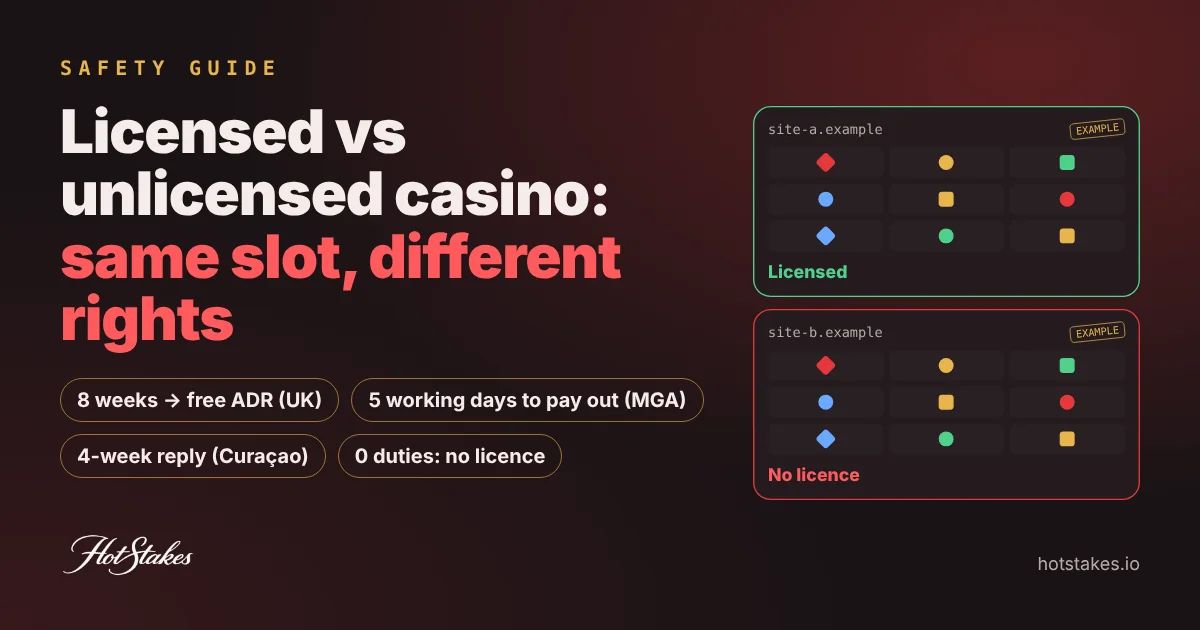
In a licensed vs unlicensed casino comparison, the slot can be byte-for-byte the same, but your rights around it are not. A licence does not change the reels, the RTP or the odds. It changes who must keep your balance apart from company money, who must hear your complaint, whether a free independent referee exists, and whether self-exclusion actually blocks you. At an unlicensed site, none of those duties exist. If the site stops paying or disappears, there is no one whose job it is to help you.
Below: a side-by-side table built from the rule texts we read on 27 Oct 2026, a “who do I complain to” chart, what happens if a site vanishes, and five checks before you deposit.
Why the same slot can appear on both sites
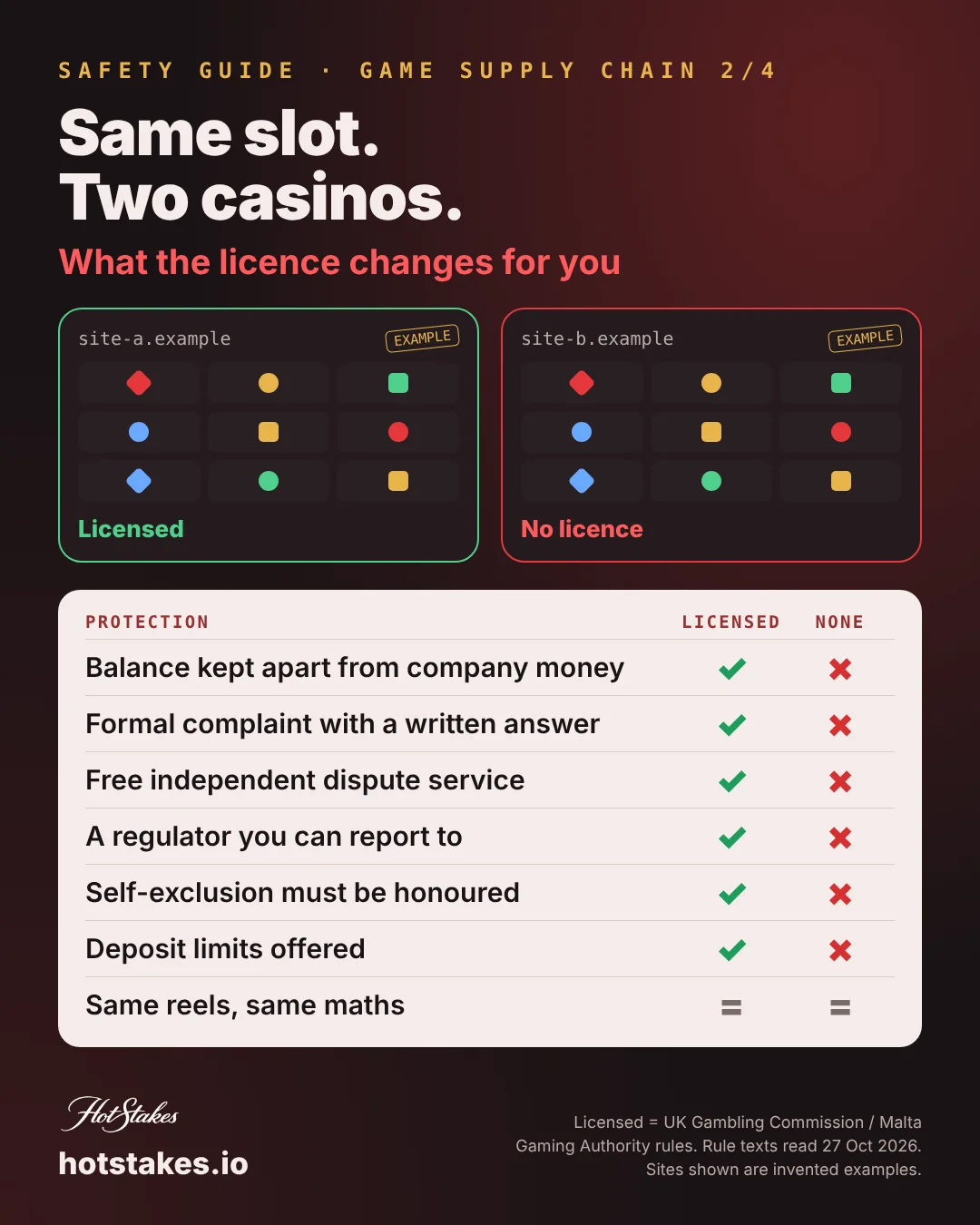
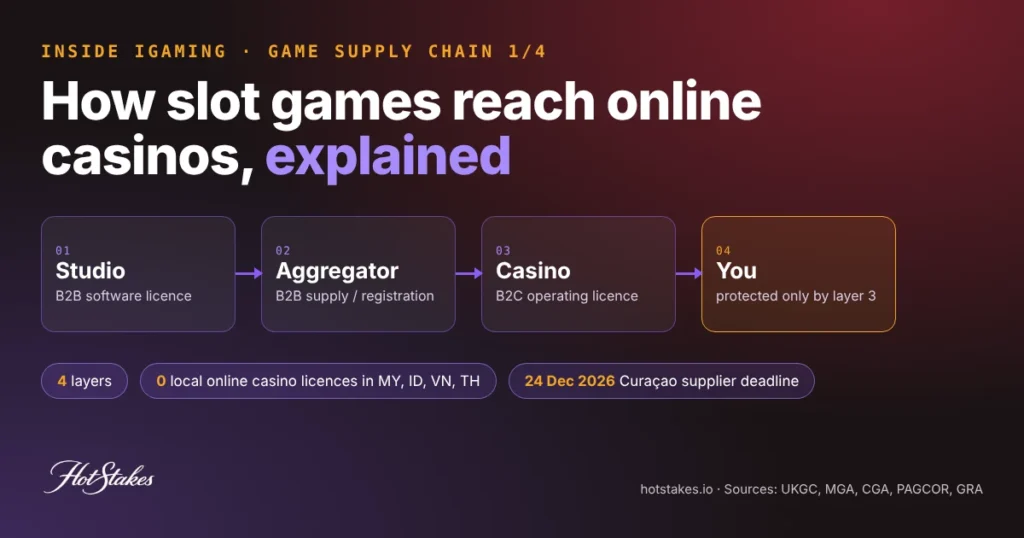
Most online slots are not built by the casino that shows them. As our series pillar on how slot games reach online casinos explains, a studio makes the game and the casino rents it, often through a middleman. The game usually runs on a remote server, not on the casino’s own computers.
That has an awkward side effect. A popular game can turn up on a site with a strong licence and on a site with none, sometimes as a pirated copy. To you, the two lobbies can look the same.
- What is the same: the artwork, the features, often the RTP setting.
- What is different: who holds your deposit, who checks the casino, and what happens when something goes wrong.
Lab certificates prove things about the game file, not about the shop selling it. Our guide to what an RTP certification seal really proves covers that limit in detail.
Takeaway: judge the casino’s licence, not the game’s reputation.
Licensed vs unlicensed casino: what the licence changes, side by side
We read the actual rule texts on 27 Oct 2026: the UK Gambling Commission (UKGC) licence conditions and guidance, the Malta Gaming Authority (MGA) Player Protection Directive, and the Curaçao Gaming Authority (CGA) Player Complaints Policy Guidelines (version 1.1, 18 June 2025) for operators licensed under Curaçao’s new law, the LOK. Where a text we read did not cover a point, we say so instead of guessing.
| Protection | UK (UKGC) | Malta (MGA) | Curaçao (CGA, LOK) | No licence |
|---|---|---|---|---|
| Game fairness rules | Technical standards and testing strategy are a licence condition | Not covered in the directive we read | Not covered in the policy we read | No one checks |
| Your balance kept apart from company money | Yes, separate client bank account (condition 4.1.1) | Yes, player funds are “not funds belonging to the licensee” (Art. 37) | Not covered in the policy we read | No rule |
| Told what happens to your money in insolvency | Yes, a published rating: not protected, medium or high | Balances must at least equal what players are owed (Art. 38) | Not covered in the policy we read | No |
| Withdrawal timing | Not covered in the texts we read | Generally within 5 working days, “if practicable” (Art. 29) | Not covered in the policy we read | Whatever the site decides |
| Formal complaint process | Yes, resolved in 8 weeks or less | Written procedure in the terms (Art. 39) | Written decision within 4 weeks, one 4-week extension | None you can enforce |
| Free independent dispute service (ADR) | Yes, approved ADR provider, free | Yes, registered ADR entity (Art. 39) | Yes, free, operator pays all costs | No |
| Self-exclusion that works | GAMSTOP mandatory for online operators since 2020 | Yes, across all the licensee’s brands (Art. 11) | Self-exclusion failures: 5-business-day complaint target | No duty to honour it |
| Deposit limits offered | Not covered in the texts we read | Must ask before first deposit (Art. 14) | Not covered in the policy we read | Optional, if at all |
| Advertising rules | Must follow the CAP advertising codes (condition 5.1.6) | Not covered in the directive we read | Not covered in the policy we read | None |
| Makes play legal where you live | No. Any foreign licence covers the operator, not your local law | No | ||
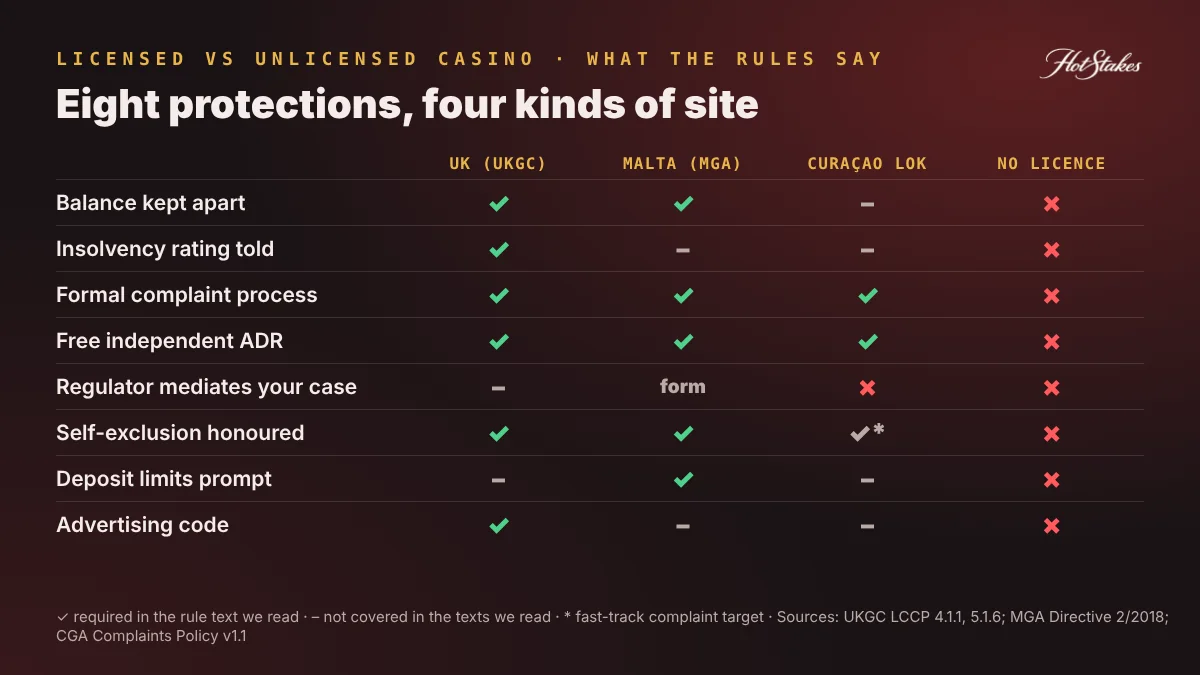
Two things stand out from the rule texts.
- A licence is not a guarantee of payment. Even in the UK, “not protected” is a real rating. The UKGC’s example wording for it reads: “These funds are not protected in the event of insolvency”.
- Licences differ a lot. A Curaçao LOK licence now comes with a written complaints rulebook and free ADR, but the CGA states it “does not mediate in individual disputes”.
Takeaway: “licensed” is a range, not a yes/no. Unlicensed is the floor: zero.
Your money: segregated funds and what happens if the site vanishes
This is the part most players never think about until it is too late. Under UK licence condition 4.1.1, remote operators holding customer funds must keep them “in a separate client bank account”. That covers deposits and winnings left on account.
Malta goes further in wording. The MGA directive says player funds are a “separate and distinct patrimony of the players”. It also bans wagering money that is waiting to be withdrawn.
An unlicensed site has none of these duties. Your balance is just a number on its screen.
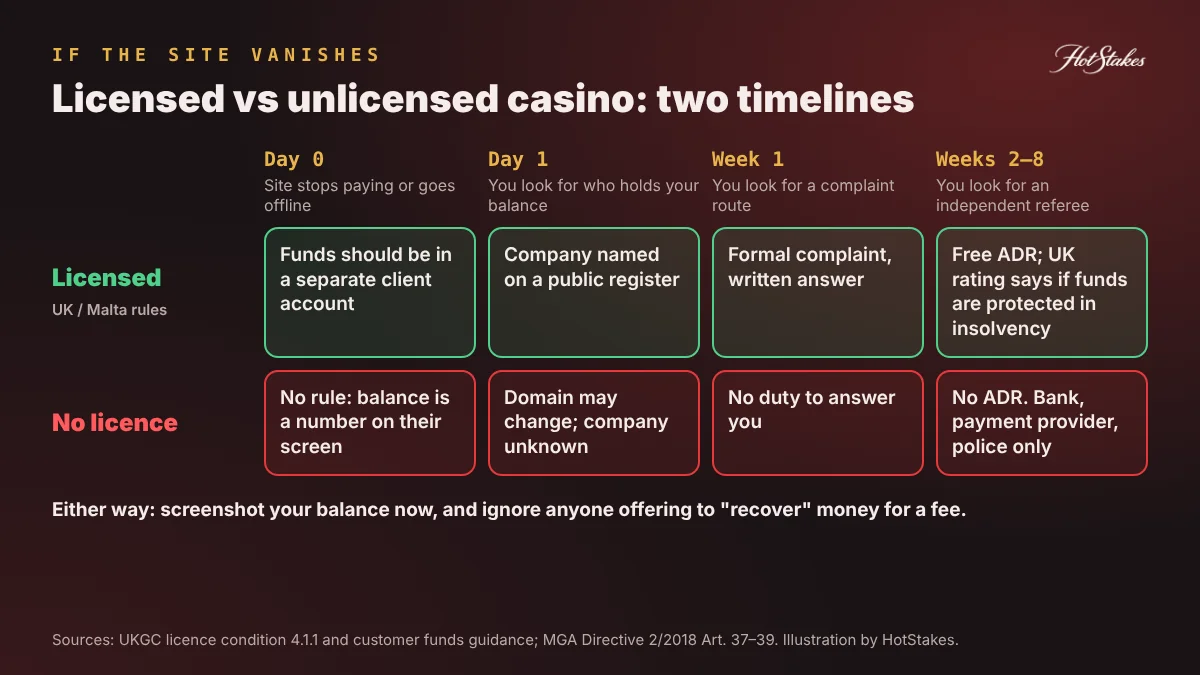
If a site goes dark, here is the realistic order of events:
- Licensed site: your funds should sit in a separate account, and the UK rating tells you in advance whether they are protected in insolvency. The regulator knows who the company is.
- Unlicensed site: the domain changes or stops loading. There is no client account rule, no regulator holding company details, and no ADR body to file with.
- Either way: save screenshots of your balance and transactions, and contact your bank or payment provider to ask what options exist.
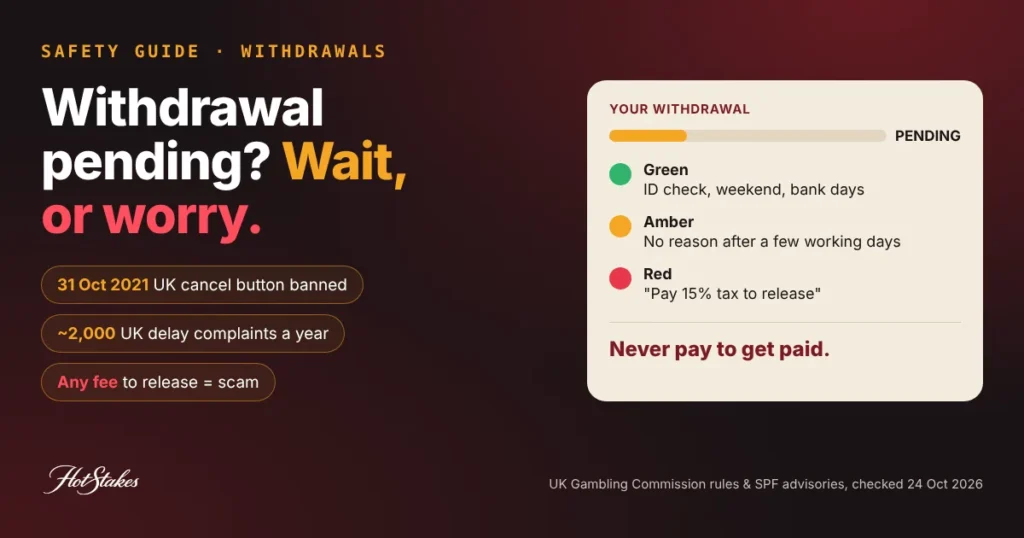
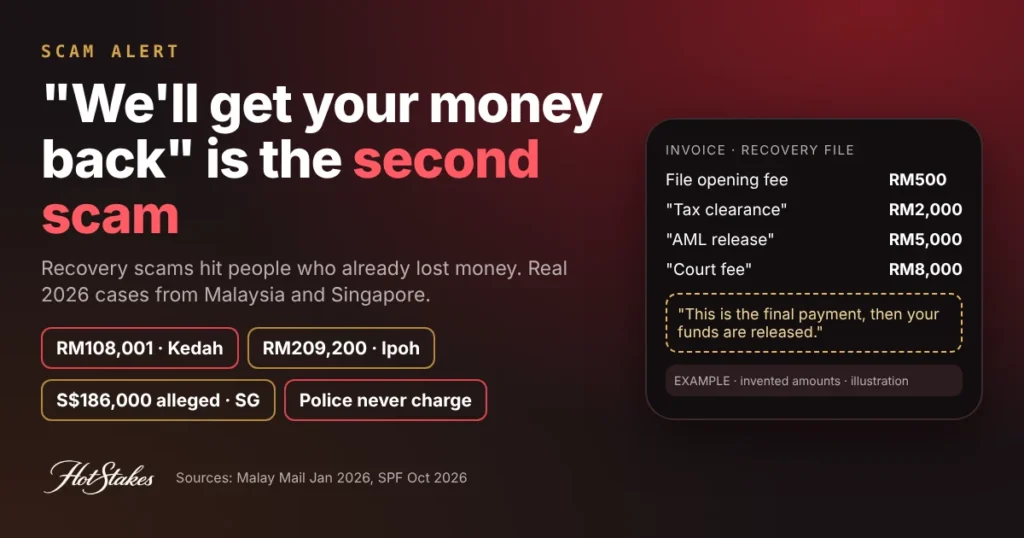
- Watch for “recovery” offers. Strangers promising to get your money back for a fee are a known scam pattern.
Takeaway: leave as little money on any casino balance as you can, and less than that on an unlicensed one.
Who do you complain to? The routes, licence by licence
A complaint route is the most practical thing a licence gives you. Every regulator we checked expects you to go to the operator first.
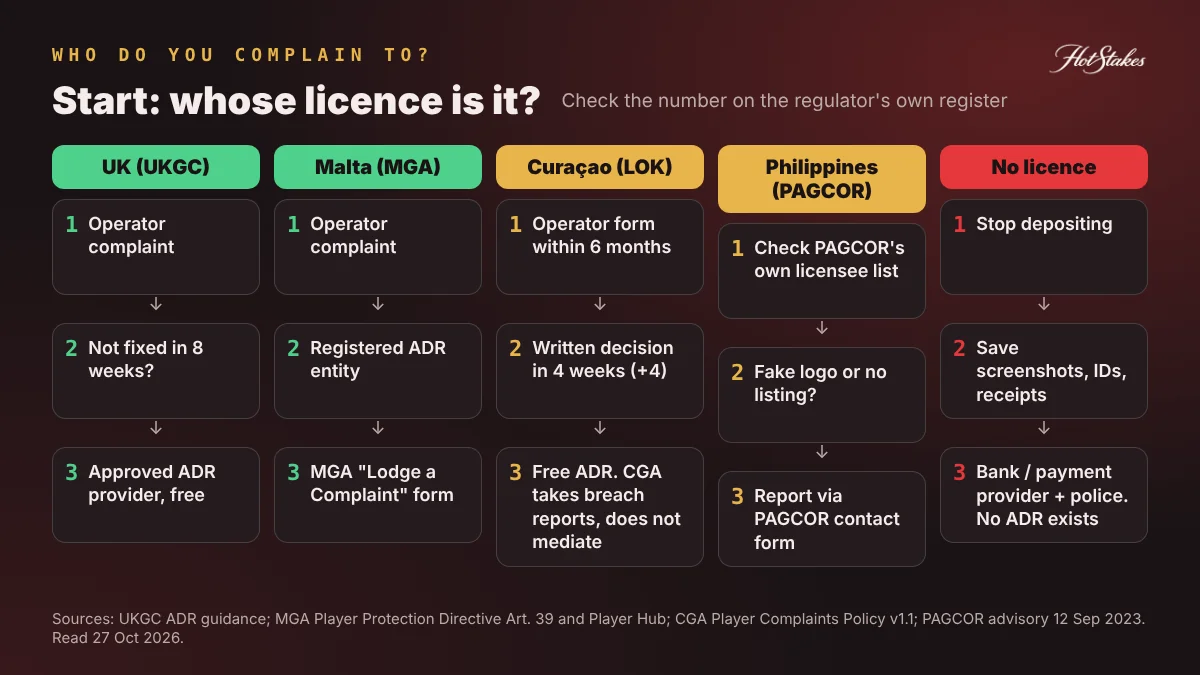
- UK licence: use the operator’s complaints process. If it is not resolved within 8 weeks, the UKGC says you can go to an ADR provider, “a free, independent service”. Licensees must choose an approved provider.
- MGA licence: exhaust the operator’s procedure, then a registered ADR entity. The MGA also runs a “Lodge a Complaint” form for MGA-licensed operators only.
- Curaçao (LOK) licence: complain within six months using the operator’s form. Expect a written decision within four weeks (one four-week extension). Then free ADR. Report licence breaches to the CGA, which uses them for supervision, not to settle your case. Background: our explainer on what Curaçao’s LOK reform changed.
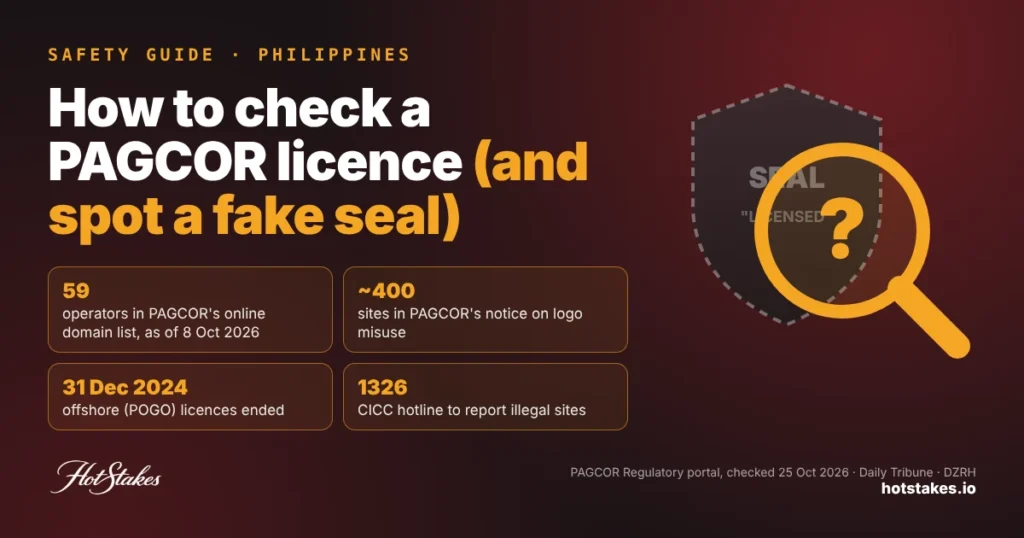
- PAGCOR (Philippines): check the site against PAGCOR’s own lists. PAGCOR has warned about sites using its logo without permission and asks the public to report them via its contact form.
- No licence: there is no dispute route. Stop depositing, keep evidence, and report the site to your local authorities.
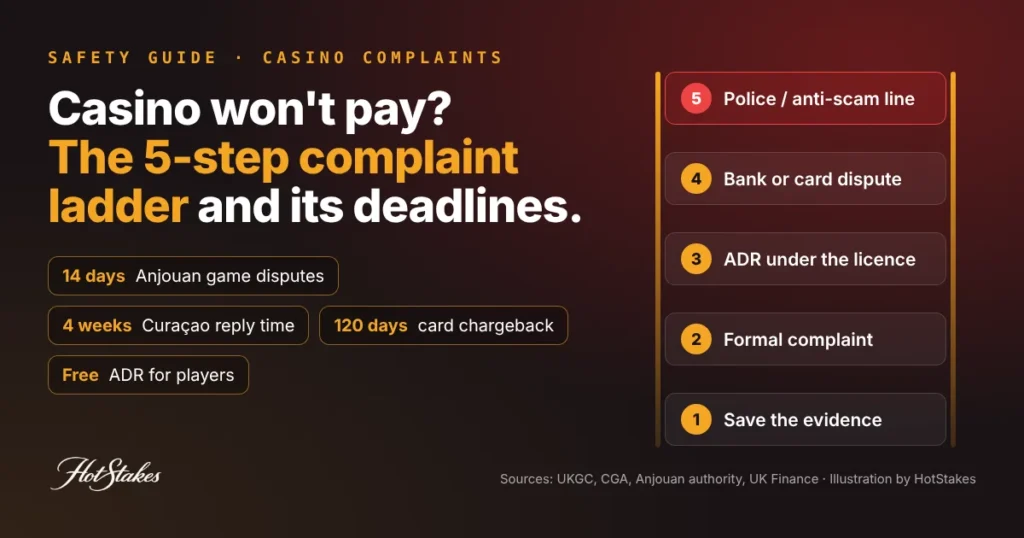
Our step-by-step guide to complaining about a casino that won’t pay has templates and timelines.
Takeaway: before you deposit, know the name of the referee. If you cannot name one, there isn’t one.
KYC, your data and responsible-gambling tools
Licensed sites check ID. The MGA directive lets licensees verify identity before releasing funds and requires steps to keep minors out. That can feel slow, and our explainer on KYC withdrawal holds shows when a check is normal.
The real difference is what sits behind the check. A licensed operator answers to a regulator for how it uses your documents. An unlicensed site asking for your passport and a selfie gives you no one to complain to if that data is misused.
- Self-exclusion: all UK online operators must take part in GAMSTOP, required since 31 March 2020. MGA licensees must block excluded players across all their brands.
- Limits: MGA licensees must ask whether you want deposit limits before your first deposit. Raising a limit only takes effect after 24 hours.
- Advertising: UK licensees must comply with the CAP advertising codes. Unlicensed sites follow no code.
Takeaway: if you have self-excluded, an unlicensed site will not stop you. That is exactly why they target excluded players.
Check the law where you live first
A licence from the UK, Malta or Curaçao lets a company operate. It does not make playing legal in your country. In Singapore, the Gambling Regulatory Authority licenses only one remote gambling operator, a local one, and taking part in unlicensed remote gambling can mean a fine of up to S$10,000, up to six months’ jail, or both.
Other markets range from player offences to full bans. Our country table on whether online gambling is legal in Asia covers 14 of them. This is general information, not legal advice.
Takeaway: the casino’s licence and your local law are two separate questions. Answer both.
Five checks before you deposit
Our category pillar on how to spot an unlicensed online casino goes deeper. The short version:
- Find the licence number in the footer and check it on the regulator’s own register, or use our licence check tool. A seal image proves nothing.
- Match the company name on the register to the one in the site’s terms.
- Find the complaints page and the named ADR provider. No ADR name is a red flag.
- Read what happens to your funds. UK licensees must state their protection rating.
- Test the exit: find the self-exclusion and deposit-limit settings before you play.
Takeaway: five minutes of checking buys you a referee, a rulebook and a way out.
FAQ
Is the same slot fairer on a licensed casino?
Not necessarily. The game maths can be identical on both sites. What differs is the oversight: under a UK licence, technical standards and game testing are a licence condition. At an unlicensed site, no one checks that the game is genuine or unaltered.
What does a casino licence protect?
Depending on the regulator: separation of your balance from company money, a formal complaints process, a free independent dispute service, self-exclusion and deposit limits, and advertising rules. It does not guarantee you will win or that every withdrawal is instant.
Is my money safe at an unlicensed casino?
There is no rule that keeps it safe. No segregated account requirement, no regulator and no ADR service applies. If the site refuses to pay or disappears, your options are limited to your bank or payment provider and a police report.
Can a Curaçao regulator settle my complaint?
No. The Curaçao Gaming Authority says it does not mediate individual disputes. LOK licensees must give a written decision within four weeks (extendable once) and offer free ADR. Report licence breaches to the CGA.
Does a foreign licence make online gambling legal for me?
No. A foreign licence covers the operator. Whether you may play depends on the law where you live. In Singapore, for example, only one local operator is licensed for remote gambling, and playing on unlicensed sites is an offence.
HotStakes is an independent directory. Some links on this site are affiliate links; we may earn a commission at no cost to you, and it never changes our rankings. Gambling involves risk — only play with money you can afford to lose, and if it stops being fun, seek help. This article is general information, not legal advice. Read our full disclaimer.
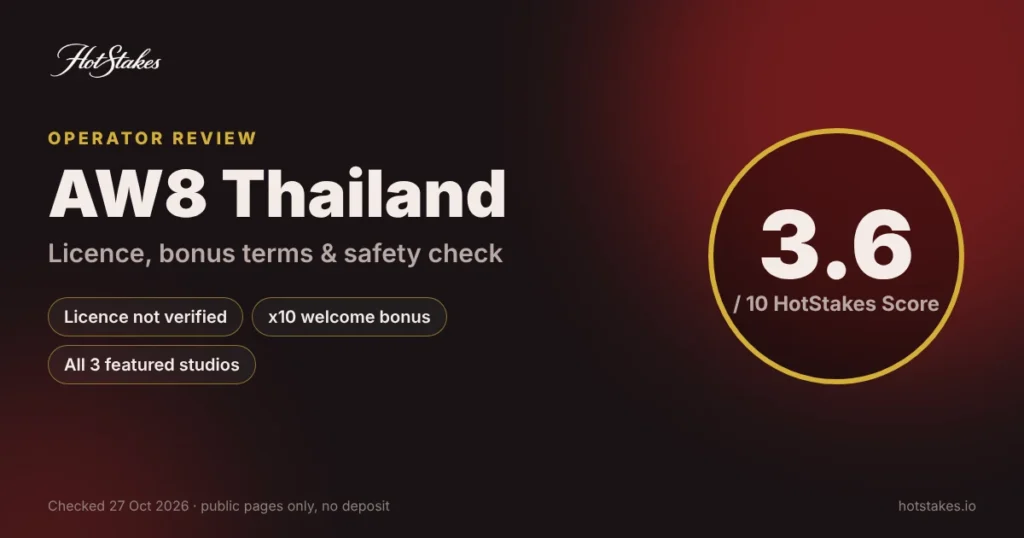 Next story →AW8 Thailand Review 2026: Licence, Bonus Terms & Safety
Start the discussion