
Wrong-Number Text Scam: The Script, Message by Message
The wrong number text scam runs in 7 stages. See example messages, the red flag at each stage, safe replies and where to report.
In this article
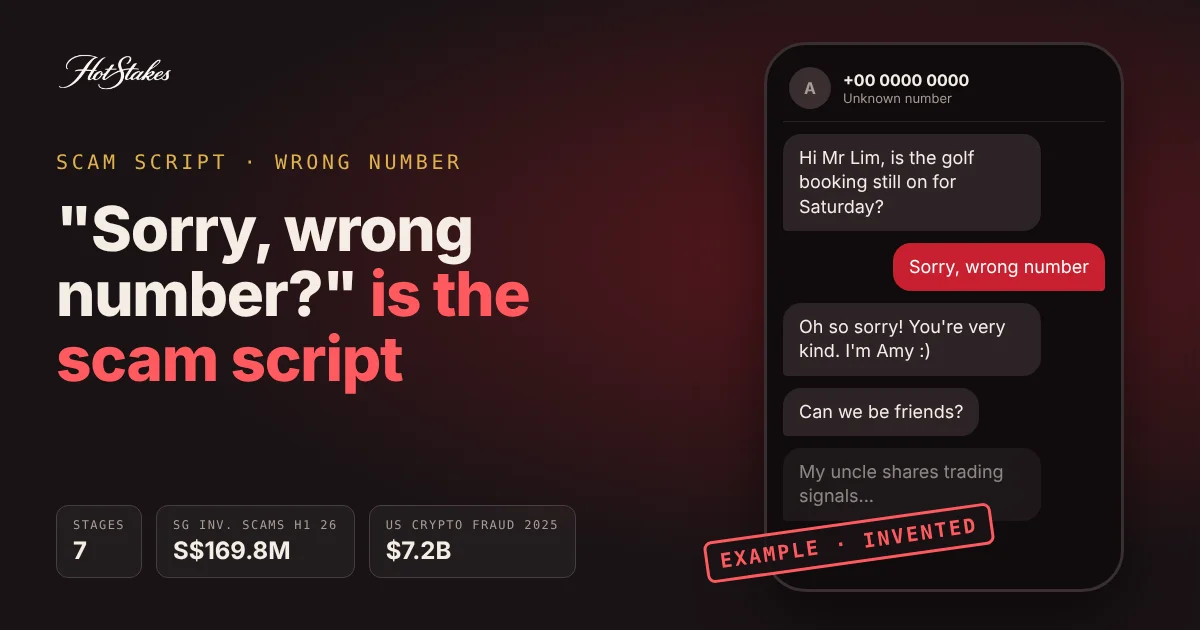
A “sorry, wrong number” text from a stranger is often the first line of a scripted investment scam. The sender is friendly, patient and in no hurry. Weeks later the chat turns to a trading or gaming platform, a small profit, and a withdrawal that actually works. If someone you have never met starts talking about a platform where you can make money, you are inside the script: stop, send nothing, and check the stage you are at below. Every message on this page is an invented example so you can match it against your own chat.
This piece is about the messages themselves. For how the whole operation is run, from the compounds to the cash-out, read our pillar guide on how a pig-butchering scam works.
Why the “wrong number” is never a mistake
A real wrong-number text ends after one apology. A scripted one keeps going.
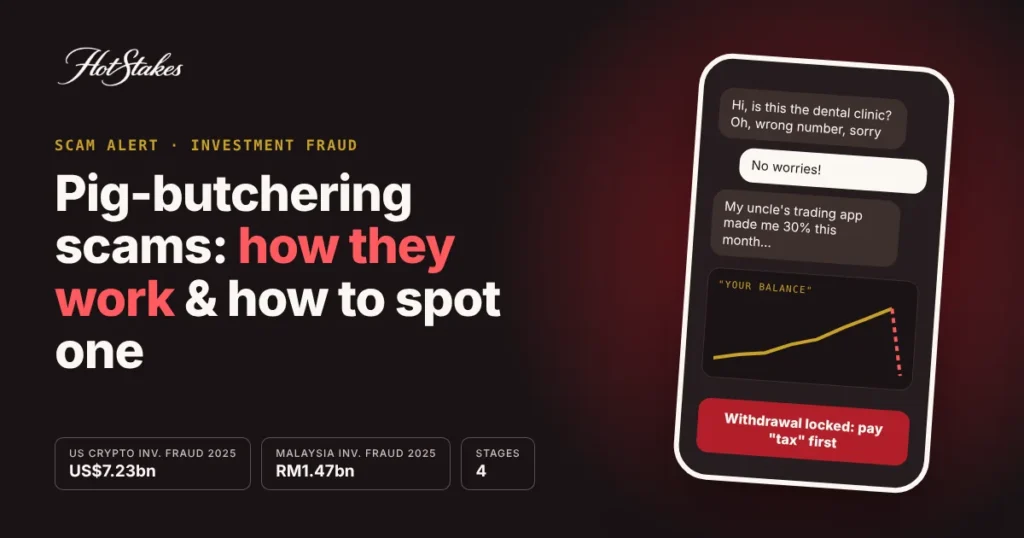
The US Federal Trade Commission put it plainly in its 2025 data spotlight on text scams: “Wrong number scams start with an out-of-the-blue message.” The FTC says these scammers strike up a fake friendship, often with romantic undertones, then steer people to bogus investment platforms. People reported losing all the money they “invested”, often tens of thousands of dollars.
The US Department of Justice describes the same opener in a 2023 seizure announcement: texts and calls “meant to appear to have been misdialed“.
A random “hi” looks like spam. A message meant for someone else invites a polite correction.
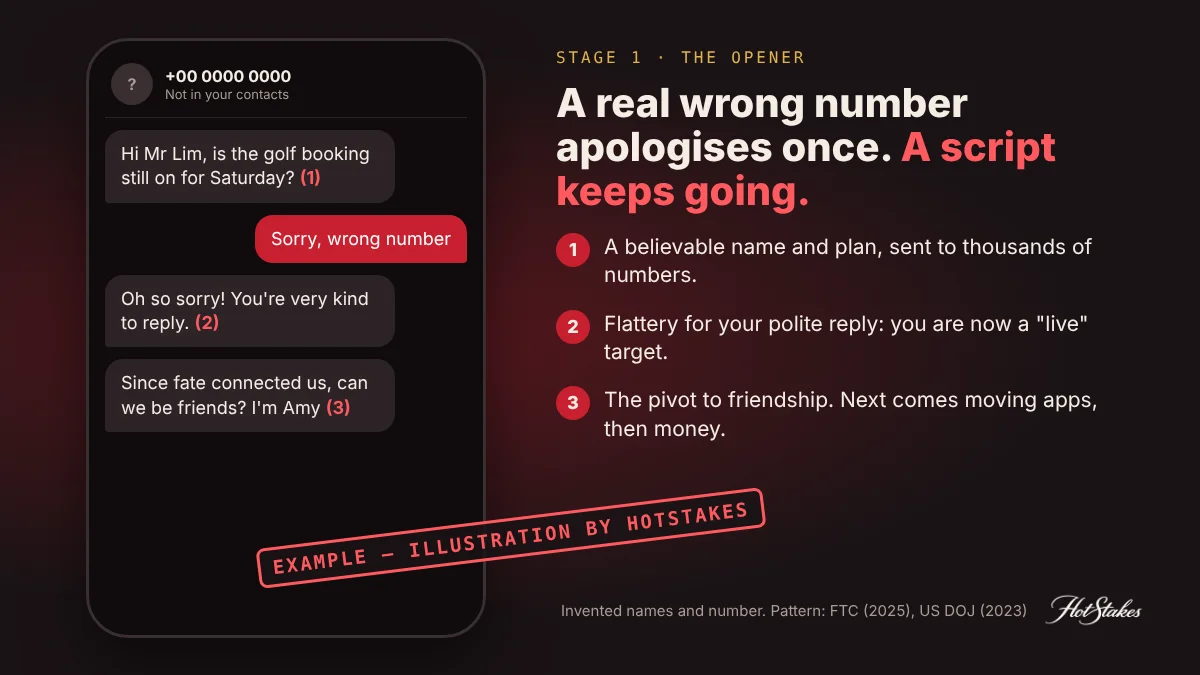
Takeaway: the opener is a filter. Your kind reply tells the sender the number is live and the person behind it is polite.
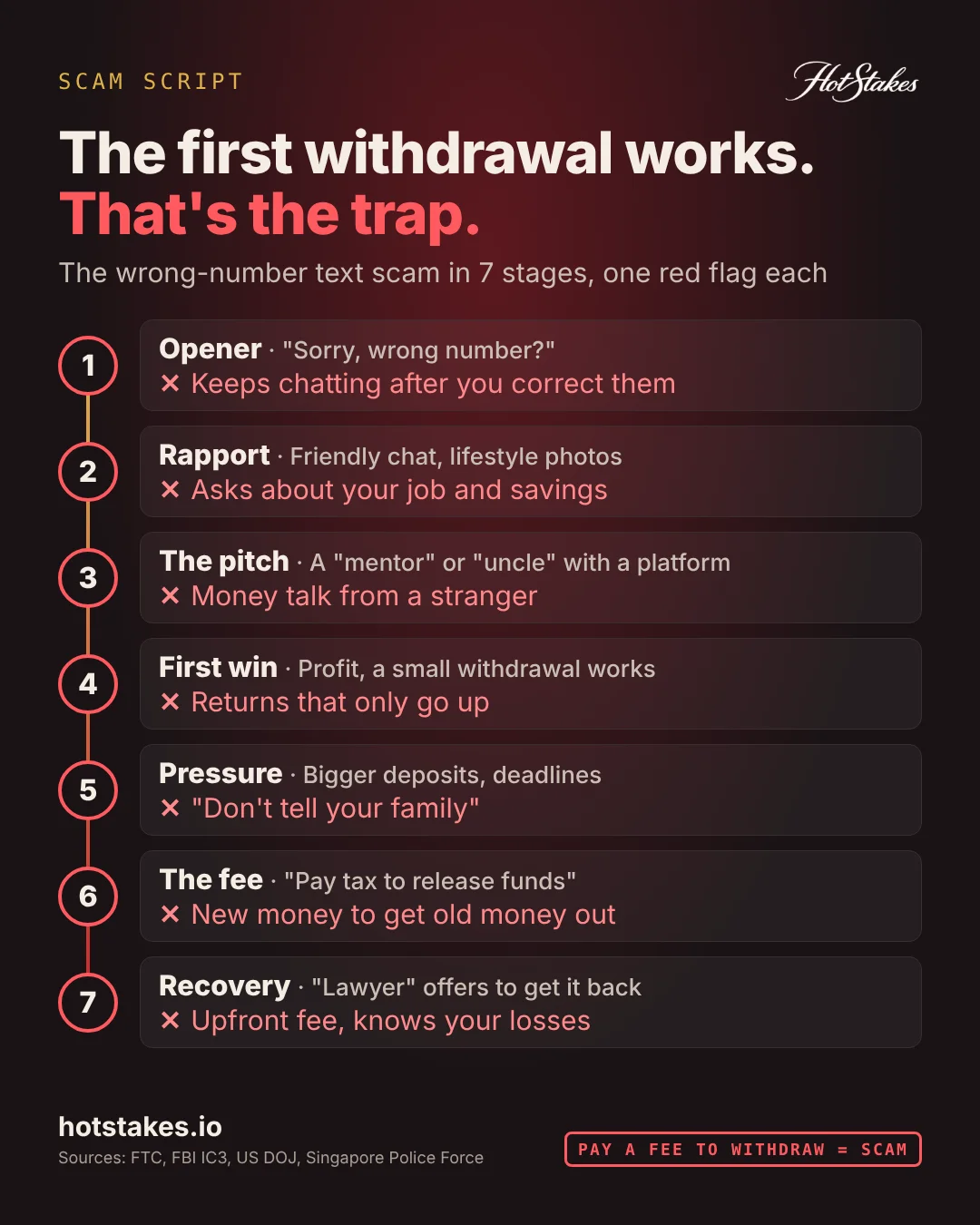
The script, stage by stage
Every message below is invented by HotStakes. Each one is built from patterns that police, the FBI, the FTC and the US Justice Department describe. They are short on purpose: enough to recognise. “Amy” and the number +00 0000 0000 are made up.
Stage 1: The opener
EXAMPLE (invented) · from +00 0000 0000
“Hi Mr Lim, is the golf booking still on for Saturday?”
“Oh so sorry, wrong number! You’re very kind to reply.”
- Red flag: after your correction, the stranger keeps chatting instead of disappearing.
- Safe move: don’t reply at all. If you already did, don’t add anything personal. Block and report the number in your messaging app.
Takeaway: one apology is normal. A second, chatty message is the script.
Stage 2: The friendly chat and lifestyle photos
EXAMPLE (invented)
“Since fate connected us, can we be friends? I’m Amy, I run a small boutique.”
“Here’s my lunch today. What do you do for work?”
“Let’s move to another app, this one is slow for me.”
- Red flag: a stranger with a picture-perfect life (cafes, travel, nice cars) who asks about your job, savings and family, and wants to switch apps.
- Safe move: don’t share where you work, what you earn or who you live with. Try a quick video call. A scripted persona will usually have an excuse.
Takeaway: the questions are a budget survey. They are working out how much you could send.
Stage 3: The “mentor”, “insider” or “uncle” pitch
EXAMPLE (invented)
“My uncle works at a trading company. He shares signals with family only.”
“I don’t usually tell people. But I trust you.”
“You can try with a small amount, no pressure.”
- Red flag: money talk from someone you have never met, framed as a favour or a secret. Sometimes it’s crypto. Sometimes it’s a “gaming” or betting platform with a “pattern” that always wins.
- Safe move: say no and stop. In Singapore, check firms on the MAS Financial Institutions Directory and Investor Alert List, as Singapore Police advise. Elsewhere, check your own securities or gaming regulator.
Takeaway: a real insider does not pick strangers from wrong-number texts. If the platform is a “gaming” site, our guide to fake gambling app red flags shows what to look for.
Stage 4: The first small win, and a withdrawal that works
EXAMPLE (invented)
“See? You’re up 18% already!”
“Try withdrawing a little, so you know it’s real.”
“Told you. Now imagine with a bigger account.”
- Red flag: profits that only ever go up, on a site or app you found through this chat.
- Safe move: treat any money you got back as lucky. Don’t add more. Screenshot everything.
This is the stage that convinces careful people. The US DOJ notes that some victims are even allowed small withdrawals to build trust. Singapore Police said in a June 2026 advisory that scammers paid initial returns to make the scheme look legitimate.
Takeaway: a small withdrawal that works proves nothing. It is bait sized to make the next deposit bigger.
Stage 5: Bigger deposits and pressure
EXAMPLE (invented)
“This window closes tonight. VIP level needs a higher balance.”
“Don’t tell your family, they won’t understand.”
“I put in my own savings. Don’t you trust me?”
- Red flag: deadlines, secrecy and guilt. Payment instructions that change: a new account name, a stranger’s bank account, crypto only.
- Safe move: tell one person you trust today. Paying into a private person’s account is a warning sign on its own. It may be a money mule account.
Takeaway: “don’t tell your family” is the loudest red flag in the whole script.
Stage 6: “Pay the tax to release your withdrawal”
EXAMPLE (invented)
“System notice: withdrawal frozen. Pay 20% tax to release funds.”
“Your account was flagged. A security deposit is required.”
“Customer service says once you pay, it goes through in 24 hours.”
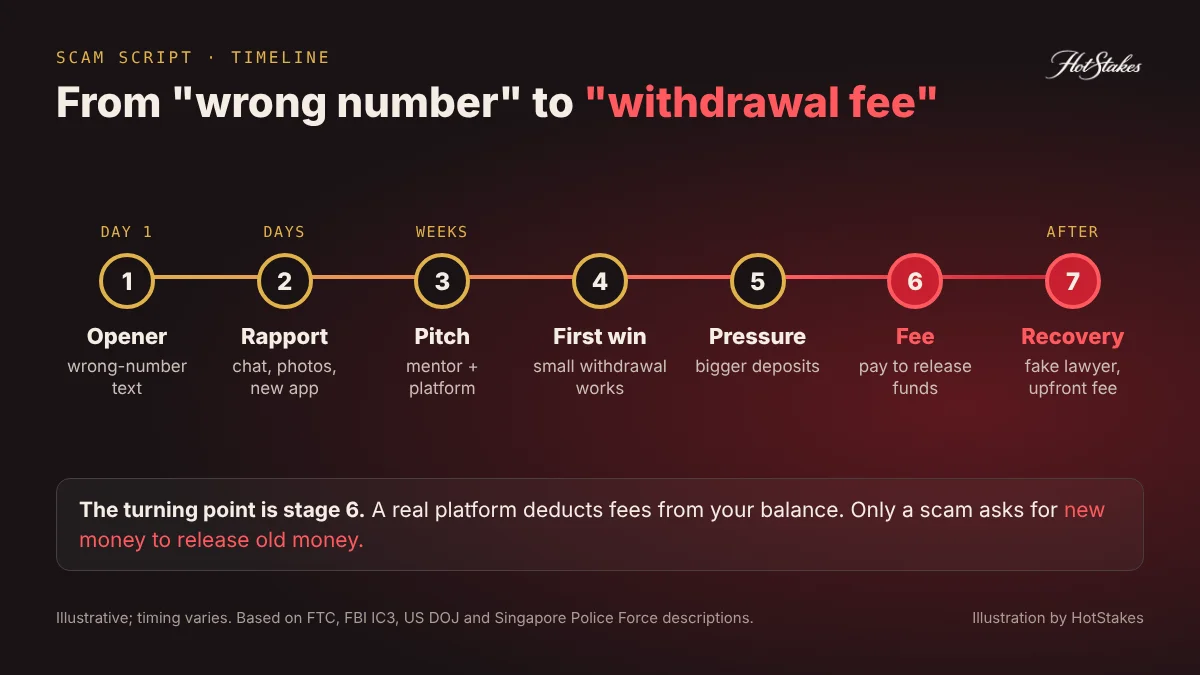
- Red flag: any fee, tax, deposit or “credit score” top-up demanded before you can withdraw.
- Safe move: pay nothing. Report now: speed matters if a bank transfer can still be stopped.
The FBI warned in 2023 that when victims try to withdraw, “they are told they need to pay a fee or taxes“, and that paying does not get the money back. Singapore Police say most victims realised it was a scam when they “could not withdraw their ‘profits'”.
What we found: on 20 Oct 2026 we read six official documents on these schemes: two FBI IC3 alerts (Oct 2022, Mar 2023), the US DOJ announcement (Apr 2023), the FTC spotlight (Apr 2025) and two Singapore Police advisories (Apr 2025, Jun 2026). Every one that describes the ending describes either a fee or tax to withdraw, or a withdrawal that never arrives. None describes a victim getting the “profits” out.
Takeaway: a real platform takes fees out of your balance. Only a scam asks for new money to release old money. A legitimate site may hold a withdrawal for ID checks, which is different: see how KYC withdrawal holds work.
Stage 7: The recovery follow-up
EXAMPLE (invented)
“We are a recovery law office. You are on a list of scam victims.”
“We traced your funds. A small processing fee is needed first.”
- Red flag: someone who knows your losses, contacts you first and wants an upfront fee.
- Safe move: only deal with the police and your bank, contacted through numbers you look up yourself.
The FBI warned in August 2025 about fictitious law firms targeting crypto scam victims, sometimes citing exact past transfer amounts and dates.
Takeaway: the same people who took the money often come back for the rest.
Red flag vs safe reply, side by side
If you see two rows of this table in your own chat, stop.
| Stage | What the message does | Red flag | Safe reply or move |
|---|---|---|---|
| 1. Opener | Texts the “wrong” person | Keeps chatting after your correction | No reply. Block and report |
| 2. Rapport | Builds a friendship, sends photos | Asks about job, savings; moves apps | Share nothing personal. Ask for a video call |
| 3. Pitch | Introduces a “mentor” or platform | Money talk from a stranger | “No thanks.” End the chat |
| 4. First win | Shows profit, lets you withdraw a little | Returns that only go up | Add nothing more. Screenshot |
| 5. Pressure | Pushes bigger deposits | Deadlines, secrecy, a stranger’s account | Tell family or a friend today |
| 6. Fee | Blocks your withdrawal | Pay tax, deposit or fee to release funds | Pay nothing. Call your hotline now |
| 7. Recovery | “Lawyer” offers to get money back | Upfront fee; knows your losses | Police and your bank only |
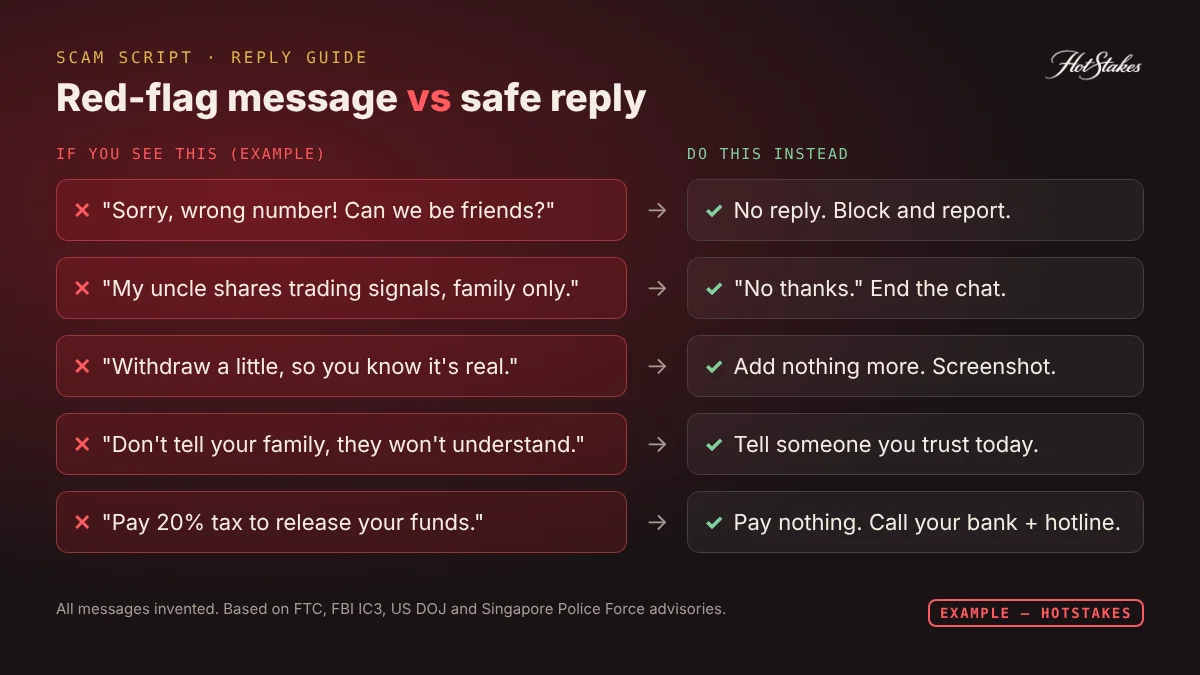
Takeaway: you never need a clever reply. Silence, a block and a report beat any argument with a script.
How to know if it’s a scam: the 4-question test
Answer these about the person and the platform. One “yes” is enough to stop.
- Did we first “meet” through a message that wasn’t meant for me?
- Have I never seen this person live on video, or met them in person?
- Did they bring up money, trading, crypto or a betting platform first?
- Am I being asked to pay anything to get money out?
Takeaway: question 4 alone settles it. A “yes” there means the platform is not going to pay you.
Already replied or already paid? Do this now
- Stop paying. No fee, tax or deposit, however reasonable the reason sounds.
- Call your bank on the number printed on your card. Ask them to stop or recall any recent transfer.
- Call your national scam hotline (below). In Malaysia the NSRC asks you to report within 24 hours of discovering the scam so accounts can be frozen.
- Save evidence: screenshots of the chat, the profile, the platform’s web address, and every transaction reference.
- Don’t confront the scammer. Block only after you have saved the chat.
- Ignore anyone offering to recover the money for a fee. That’s stage 7.
Takeaway: the first hour matters more than the amount. Call the bank first, then the hotline.
Where to report (numbers checked 20 Oct 2026)
We confirmed each number below on an official or major-news page this run.
| Country | Who to contact | Notes |
|---|---|---|
| Malaysia | NSRC hotline 997 | Daily, 24 hours. For online financial scams |
| Singapore | ScamShield Helpline 1799; police 999 | 1799 is 24/7. Call 999 if urgent police attention is needed |
| Hong Kong | Anti-Scam Helpline 18222 | Around the clock, consultation. Report cases at a police station; 999 for emergencies |
| Philippines | Inter-Agency Response Center hotline 1326 | CICC-led; takes investment and romance scam reports |
| Thailand | Anti-Online Scam Operation Centre 1441 | Can work with banks to halt transfers |
| India | Cyber crime helpline 1930 | 24 hours; also cybercrime.gov.in |
| Indonesia | Indonesia Anti-Scam Centre (IASC) online report | Report at iasc.ojk.go.id with your evidence |
Why it matters: investment scams were the costliest scam type in Singapore in the first half of 2026, with 2,256 cases and S$169.8 million lost, police figures show. In the US, the FBI’s 2025 internet crime report put cryptocurrency investment fraud at $7.2 billion in reported losses, the biggest single source of losses.
Takeaway: save your country’s number in your phone today, before you need it.
For families: how to raise it without a fight
Victims are often careful people targeted by a team working in shifts, some of them trafficked into scam compounds. Shame keeps victims paying.
- Read the chat together against the table above.
- Ask question 4: “Do they want money before you can withdraw?”
- Offer to make the hotline call with them.
- Never say “how could you fall for this”. Say “this script fools thousands of people”.
Takeaway: the goal is the next payment not happening, not winning the argument. More warnings live in our Scam Alerts section.
FAQ
Is every wrong-number text a scam?
No. People do mistype numbers. A genuine sender apologises once and stops. If the stranger keeps chatting, asks personal questions or brings up money or a platform, treat it as the wrong number text scam.
What should I reply to a wrong-number text?
Nothing. You don’t owe a stranger a correction. Block the number and use your messaging app’s report option. If you already replied, don’t share personal details and don’t move to another app.
The platform let me withdraw money. Doesn’t that prove it’s real?
No. US prosecutors and Singapore Police both describe scammers allowing small early withdrawals or paying initial returns to build trust. The real test comes when you try to take out a larger sum and are asked to pay first.
They say I must pay tax before my withdrawal is released. Should I pay?
No. The FBI says victims who are told to pay a fee or tax to withdraw do not get their money back after paying. Stop, call your bank, and call your national scam hotline.
Someone says they can recover my lost money for a fee. Is that real?
Treat it as a second scam. The FBI has warned about fake law firms that contact crypto scam victims and ask for upfront fees. Deal only with the police and your bank, using numbers you look up yourself.
HotStakes is an independent directory. Some links on this site are affiliate links; we may earn a commission at no cost to you, and it never changes our rankings. Gambling involves risk — only play with money you can afford to lose, and if it stops being fun, seek help. This article is general information, not legal advice.
 Next story →Macau Junket Collapse Explained: Suncity and Alvin Chau