

Sic Bo House Edge: Every Bet Ranked, 2.78% to 47%
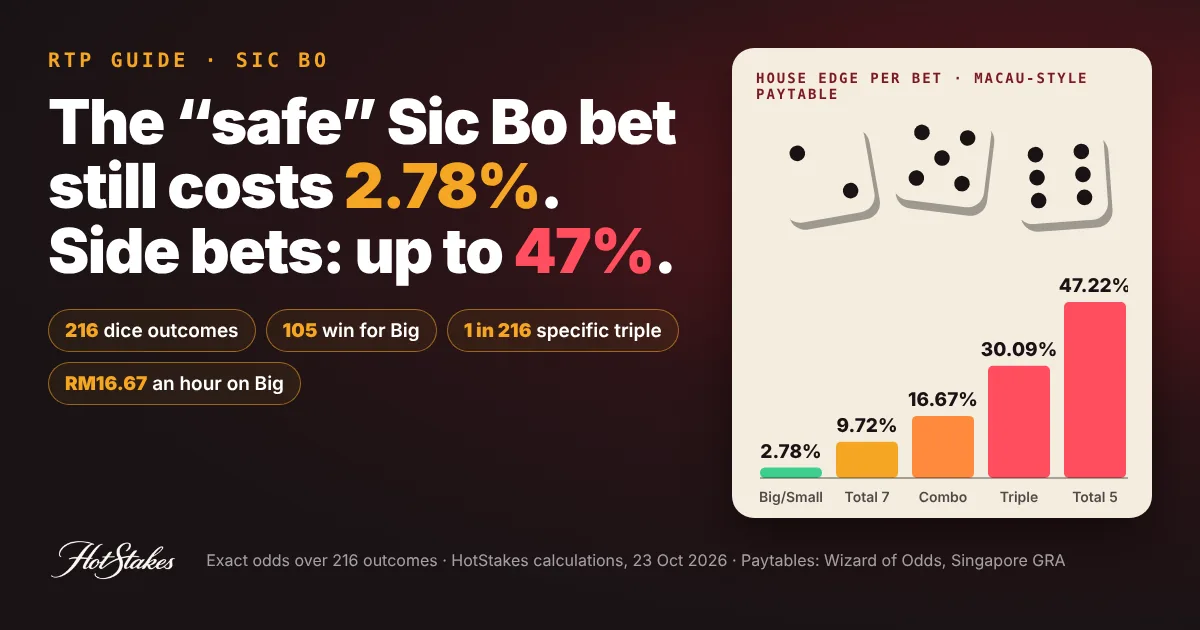
Big and Small cost 2.78%. On a Macau-style paytable side bets cost up to 47%. Every Sic Bo bet worked out from all 216 dice rolls.
In this article
Every round, three dice can land 216 ways. That fixes the price of every bet on the Sic Bo table. The Sic Bo house edge is 2.78% on Big, Small, Odd and Even, the cheapest bets on the table, and on a Macau-style paytable the side bets cost between 7.87% and 47.22%. Below we work out every standard bet from the 216 outcomes, compare two real paytables, simulate 1,000 rounds and price an hour of live play.
Where 2.78% comes from: 216 rolls, 105 wins
Three dice with six faces each give 6 × 6 × 6 = 216 equally likely results. Every Sic Bo bet is just a list of results that win.
Take Big (totals 11 to 17). Totals 11 to 18 cover 108 of the 216 results. But the Big bet also loses on a triple, and three triples fall in that range (4-4-4, 5-5-5, 6-6-6). Singapore’s regulator-approved rules put it plainly: Big “shall lose if any other total or Any Triple appears”.
That leaves 105 winning results and 111 losing ones. Paid at 1 to 1, you win RM1 105 times and lose RM1 111 times. Net: −6 out of 216, or −2.78%.
A fair price would be 37 to 35, the “no house edge” figure on Wikipedia’s Sic Bo page. The six triples are the whole house edge on Big and Small.
Here is how to check any bet yourself:
- Count the winning results out of 216 (a specific triple: 1; any triple: 6; Total 10: 27).
- Read the payout printed on your table, as “X to 1”.
- Multiply winning results × (X + 1). That is what 216 one-unit bets pay back.
- Subtract 216 and divide by 216. The negative number is the house edge.
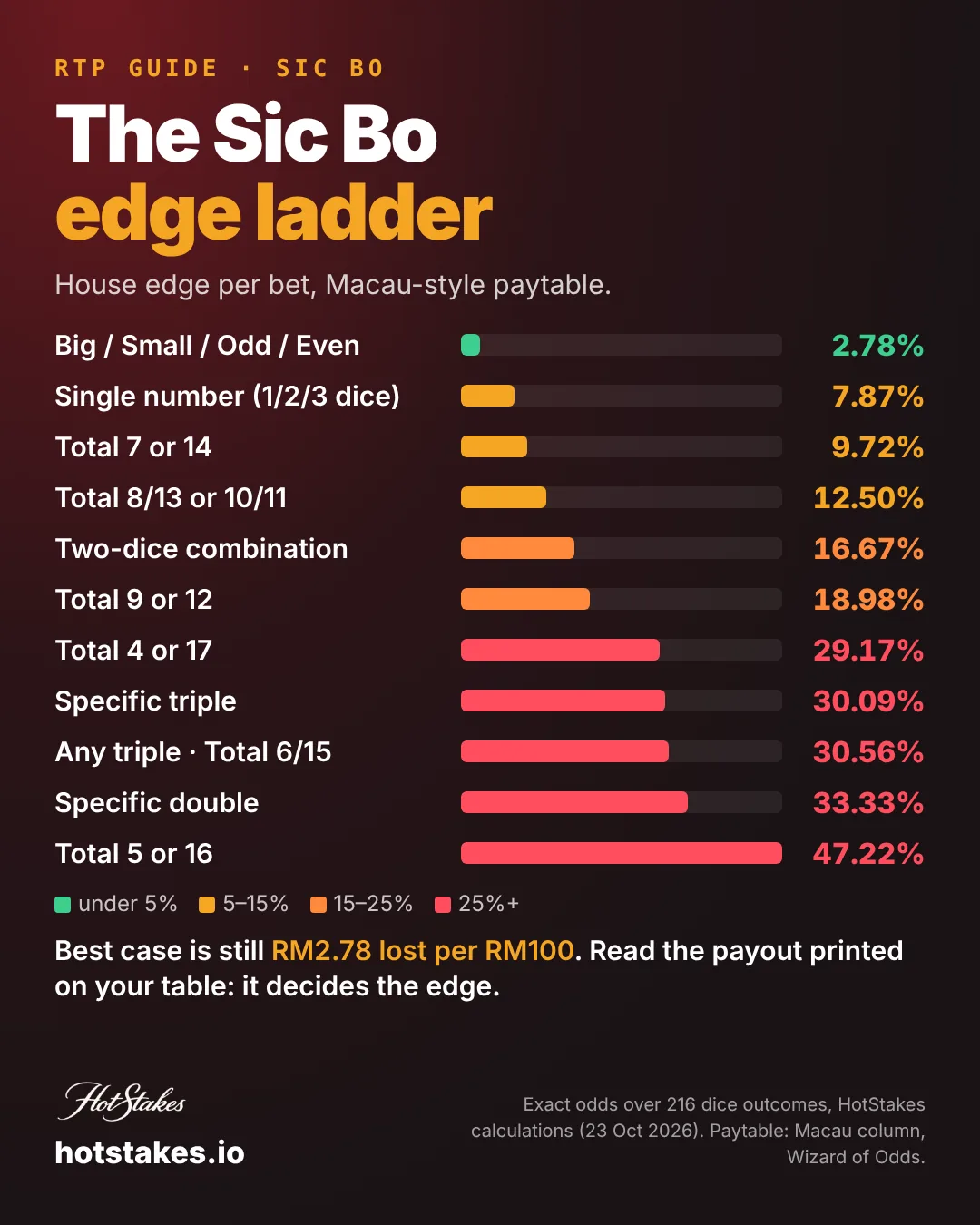
Example: a specific triple paying 150 to 1 returns 1 × 151 = 151 for every 216 staked. That is a 30.09% edge. Our RTP calculator turns any edge into a cost per session.
Takeaway: Big and Small are close to a coin flip, minus the six triples. That small gap is the 2.78% you pay.
Sic Bo odds, bet by bet: the full edge ladder
We counted every standard bet over the 216 outcomes. We priced each one on two paytables:
- Macau-style: the “Macau” paytable listed by Wizard of Odds (Michael Shackleford, page updated 8 Oct 2026).
- Singapore MBS: the Marina Bay Sands paytable in the Sic Bo rules approved by Singapore’s Gambling Regulatory Authority (version 7, effective 19 September 2025).
The table is sorted from the lowest to the highest edge on the Macau-style paytable.
| Bet | Wins (of 216) | Win chance | Macau-style pays | Edge | Singapore MBS pays | Edge |
|---|---|---|---|---|---|---|
| Big or Small (lose on triples) | 105 | 48.61% | 1 to 1 | 2.78% | 1 to 1 | 2.78% |
| Odd or Even (lose on triples) | 105 | 48.61% | 1 to 1 | 2.78% | 1 to 1 | 2.78% |
| Single number (on 1, 2 or 3 dice) | 91 | 42.13% | 1 / 2 / 3 to 1 | 7.87% | 1 / 2 / 12 to 1 | 3.70% |
| Total 7 or 14 | 15 | 6.94% | 12 to 1 | 9.72% | 12 to 1 | 9.72% |
| Four-number bet (three of e.g. 1-2-3-4) | 24 | 11.11% | 7 to 1 | 11.11% | 7 to 1 | 11.11% |
| Total 8 or 13 | 21 | 9.72% | 8 to 1 | 12.50% | 8 to 1 | 12.50% |
| Total 10 or 11 | 27 | 12.50% | 6 to 1 | 12.50% | 6 to 1 | 12.50% |
| Three-number combination (e.g. 1-2-3) | 6 | 2.78% | 30 to 1 | 13.89% | 30 to 1 | 13.89% |
| Two-dice combination (e.g. 1 and 2) | 30 | 13.89% | 5 to 1 | 16.67% | 6 to 1 | 2.78% |
| Total 9 or 12 | 25 | 11.57% | 6 to 1 | 18.98% | 7 to 1 | 7.41% |
| Total 4 or 17 | 3 | 1.39% | 50 to 1 | 29.17% | 62 to 1 | 12.50% |
| Double plus single (e.g. 1-1-3) | 3 | 1.39% | 50 to 1 | 29.17% | 50 to 1 | 29.17% |
| Specific triple (e.g. 6-6-6) | 1 | 0.46% | 150 to 1 | 30.09% | 180 to 1 | 16.20% |
| Any triple | 6 | 2.78% | 24 to 1 | 30.56% | 31 to 1 | 11.11% |
| Total 6 or 15 | 10 | 4.63% | 14 to 1 | 30.56% | 18 to 1 | 12.04% |
| Specific double (e.g. two 5s) | 16 | 7.41% | 8 to 1 | 33.33% | 11 to 1 | 11.11% |
| Total 5 or 16 | 6 | 2.78% | 18 to 1 | 47.22% | 31 to 1 | 11.11% |
Two details matter. A specific double counts 16 results because the triple (5-5-5) also wins it. A single-number bet wins on 75 results with one match, 15 with two and 1 with three.
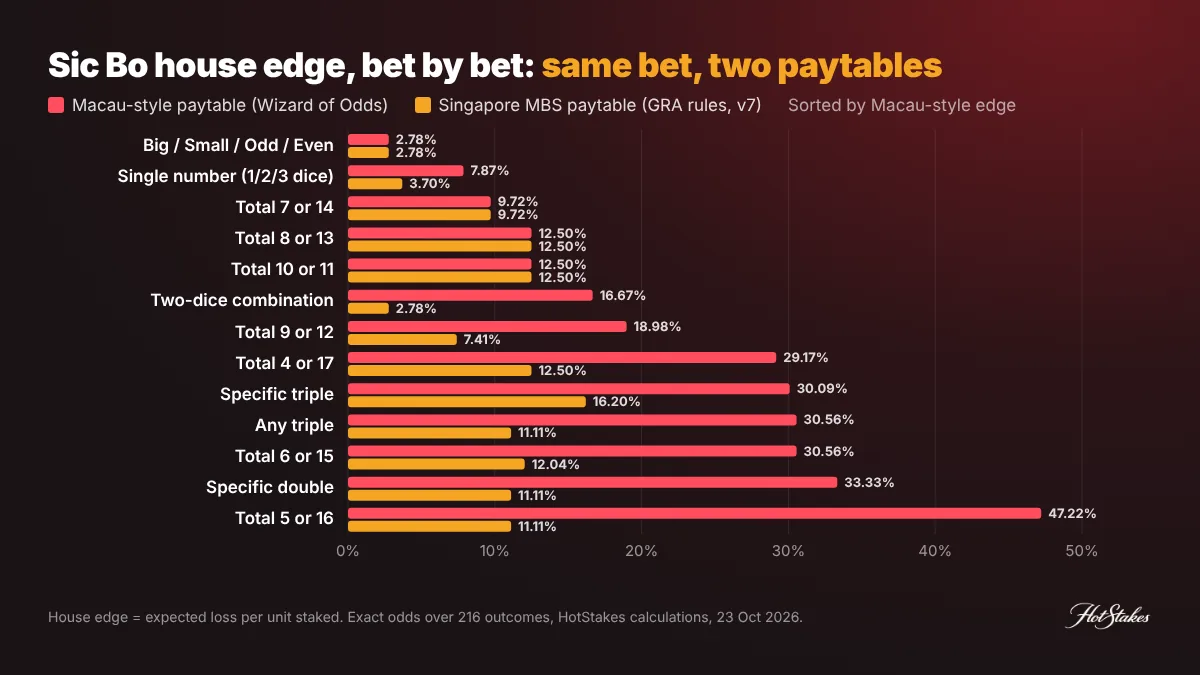
Takeaway: The best Sic Bo bet by house edge is Big, Small, Odd or Even at 2.78%. On a Macau-style table, almost everything else costs you 10% or more of every stake.
The payout on your table decides the edge
The dice never change. The payouts do. That is why the same bet can sit at opposite ends of the ladder.
Total 5 or 16 wins on 6 of 216 results everywhere. At 18 to 1 (Macau-style) it costs 47.22%. At 31 to 1 (Singapore MBS) it costs 11.11%. Same dice, four times the price.
Even reference tables get this wrong. Wikipedia’s Macau column shows Total 4 or 17 at 50 to 1 with a 27.78% edge. Our count gives 3 × 51 = 153 back per 216 staked, a 29.17% edge, which matches Wizard of Odds.
Live online tables add another twist: multipliers. The rules documents linked from our data for Lotus Sicbo EU01 and Oracle Sicbo WS01 (both opened 23 Oct 2026) show:
- Lower base payouts with random boosts, for example specific triple “150 – 999:1” and Total 5 or 16 “20 – 249:1”.
- Big, Small, Odd, Even and single-number one-die hits are not boosted.
- A stated RTP of 97.22% for Big/Small and Odd/Even, and an overall range of 95.47% to 97.22%.
The documents do not say how often each multiplier lands, so we cannot check the side-bet figures ourselves. Taking the provider at its word, every side bet still costs more than Big or Small.
Takeaway: Before betting anything except Big, Small, Odd or Even, read the payout printed on that table and run the four steps above.
What our StakeGO table data shows
Our directory data (StakeGO live tables, synced 22 October 2026) lists a house edge for each table. Both Sic Bo tables, Lotus Sicbo EU01 and Oracle Sicbo WS01, show 2.78. That is the Big/Small edge, and it matches our 105-of-216 count exactly.
Here is how it compares with the other StakeGO tables in the same data:
- Baccarat: 1.06–1.24 (every baccarat and speed baccarat table listed).
- Roulette: 2.7 (some tables list 2.9 for certain bets).
- Sic Bo: 2.78.
- Dragon Tiger: 3.73. Our Dragon Tiger house edge guide explains where that comes from.
So Big in Sic Bo sits next to single-zero roulette. It costs more than baccarat and less than Dragon Tiger. The side bets are in a different league.
Takeaway: The 2.78% on a table listing describes the cheapest bet only. It is not the cost of the whole table.
1,000 rounds of RM10: Big vs a specific triple
An edge is an average. To show what it feels like, we simulated 100,000 sessions of 1,000 rounds at RM10 (RM10,000 staked) on Big and on a specific triple paying 150 to 1. This is our simulation, run 23 October 2026.
- Big: expected loss RM278. Median result −RM280. 18% of sessions finished ahead. 90% landed between −RM800 and +RM240.
- Specific triple (150 to 1): expected loss RM3,009. Median result −RM3,960. About 19% finished ahead. 90% landed between −RM8,490 and +RM2,080.
- Specific triple on the Singapore MBS payout (180 to 1): expected loss RM1,620, with 32% of sessions ahead.
The surprise: about one session in five ends ahead on both bets. The difference is the size of the hole. On average you hit your triple 4.63 times in 1,000 rounds and need 7 hits to come out ahead. About 1% of triple sessions never hit at all.
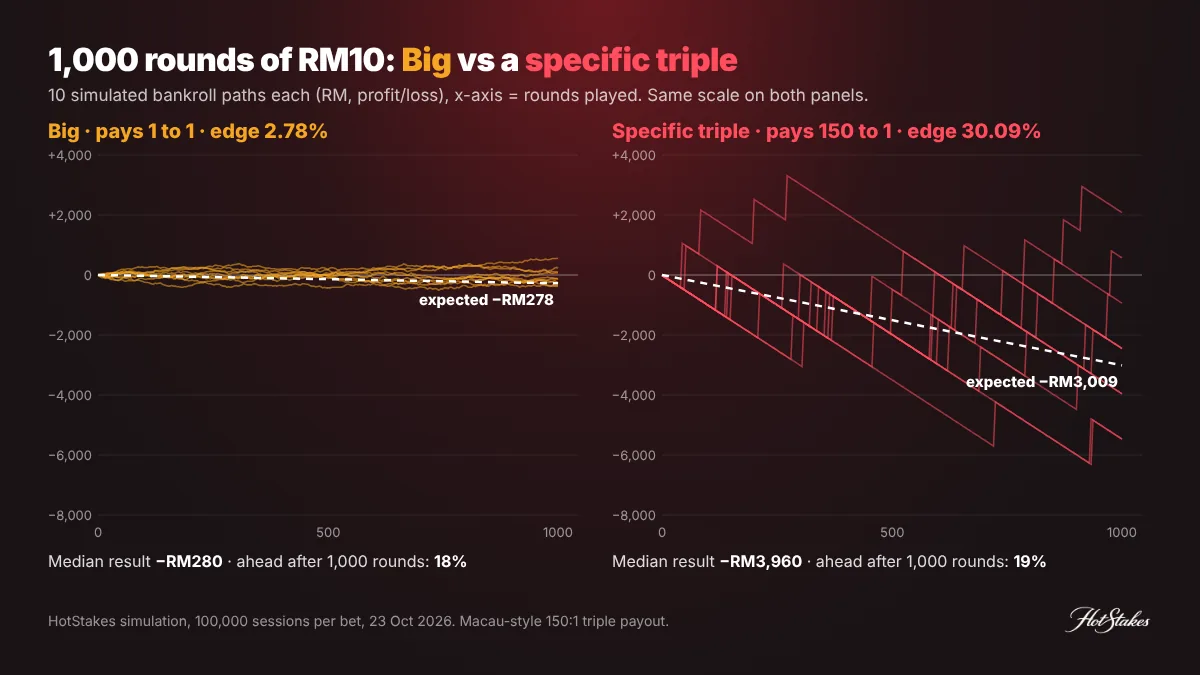
Big drifts down slowly. The triple drops in a straight line between rare spikes. Spikes are what players remember; the slope is what they pay. Our guide to RTP vs volatility explains why the two feel so different.
Takeaway: A long-shot bet does not give you better odds of a winning night. It gives you a much bigger expected loss for roughly the same chance.
What an hour of Sic Bo costs
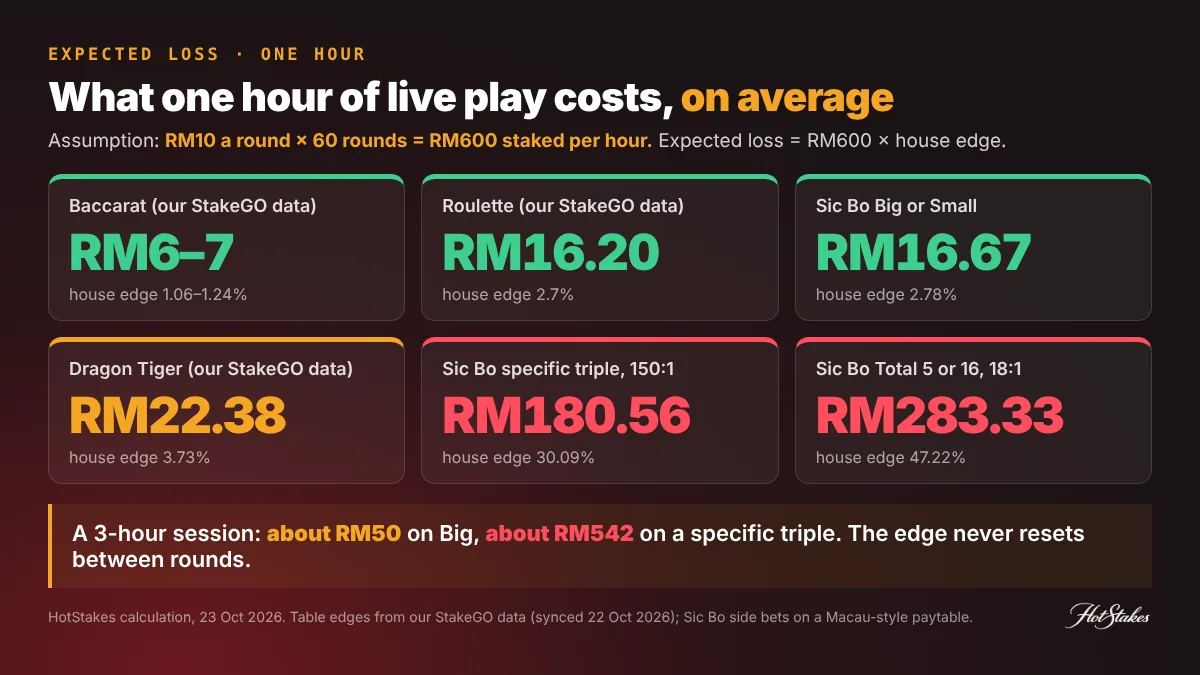
This is our calculation with stated assumptions: RM10 a round, 60 rounds an hour, so RM600 staked per hour. Your table may run faster or slower. Expected loss = RM600 × house edge.
- Big or Small (2.78%): about RM16.67 an hour.
- Specific triple at 150 to 1 (30.09%): about RM180.56 an hour.
- Total 5 or 16 at 18 to 1 (47.22%): about RM283.33 an hour.
For comparison, at the same pace and stake: baccarat at 1.06–1.24% costs RM6 to RM7, roulette at 2.7% about RM16.20, and Dragon Tiger at 3.73% about RM22.38 (edges from our StakeGO data).
Takeaway: Bet size, pace and edge together set your hourly cost. Faster rounds raise it as surely as a worse bet does. More on that in why the house always wins.
“Big came up five times”: streaks and systems
Dice have no memory. After five Bigs in a row, the next roll is still Big on 105 of 216 results, Small on 105 and a triple on 6. The belief that the other side is “due” is the gambler’s fallacy, the same trap covered in is a slot due to hit?
Betting systems do not help either. Doubling after each loss (Martingale) or following road charts changes how much you bet and when. It does not change what each bet pays or how often it wins. Every bet still carries its edge, so the total expected loss is stake × edge, summed. In a 2019 paper on teaching gambling maths, Ethier and Hoppe group “the futility of betting systems” with the law of large numbers as ideas that make students less keen on pure-chance games.
If you play anyway, these steps keep the cost honest. None of them help you win:
- Know the price: Big, Small, Odd and Even are the cheapest bets at 2.78%.
- Check the table’s payouts before any side bet, and work out its edge.
- Set a budget and a time limit before you sit down, using the hourly figures above.
- Ignore streaks and road charts. They describe the past only.
- Get help early if it stops being fun. In Singapore, NCPG helpline counsellors are on 1800-6-668-668.
New to the term? Our glossary defines house edge in one line.
FAQ
What is the house edge in Sic Bo?
It depends on the bet. Big, Small, Odd and Even carry a 2.78% house edge because they lose on the six triples. On a Macau-style paytable, side bets range from 7.87% (single number) to 47.22% (Total 5 or 16).
What is the best Sic Bo bet?
By house edge, Big, Small, Odd or Even at 2.78%. On some paytables, such as Singapore’s Marina Bay Sands rules, the two-dice combination at 6 to 1 also costs 2.78%. No bet has a player edge.
What are the Sic Bo Big/Small odds?
Big wins on 105 of 216 dice results, a 48.61% chance, and pays 1 to 1. Small is the same. Both lose on any triple, which is where the 2.78% edge comes from.
Why do Sic Bo payouts differ between tables?
Each casino or game provider sets its own paytable; in regulated casinos the regulator approves it. A specific triple pays 150 to 1 on the Macau-style table (30.09% edge) and 180 to 1 at Marina Bay Sands (16.20%). Always read the payout shown on the table you play.
Can a betting system beat Sic Bo?
No. Systems change the size and timing of bets, not the payout or the probability. Each bet keeps its house edge, so expected loss is total stake times edge.
HotStakes is an independent directory. Some links on this site are affiliate links; we may earn a commission at no cost to you, and it never changes our rankings. Gambling involves risk — only play with money you can afford to lose, and if it stops being fun, seek help. This article is general information, not legal advice. Read our full disclaimer.
 Next story →Scratch and Win Scam: The Script Behind the Fake Prize

Start the discussion