

RTP Certification Explained: What a Lab Seal Really Proves
GLI, BMM and eCOGRA test one version of a game. What RTP certification proves, what it doesn't, and how to check a seal is real.
In this article
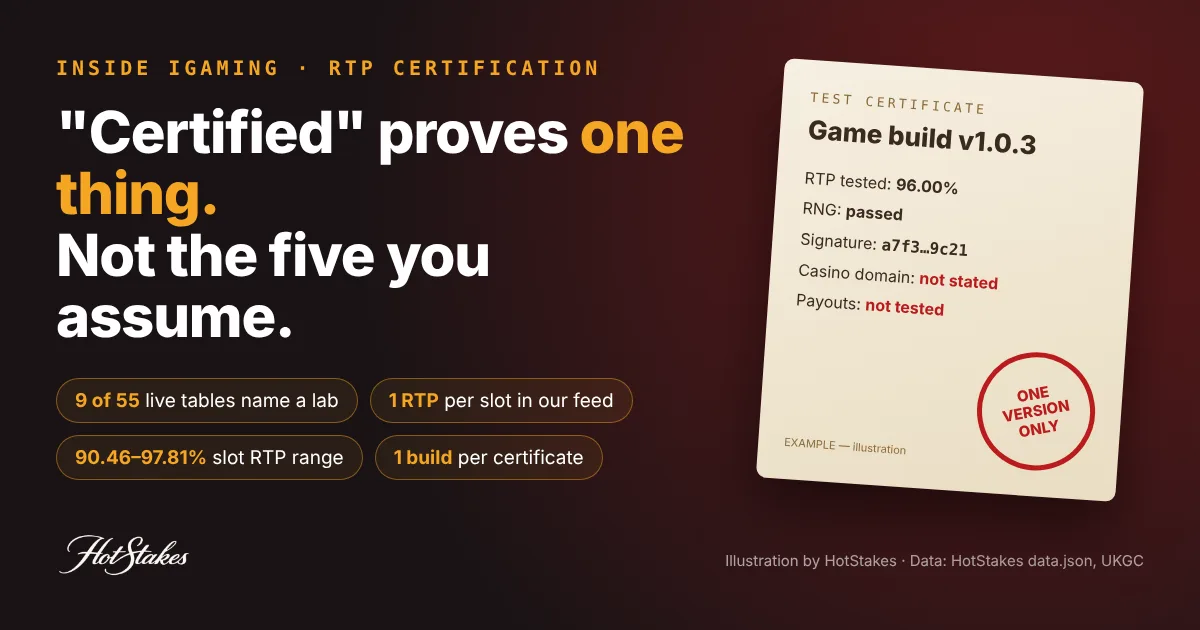
A “GLI certified” or “eCOGRA” badge sits in the footer, and it feels like a promise. It promises less than you think. RTP certification means a testing lab checked one specific version of a game (its maths, its random number generator and its paytable) against a set of rules; it does not prove the casino you are on runs that version, pays withdrawals, or holds a licence. Below: what labs such as GLI, BMM Testlabs, eCOGRA, Quinel and iTech Labs actually test, how rarely live tables in our data name one, and how to check a seal yourself.

What a testing lab actually checks
A game studio sends its game to an independent lab before release. The lab tests it against the technical standard of each market where it will be sold. GLI, one of the biggest labs, describes the core of the job in its own explainer on how casino games are tested:
- The maths. The lab builds its own simulation of the game and runs billions of simulated rounds to confirm the RTP matches the design and meets the market’s legal minimum. GLI gives 80% in some regions and 85% in others as examples.
- The random number generator (RNG). The lab checks that outcomes are random and unpredictable.
- The prizes. Testers force bonus rounds and jackpots to confirm the game pays what the paytable says.
- The local rules. Every requirement of every market the game is sold in.
The rules being tested are written by regulators, not labs. The UK Gambling Commission’s standard on random outcomes, RTS 7, says results must be “acceptably random” and bans “compensated” games that tighten or loosen to hit a target. GLI’s own GLI-11 standard states that “it is up to each local jurisdiction to set their own public policy”. The online counterpart, GLI-19 for interactive gaming systems, separates what is tested in the lab from operational controls checked after installation.
Here is what each lab named in this article says it does, from its own pages:
| Lab | What it says it tests | Ongoing checks offered |
|---|---|---|
| GLI | RTP simulation, RNG, forced prize outcomes, market rules (GLI) | Publishes GLI-11 and GLI-19 standards |
| BMM Testlabs | RNGs, source code analysis, “mathematical analysis RTP & odds”, live dealer (BMM) | Product certification for suppliers |
| eCOGRA | Fair gaming and player protection reviews of operators and suppliers (eCOGRA) | Bi-annual RNG reports, optional monthly RTP reports, dispute mediation |
| iTech Labs | RNG source code, raw and scaled output; RTP (iTech Labs) | RTP/RNG audits based on server logs |
| Quinel | Registered to test games and RNGs for Ontario (AGCO) | Depends on the regulator’s scheme |
Ontario’s regulator, the AGCO, lists BMM, eCOGRA, GLI and Quinel among eight labs “registered to test and certify key components of igaming systems such as games and random number generators”. That kind of regulator list is how you know a lab is real.
Takeaway: A lab checks a game against someone else’s rulebook. The value of the certificate depends on whose rulebook it was.
Slots vs live tables: two different kinds of “certified”
A slot’s outcome comes from software. A live roulette ball or baccarat shoe is physical. So the testing is different.
The UK Gambling Commission’s testing strategy requires a test house to run statistical analysis on RNGs before release, but expressly excludes “live dealer physical devices”. For live studios, licensees must instead “seek independent assurance” that the operation meets the rules, assessed by a regulator or a test house. In plain terms: a lab badge on a live table is about studio equipment and procedures, not an algorithm.
We checked how often live tables name a lab at all. Our data.json feed (synced 20 Oct 2026) lists 55 StakeGO live tables with a “cert” field supplied by the studio:
- 9 of 55 name a lab: 4 BMM Testlabs, 4 Quinel, 1 GLI.
- 46 of 55 say “NA” or “N/A”.
- The BMM-listed tables are Galaxy Roulette EU01, Classic Baccarat EU01, Lotus Sicbo EU01 and Galaxia Speed Bac EU03. The single GLI table is Dragon Tiger MD01. All four Quinel tables are auto roulette wheels.
Be careful with what “NA” means. It means the supplier’s feed does not name a lab for that table. It does not prove the table was never tested. It does mean a player has no lab name to check.
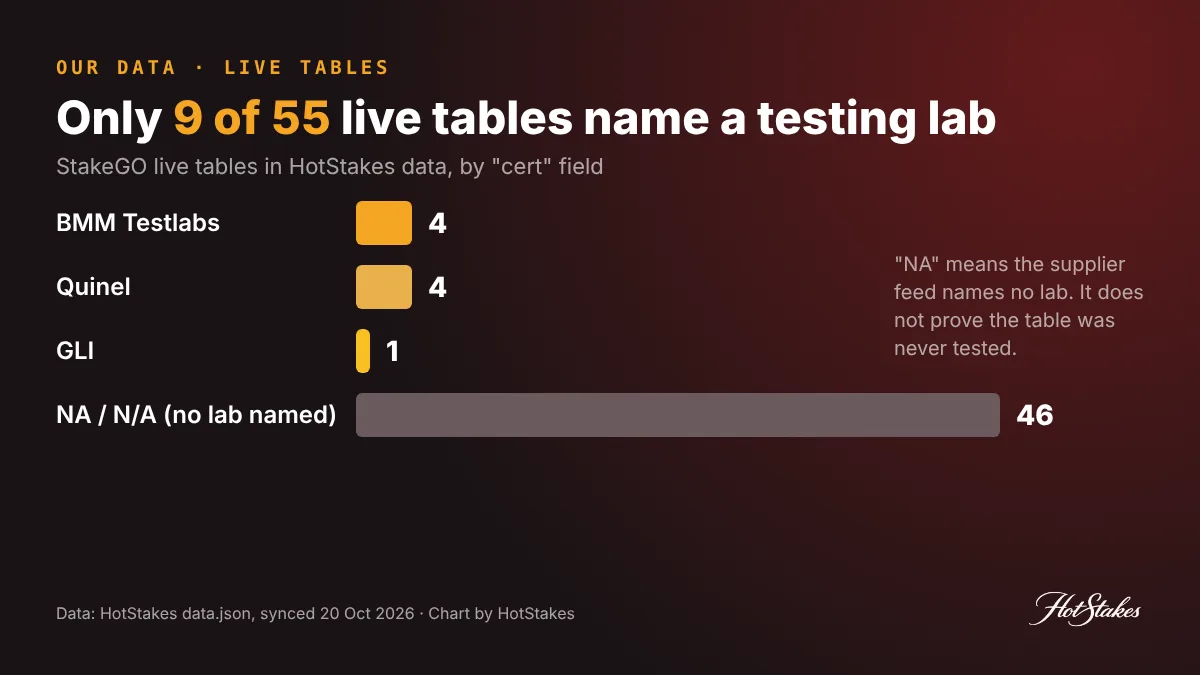
Takeaway: Most live tables in our feed name no lab at all. Where one is named, it tells you who looked at the studio, not that your casino is honest.
A certificate covers one version, not “the game”
This is the part badge-wavers skip. When a UK-licensed game is tested, the test report must list the game’s RTP, software number and digital signature. Updates that affect fairness must be retested. In other words, the certificate is stamped on a specific build at a specific RTP.
That matters because many slots ship in more than one RTP version. Industry executives discussed it openly in a 2025 NEXT.io roundtable (a promoted feature). One operator chief said finding “two versions of the same game with different payouts feels like a trick, even if it isn’t”. Another said players “must clearly understand which version they’re playing”.
Each version can be certified. The lab is not certifying that your casino picked the best one.
What our own data can and cannot show
- Slots: our feed lists 424 Hotdog slots, and every one carries exactly one RTP figure, from 90.46% to 97.81%. 358 are at 96% or above; 33 are below 95%. A single directory number, including ours, is the provider’s listed figure. It cannot tell you which configuration a given casino has switched on.
- Live tables: 9 roulette tables list two house-edge figures, such as “B.Off: 2.7 / B.On: 2.9”, because the edge changes with the bet or mode you choose. Baccarat tables list a range, 1.06% to 1.24%, because Banker and Player bets differ.
So even an honest, certified game does not have one “true” RTP for every player. It has the figure for the version and bet you are actually on. Our RTP vs volatility guide explains why that figure tells you little about a single session.
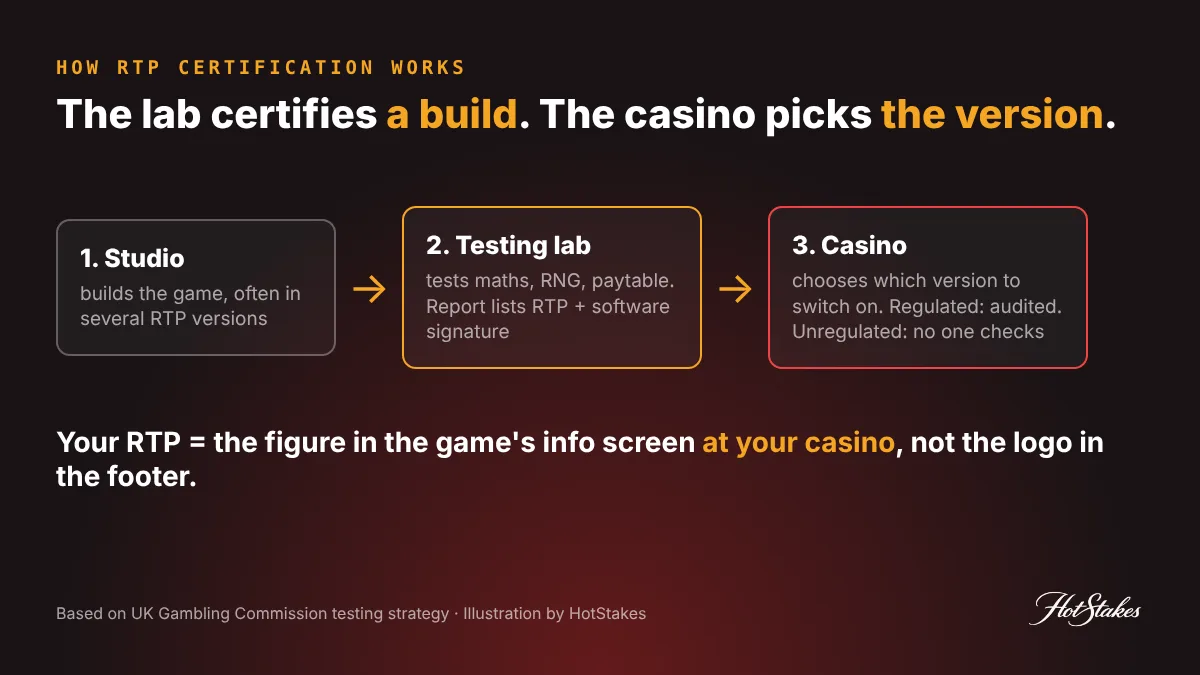
Takeaway: Ask “certified at which RTP?” The only number that applies to you is the one in the game’s own info screen at your casino.
What a “certified” badge does NOT prove
A genuine certificate is real evidence. It is evidence about the game, made before release. It says nothing about these six things:
- That this casino runs the certified build. Regulated markets back this up with signatures and audits. On an unregulated site, nobody independent checks.
- That it runs the high-RTP version. A 97% version and a lower version of the same slot can both carry the same lab’s name.
- That the casino pays out. Withdrawal limits, delays and voided wins are operator decisions, not game maths.
- That the casino is licensed. Game certification and an operator licence are separate things. A game studio can be certified while the site hosting its games is not licensed anywhere.
- That you will get the RTP back. In its player guide to gaming machines, the UK Gambling Commission says RTP is “an average achieved over a significant number of game plays and not each time” you play. Over any session, results swing wildly.
- That the seal is genuine. A logo is an image file. Anyone can copy it.
Point 5 is where most of the misunderstanding lives. A certified 96% game is still built to keep 4% of everything staked over time; our guide to why the house always wins walks through the maths.
Takeaway: Certification answers “is the game built fairly?” It does not answer “is this casino fair to me?”
Fake seals: the badge is just a picture
Regulators have warned about copied seals. In February 2026 the Curaçao Gaming Authority said a site called TRUMPBET.CC (named here as plain text, not linked) was “neither authorized nor licensed” and “falsely presents itself as licensed”, using the authority’s logo and its Digital Authorization Seal without permission, as reported by AGB. The authority urged players to check the official register instead.
Registers have gaps too. In September 2025 the Curaçao authority removed operators whose licences had been revoked from its public register, which critics said “reduces transparency”, according to the Curaçao Chronicle.
We opened the authority’s online gaming licence register page this run (October 2026). It describes itself as the CGA licence register portal, but we found no visible search box for checking a domain on that page. The licensing portal FAQ is aimed at operators applying for licences. The fix for a seal is the click-through, covered next. For the bigger picture, see our Curaçao licence reform explainer.
Takeaway: A seal that does not open a page on the issuer’s own domain proves nothing. Treat it as decoration.
How to check a seal and an RTP in five minutes
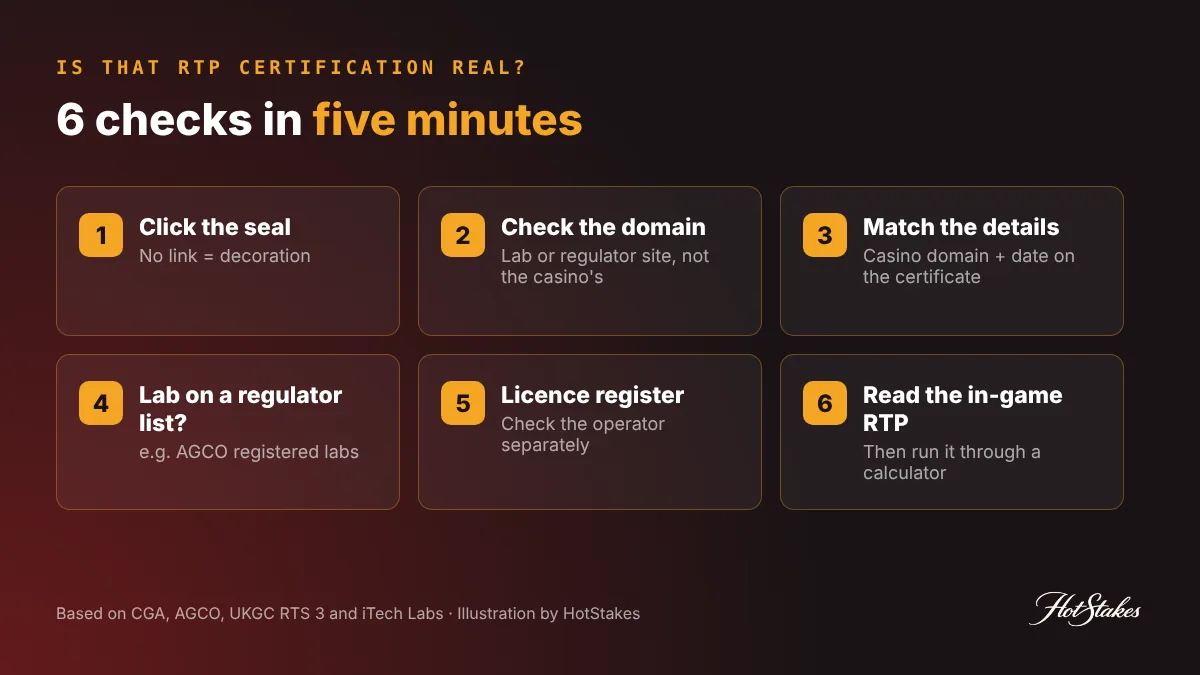
- Click the seal. A genuine lab or regulator seal should open a certificate or licence record on the issuer’s own domain (gaminglabs.com, bmm.com, ecogra.org, itechlabs.com, a .gov or regulator domain). iTech Labs, for example, says its certifications come with a “hot-linked original certificate”. No link, or a link to a page on the casino’s own site, is a red flag.
- Read the address bar. Look-alike domains are common. Check the spelling letter by letter.
- Match the details. The certificate should name the operator or game, the website domain and a date. If the casino’s domain is not on it, it is not that casino’s certificate.
- Check the lab is real. Regulators list approved labs, such as the AGCO’s register of testing labs. A lab name you cannot find on any regulator list deserves suspicion.
- Check the licence separately on the regulator’s own register, not via the casino’s footer. Our guide to spotting an unlicensed online casino lists what to look for.
- Open the game’s info or help screen and find the RTP shown there. UK rules require RTP information to be easily available before you play. If a site hides it, ask why.
- Compare and calculate. Compare the in-game figure with the provider’s published figure, then put it into our RTP calculator to see the expected cost over your planned spins.
If a game keeps showing “wins” that are smaller than your stake, that is a design feature, not a lab failure; we explain it in losses disguised as wins.
Takeaway: Two clicks (the seal, then the register) separate a real certificate from a pasted logo.
FAQ
What does RTP certification mean?
It means an independent testing lab checked a specific version of a game, including its maths, random number generator and paytable, against a regulator’s technical standard, and confirmed the stated RTP matches the design. It is a test of the game, not of the casino.
Does “GLI certified” mean a casino is safe?
No. GLI certification applies to a game or system that was tested. It does not show that a particular casino runs that certified version, is licensed, or pays withdrawals. Check the operator’s licence on the regulator’s own register.
Is RTP verified after a game goes live?
In some regulated markets, yes. The UK requires licensees to monitor game performance, with an annual assessment by an approved test house, and eCOGRA offers optional monthly RTP reports to approved sites. On unregulated sites there is usually no independent ongoing check.
Can the same slot have a different RTP at different casinos?
Yes. Many slots are released in several RTP versions, and each can be certified. The version shown in the game’s own info screen at your casino is the one that applies to you.
How do I know a testing lab seal is real?
Click it. A genuine seal should open a certificate on the lab’s or regulator’s own domain that names the casino’s website and a date. A seal that does not click through, or opens a page on the casino’s own site, proves nothing.
HotStakes is an independent directory. Some links on this site are affiliate links; we may earn a commission at no cost to you, and it never changes our rankings. Gambling involves risk — only play with money you can afford to lose, and if it stops being fun, seek help. This article is general information, not legal advice. Read our full disclaimer.
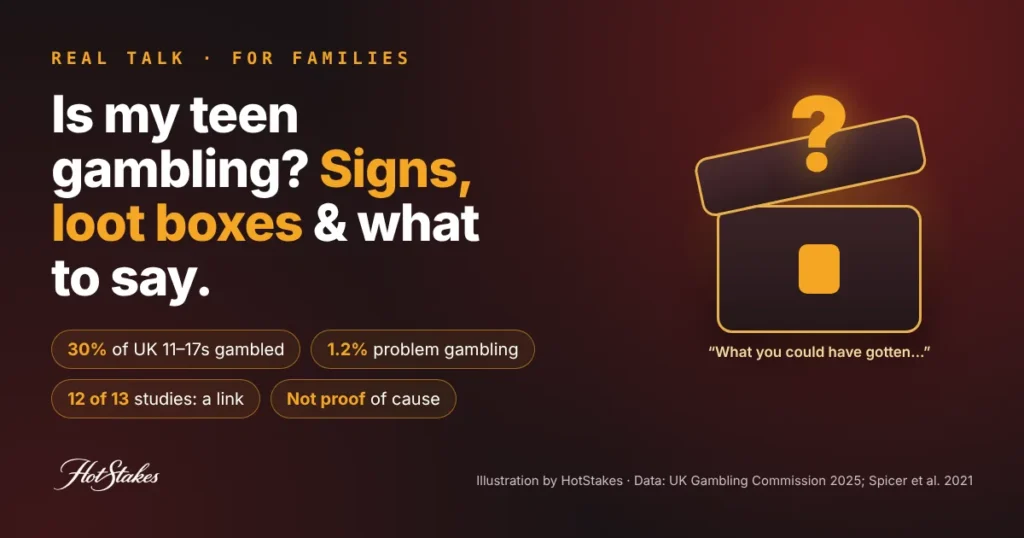 Next story →Signs Your Child Is Gambling: Loot Boxes, Skins, What to Do

Start the discussion