

Sticky vs Non-Sticky Bonus: Which One Lets You Cash Out?
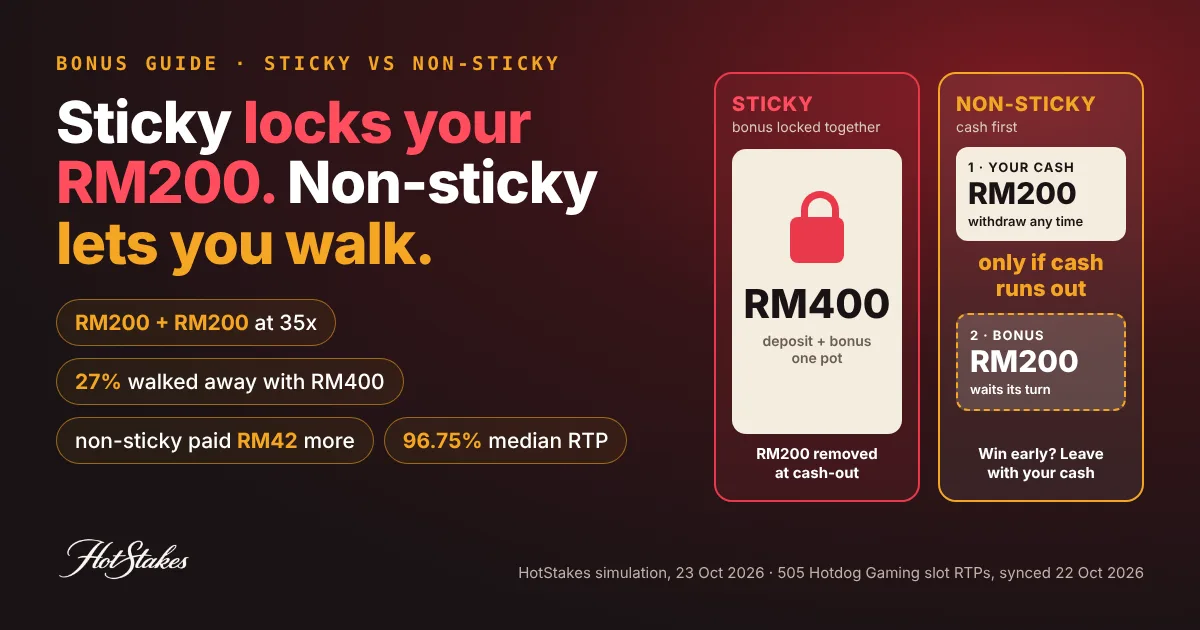
Same RM200 bonus, two rules. We simulated both: non-sticky paid about RM42 more and let 27% walk away with RM400 before the bonus was used.
In this article
Two casinos both offer “100% up to RM200, 35x wagering”. They look identical. They are not. The difference is which money you play first, and whether the bonus ever becomes yours. With a non-sticky bonus your own deposit is played first and you can cash out a win before the bonus is touched; with a sticky bonus the two are locked together and the bonus is taken back when you withdraw. In our simulation of the same offer both ways, the non-sticky version paid back about RM40 more on average.
What is a sticky bonus?
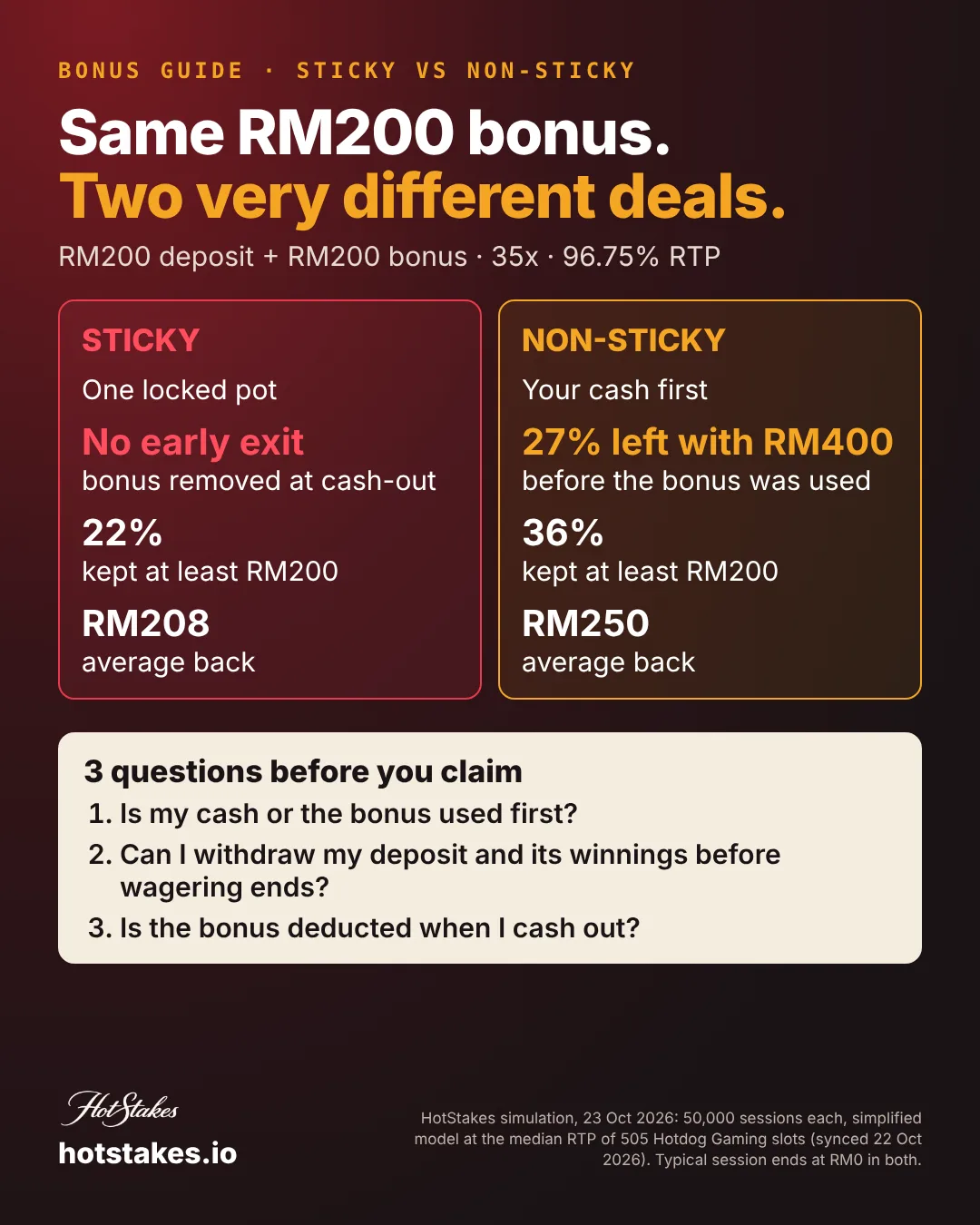
A sticky bonus is bonus money you can play with but can never withdraw. It “sticks” to your account until you cash out, and then it is subtracted.
Here is how it usually works:
- You deposit RM200 and receive a RM200 bonus.
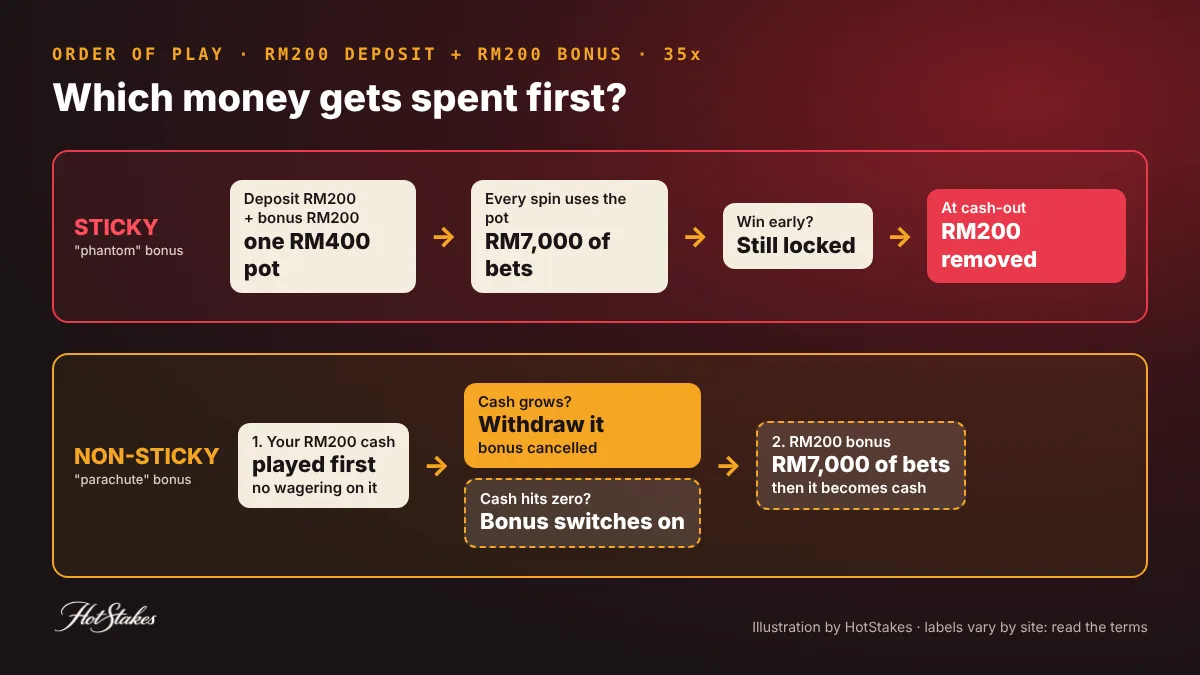
- Both go into one balance of RM400. Every spin draws on that combined pot.
- Nothing is withdrawable until you finish the wagering requirement, here 35 × RM200 = RM7,000 of bets.
- When you cash out, RM200 is removed. If your balance is RM650, you get RM450.
“Phantom bonus” is a common name for the same thing: the bonus is visible while you play, then vanishes at withdrawal. Labels vary between sites, so trust the wording in the terms, not the name. Our glossary entry on sticky bonuses has the short version.
Takeaway: With a sticky bonus, your RM200 deposit is locked in with the bonus from the first spin.
What is a non-sticky bonus?
A non-sticky bonus keeps your money and the casino’s money in separate wallets. Your cash is played first. The bonus waits.
- If you win early, you can withdraw your cash balance. The bonus is cancelled, but your deposit and what you won with it are yours.
- If your cash runs out, the bonus becomes active. Now you play the RM200 bonus and the RM7,000 wagering applies.
- If you finish the wagering, what is left usually becomes real, withdrawable money, sometimes up to a cash-out cap.
That is why some sites call it a “parachute”: it only opens if you fall. The structure works the same way in a deposit match welcome bonus or a weekly reload bonus.
| Sticky (“phantom”) | Non-sticky (“parachute”) | |
|---|---|---|
| Which money is played first | One combined pot | Your cash, then the bonus |
| Can you withdraw a win before wagering is done? | No | Yes, from your cash (bonus cancelled) |
| Does the bonus ever become cash? | No, it is removed at cash-out | Yes, if you finish wagering |
| Your worst case | Lose RM200 deposit | Lose RM200 deposit |
| Your best exit | Finish RM7,000 of bets, then lose RM200 of the balance | Win early and leave with your cash |
Takeaway: Same worst case, very different best case. That gap is the whole story.
The order of play, step by step
Picture the same night under both rules. You deposit RM200, claim RM200, and spin at RM2.
You win before finishing the wagering
Say your balance climbs to RM450 after 100 spins, RM200 of betting.
- Sticky: you still owe RM6,800 of bets. You cannot withdraw. Keep playing, and the house edge works on the whole RM450.
- Non-sticky: all of that was your cash. You can withdraw RM450 and give up the bonus. The bonus was never touched.
You lose your deposit first
- Sticky: the pot keeps shrinking toward zero. There is no second chance, because the bonus was already being spent.
- Non-sticky: your cash hits zero, then the RM200 bonus switches on. You get a fresh run with the casino’s money.
One more rule to check in either case: most bonuses cap your stake per spin while wagering, and breaking that rule can cost you the bonus.
Takeaway: Non-sticky gives you an exit when you are ahead and a second chance when you are behind. Sticky gives you neither.
The maths: why non-sticky is usually worth more
We use the same formula as our wagering requirements guide:
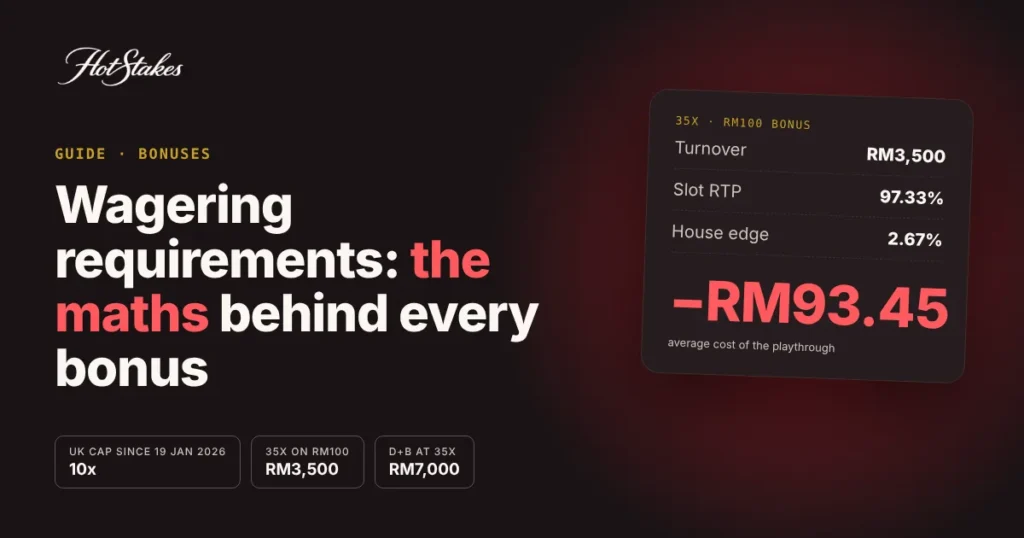
Expected cost of wagering = amount you must bet × house edge
For the house edge we used our own data. Our file lists 505 Hotdog Gaming slots, all with a published RTP (synced 22 October 2026). The median RTP is 96.75%, a house edge of 3.25%. Fortune Ox sits exactly on that median, with a mid-range volatility rating of 3 out of 5, which is also the median rating in our data.
So clearing RM7,000 of wagering costs about RM7,000 × 3.25% = RM227.50 on average.
- Sticky, by the formula: RM400 − RM227.50 ≈ RM172.50 left after wagering. Then the RM200 bonus is removed. On average there is nothing left to withdraw.
- Non-sticky, by the formula: the bonus only gets used if your cash is already gone. At that point it is the casino’s money at risk, not yours. You lose nothing extra if it fails, and you keep the upside if it works.
That second point is why non-sticky wins. The bonus is an option you hold, not a deposit you have already handed over.
You can run your own numbers in our wagering calculator.
Takeaway: A sticky bonus mostly prices the RM200 “gift” as more betting on your own money. A non-sticky bonus prices it as a second chance.
What our simulation shows
The formula gives averages. It does not tell you how often you actually leave with money. So on 23 October 2026 we ran our own Monte Carlo simulation in Python.
The set-up, stated plainly:
- Offer: RM200 deposit, RM200 bonus, 35x the bonus (RM7,000), RM2 spins, 50,000 sessions per scenario.
- Game: a simplified, medium-volatility slot model, not any specific game. Eight win sizes from 0.5x to 500x the stake, hit rate about 36%, scaled to a 96.75% RTP.
- Sticky rules: one RM400 pot; play until the wagering is done or the balance drops below RM2; RM200 removed at cash-out.
- Non-sticky rules: cash first, with no wagering on cash play. The player withdraws if cash reaches RM400. If cash runs out, the bonus activates and the same 35x applies.
| Result (96.75% RTP, medium volatility) | Sticky | Non-sticky |
|---|---|---|
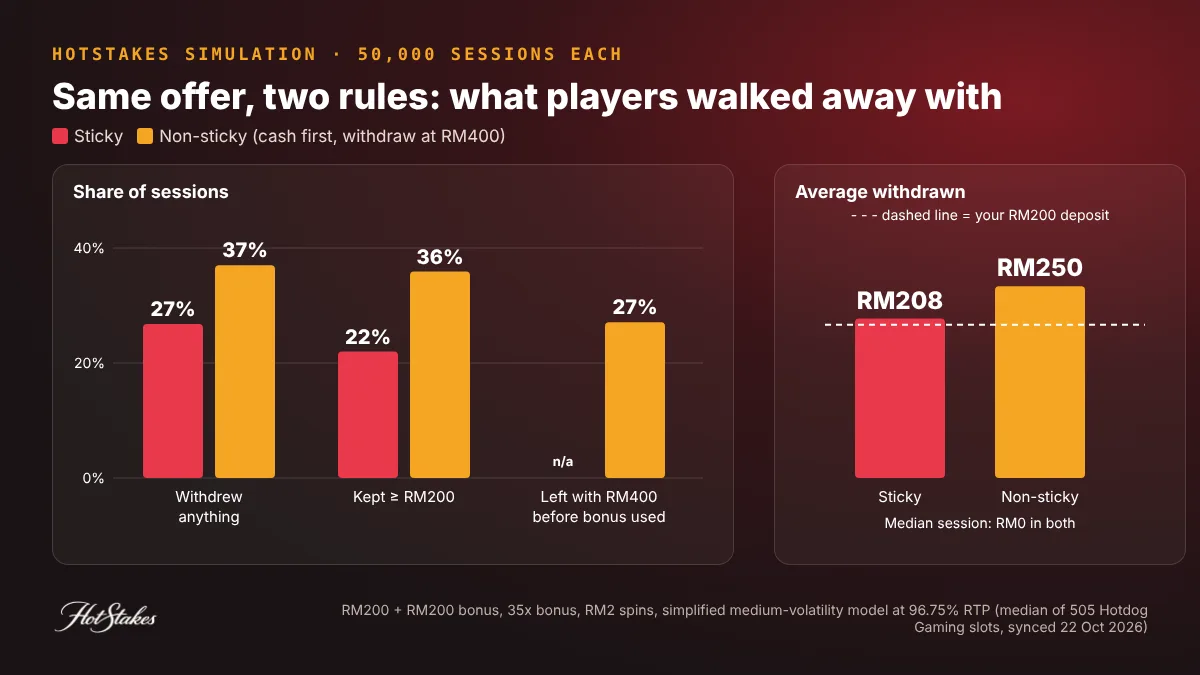
| Chance of withdrawing anything | 27% | 37% |
| Chance of leaving with at least your RM200 | 22% | 36% |
| Walk away with RM400 before the bonus is used | Not possible | 27% |
| Average amount withdrawn | RM208 | RM250 |
| Expected value vs your RM200 deposit | +RM8 | +RM50 |
| Typical (median) session | RM0 | RM0 |
What stands out:
- Non-sticky paid about RM42 more on average for the same headline offer. The averages are accurate to roughly ±RM2.
- The typical session still ends at zero in both. The averages are lifted by a minority of big wins.
- The sticky +RM8 is not a reason to claim. The formula says about −RM28. The simulation comes out higher only because you cannot lose more than your balance, and a few big hits carry the average.
- Your walk-away point barely changed the average. Cashing out at RM300 raised the chance of leaving with something to 48%; waiting for RM600 cut it to 27%. The average stayed between RM244 and RM250.
Same test, lower volatility
Volatility changes the picture, so we reran it with a low-volatility model (top win 50x). Both versions now lose money on average: sticky averaged RM97 back (−RM103), non-sticky RM152 (−RM48). Steadier games let more sticky players finish the wagering, which means paying the full house edge and then losing the bonus anyway. Our RTP vs volatility guide explains why short sessions swing so much.
On a 94% RTP slot (medium model), sticky dropped to RM140 back on average and non-sticky to RM196.
Takeaway: In every version we ran, non-sticky beat sticky by roughly RM40 to RM56 on a RM200 bonus. Neither turns a slot into a winning bet.
How to spot each type in the terms
Casinos rarely print the word “sticky”. You have to read the mechanics. The example below is invented, but the phrases are the kind you will meet.
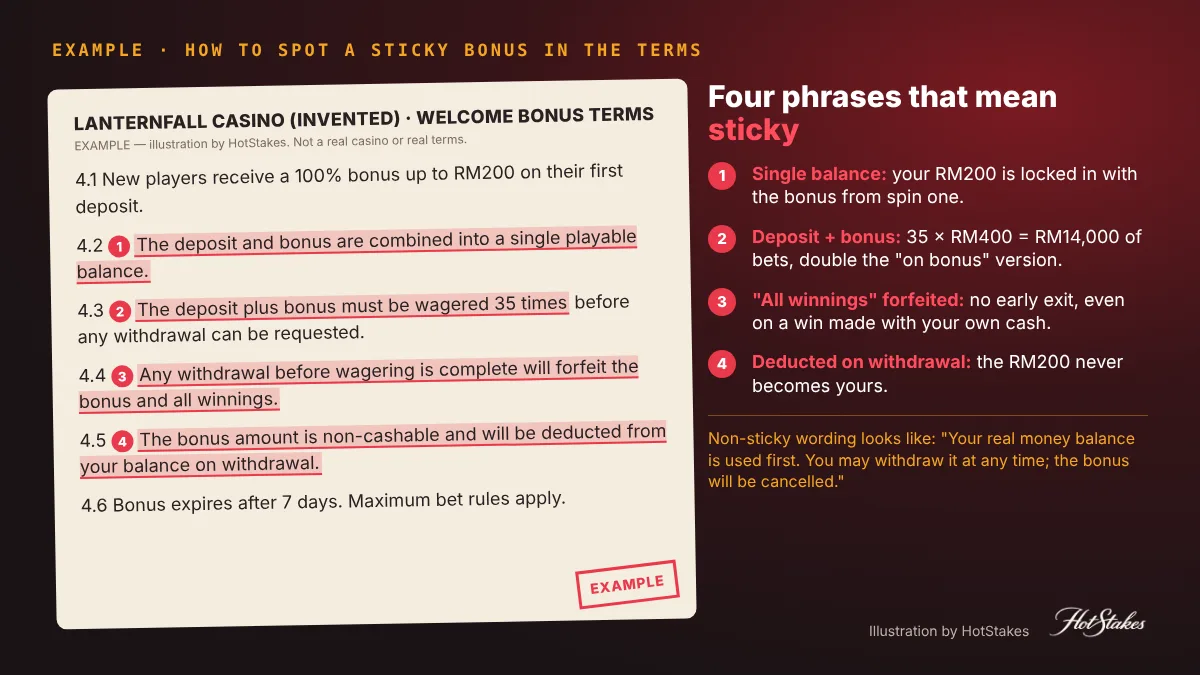
Phrases that point to sticky:
- “The bonus amount is non-cashable and will be deducted on withdrawal.”
- “Bonus and deposit are combined into a single balance.”
- “Withdrawing before wagering is complete forfeits the bonus and any winnings.”
Phrases that point to non-sticky:
- “Your real money balance is used first.”
- “You may withdraw your cash balance at any time; the bonus will be cancelled.”
- “Bonus funds become real money once wagering is complete.”
Watch for hybrids. Some non-sticky offers make wagering count on deposit + bonus, or cap what the bonus can pay out. A bonus with no deposit at all, like a no deposit bonus or free spins with wagering, has no cash wallet to protect, so this question matters less there.
Takeaway: If “winnings” are forfeited along with the bonus when you withdraw early, treat the offer as sticky, whatever it is called.
What regulators say about your deposit
Great Britain has settled this question by rule. Those rules do not bind casinos serving Asia, but they show what regulators consider fair.
- Your deposit must stay withdrawable. The Gambling Commission’s guidance says players must be able to withdraw their deposit balance “at any time, including when a bonus is pending or active”. It adds that wagering requirements “must not apply when a player is playing with their deposit balance” (Gambling Commission).
- No single pot. The same guidance says deposit and bonus funds “must not be mixed together or displayed to the player as a single pot”. That rules out the classic sticky design.
- It began with the competition watchdog. After an investigation that opened in 2016, the Competition and Markets Authority secured undertakings in February 2018 from Ladbrokes, William Hill and PT Entertainment, so that players “won’t be required to play multiple times before they can withdraw their own money” (CMA). BGO’s undertakings put it in contract form: allow consumers “to withdraw their Deposit Balance at any time” (BGO undertakings, PDF). The full timeline is on the CMA case page.
- A 10x cap and no mixed-product offers. Since 19 January 2026, the Commission has limited wagering requirements to ten times and banned promotions that mix gambling products. Code 5.1.1 lists betting, casino, bingo and lottery as separate types. Our 35x example would not be allowed there.
- “Free” has to mean free. UK advertising guidance says marketers “should not describe an offer as ‘free'” if you must risk your own money to qualify, and wagering requirements count as significant conditions to show clearly (ASA/CAP).
Casinos that market bonuses to players in Malaysia and Singapore are not bound by these UK rules. If a site’s terms say your deposit is locked, no UK regulator will step in, so the terms are your only protection.
Takeaway: A UK-licensed casino must play your deposit as free cash. Use that as your benchmark everywhere else.
Three questions to ask before you claim
- Which money is used first, mine or the bonus? If the answer is “one combined balance”, it is sticky.
- Can I withdraw my deposit and what I win with it before the wagering is done? And if I do, do I lose only the bonus, or my winnings too?
- Is the bonus removed when I cash out, and is wagering on the bonus only or on deposit + bonus? Then multiply the required bets by the house edge.
If support cannot answer all three clearly in writing, skip the offer. Comparing ringgit sites? Our MYR casino page and operator list show current offers. Terms change, so ask these three questions each time.
If you claim bonuses to chase losses, or deposit because an offer arrived, that is a signal to pause. In Singapore, NCPG’s helpline is 1800-6-668-668.
Takeaway: Declining a bonus is always an option, and a sticky one is often worth declining.
FAQ
What is a sticky bonus?
A sticky bonus is bonus money combined with your deposit in one balance. You can bet with it, but you can never withdraw it: the bonus amount is deducted when you cash out, and nothing is withdrawable until the wagering is finished.
What is the difference between a sticky and a non-sticky bonus?
With a non-sticky bonus your own cash is played first and can be withdrawn at any time (the bonus is cancelled). The bonus only activates if your cash runs out, and it can become real money after wagering. With a sticky bonus both are locked together and the bonus is removed at cash-out.
Is a non-sticky bonus better?
Usually, yes. In our simulation of a RM200 + RM200 offer at 35x on a 96.75% RTP slot model, the non-sticky version paid back about RM42 more on average and let 27% of players leave with RM400 before using the bonus.
Can I withdraw my winnings before finishing the wagering?
With a non-sticky bonus, you can usually withdraw your cash balance, including winnings from it, and give up the bonus. With a sticky bonus, you normally cannot withdraw anything until the wagering is complete.
What is a phantom or parachute bonus?
“Phantom” usually means a sticky bonus: it disappears from your balance when you withdraw. “Parachute” usually means non-sticky: the bonus only opens up if your cash runs out. Sites use these names loosely, so read the terms.
HotStakes is an independent directory. Some links on this site are affiliate links; we may earn a commission at no cost to you, and it never changes our rankings. Gambling involves risk — only play with money you can afford to lose, and if it stops being fun, seek help. This article is general information, not legal advice. Read our full disclaimer.
 Next story →Sic Bo House Edge: Every Bet Ranked, 2.78% to 47%


Start the discussion