

RTP vs Volatility Explained: What 399 Slots Show
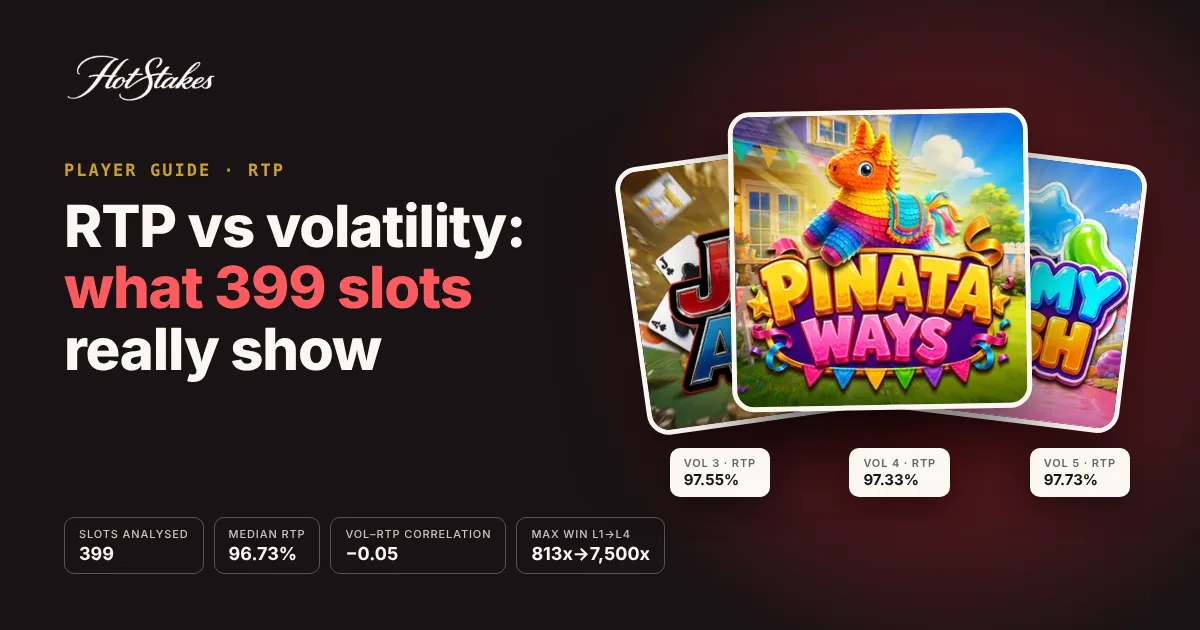
RTP vs volatility explained with data from 399 Hotdog Gaming slots: why RTP barely changes with volatility, but max win and session swings do.
In this article
RTP tells you how much a slot pays back on average over millions of spins; volatility tells you how unevenly it pays it back along the way. Two slots can share the same RTP and still feel completely different, because volatility, not RTP, decides whether your session is a slow drip of small wins or long dry spells broken by one big hit. HotStakes ran the numbers on 399 Hotdog Gaming slots to show how the two actually relate.
What RTP actually measures
Return to player (RTP) is the share of all money staked that a game is designed to pay back as winnings. A 96.73% RTP means that, across an enormous number of spins, the game returns about 96.73 units for every 100 staked and keeps 3.27 as house edge. The UK Gambling Commission puts it bluntly in its player guide to return to player: RTP “is an average achieved over a significant number of game plays and not each time the gaming machine is played.”
Regulators treat it as a theoretical number. The Commission’s remote technical standard RTS 3 asks operators to show “the average theoretical return to player percentage” before a customer gambles. It is a design target, not a promise about tonight.
Takeaway: RTP is the long-run price of playing, about what the game keeps on average, and says almost nothing about one session.
What volatility measures
Volatility (also called variance) describes how widely results swing around that average. A low-volatility slot hands back its RTP through frequent small wins. A high-volatility slot hands back the same RTP through rare, large wins, so most sessions run below average and a few run far above it.
This is not marketing language. A UNLV Gaming Research & Review Journal study by Lucas, Singh and Gewali simulated 50,000 players per game on six slots with the same par (house edge) and different pay-table standard deviations. Higher standard deviation produced fewer pulls before a losing player went broke, which the authors call “a crucial determinant of a slot player’s experience.” Regulators agree it matters: the UK Commission’s guidance on live RTP monitoring says volatility “will be a key parameter” when setting how far a game’s measured RTP may drift before alarms go off.
Takeaway: same RTP, higher volatility means a shorter, bumpier ride for the same budget.
Same RTP, different ride: a worked example
To isolate volatility, picture three made-up games, each with exactly 96% RTP and a 1-unit stake, played for 200 spins. Each one returns 192 units on average. The only difference is how the payout is packaged:
- Game A (low volatility): pays 2x with a 48% chance per spin. Over 200 spins, the chance of never winning is effectively zero.
- Game B (high volatility): pays 100x with a 0.96% chance. The chance of 200 spins with no win at all is about 14.5%.
- Game C (extreme volatility): pays 1,000x with a 0.096% chance. The chance of 200 straight losing spins is about 82.5%.
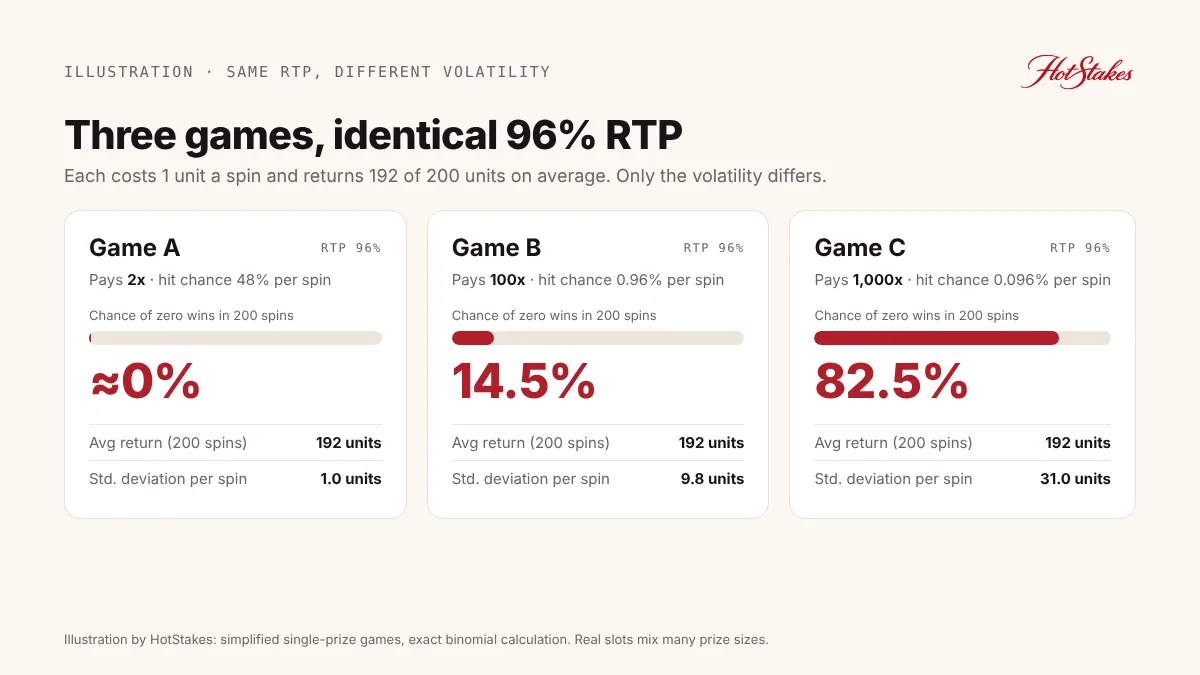
Same RTP, same expected loss of 8 units, wildly different experiences. Game C’s standard deviation per spin is about 31 units versus 1 unit for Game A. These are simplified single-prize games for illustration (HotStakes’ own calculation); real slots mix hundreds of outcomes, but the principle holds.
Takeaway: RTP sets the average; volatility sets how likely you are to actually see it in a short session.
What 399 Hotdog Gaming slots show
HotStakes analysed the Hotdog Gaming game sheet behind our slot directory and Top 30 slots rankings (synced 19 October 2026). It lists 399 slots, each with a volatility rating from 1 (low) to 5 (high). For 380 of them the sheet gives a single fixed RTP; the other 19 list a variable range.
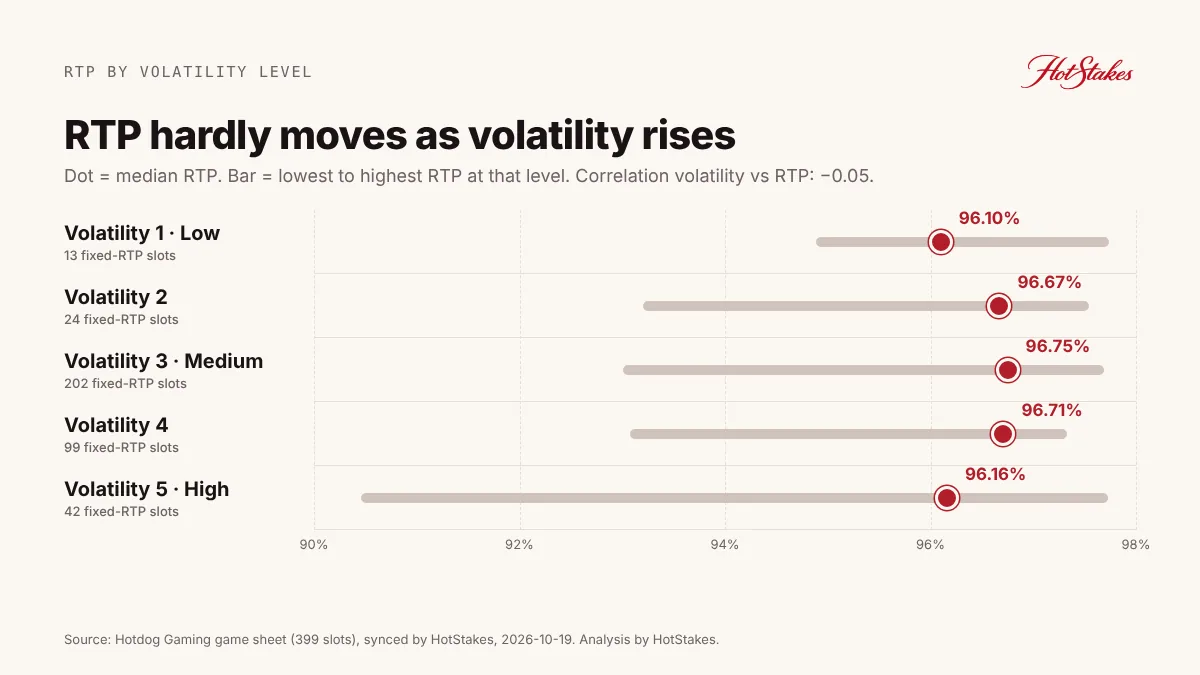
| Volatility (1–5) | Slots | Median RTP* | Median max win | Max win ≥ 10,000x |
|---|---|---|---|---|
| 1 (low) | 23 | 96.10% | 813x | 0 of 23 |
| 2 | 25 | 96.67% | 1,600x | 3 of 25 |
| 3 (medium) | 208 | 96.75% | 3,913x | 31 of 193 |
| 4 | 101 | 96.71% | 7,500x | 38 of 101 |
| 5 (high) | 42 | 96.16% | 5,572x | 17 of 42 |
*Median of slots with a single fixed RTP (380 of 399). Max win counts only slots that list one. Source: Hotdog Gaming game sheet, synced by HotStakes, 19 October 2026.
Three findings stand out:
- RTP barely moves with volatility. Medians sit between 96.10% and 96.75% at every level, and the statistical correlation between volatility and RTP across the 380 fixed-RTP slots is effectively zero (−0.05). A high-volatility slot is not “paying for” its excitement with a lower RTP, and a low-volatility one is not more generous.
- Max win climbs with volatility, but not neatly. The median cap rises from 813x at level 1 to 7,500x at level 4, then dips to about 5,572x at level 5, where many games are capped at 5,000x. None of the 23 level-1 slots offers 10,000x or more.
- The spread inside each level is huge. Level-3 slots range from 93.01% to 97.69% RTP. Knowing the volatility tells you nothing about which end of that range you are on.
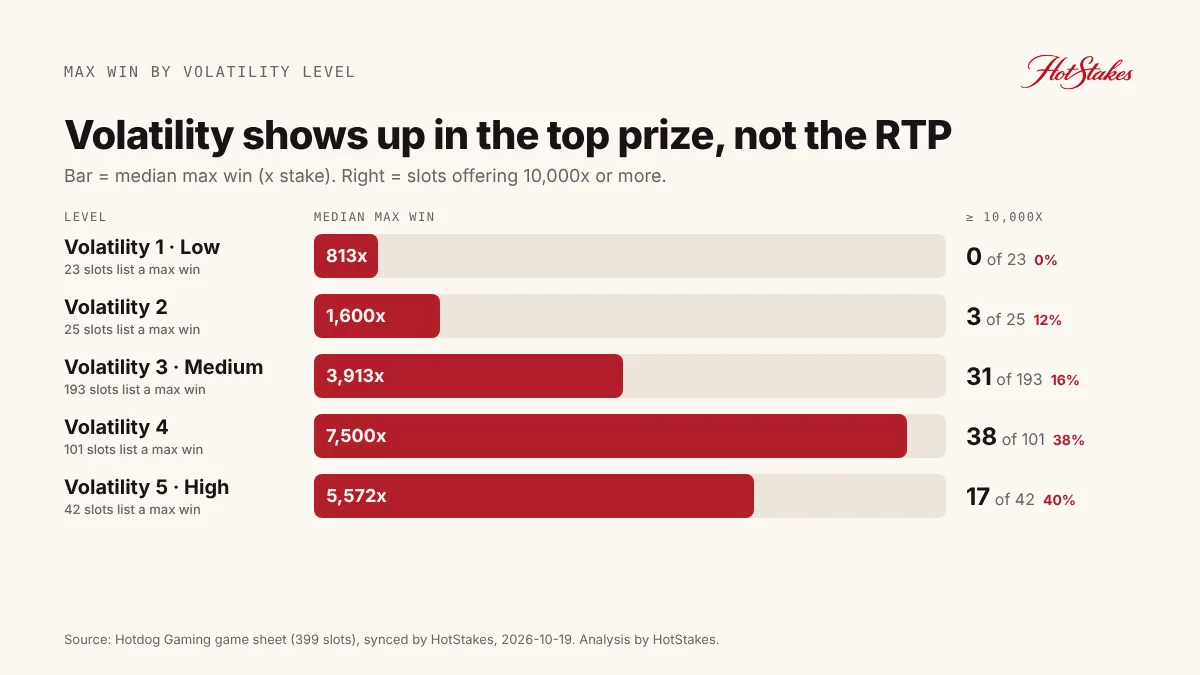
Takeaway: in this catalogue, volatility predicts the size of the top prize far better than it predicts RTP, so always check both numbers separately.
Similar RTP, different volatility: real examples
These five Hotdog Gaming slots all sit within about 0.4 percentage points of each other on RTP, yet they span the whole volatility scale.
| Slot | RTP | Volatility | Max win | What to expect |
|---|---|---|---|---|
| Super Road Machine | 97.62% | 1 / 5 | 104x | Frequent small returns, low ceiling |
| Witch’s Pact | 97.54% | 2 / 5 | 322x | Steady play, modest top prize |
| JQK Ace Ways | 97.55% | 3 / 5 | 2,404x | Balanced cascade slot |
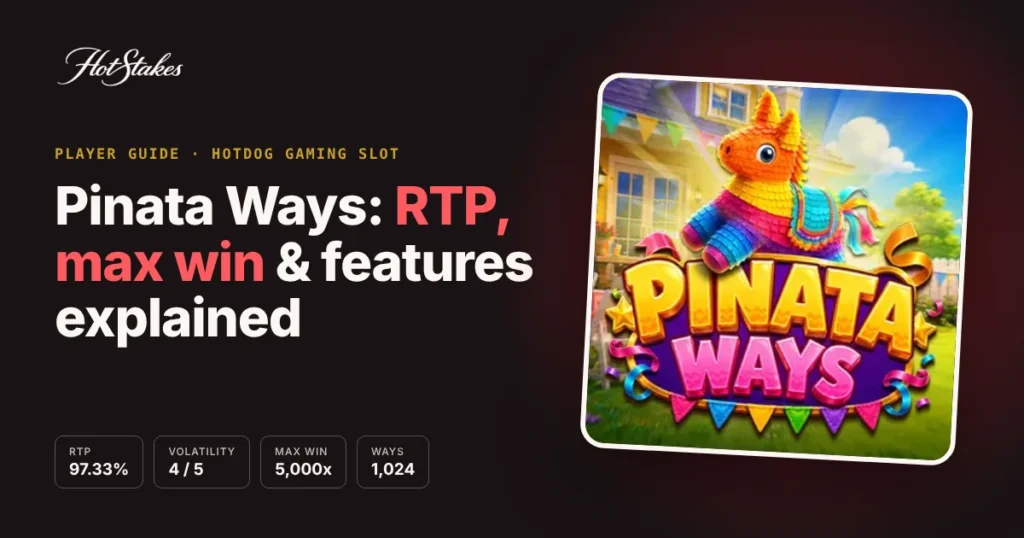
| Pinata Ways | 97.33% | 4 / 5 | 5,000x | Longer dry spells, multiplier-driven peaks |
| Gummy Rush | 97.73% | 5 / 5 | 5,000x | Highest volatility, most swing |
Source: Hotdog Gaming game sheet, synced by HotStakes, 19 October 2026. For the full breakdown of one of these games, see our Pinata Ways RTP and features guide.
Takeaway: if you want more time per ringgit or baht, pick by volatility; RTP alone will not separate these games.
What players in our rankings actually pick
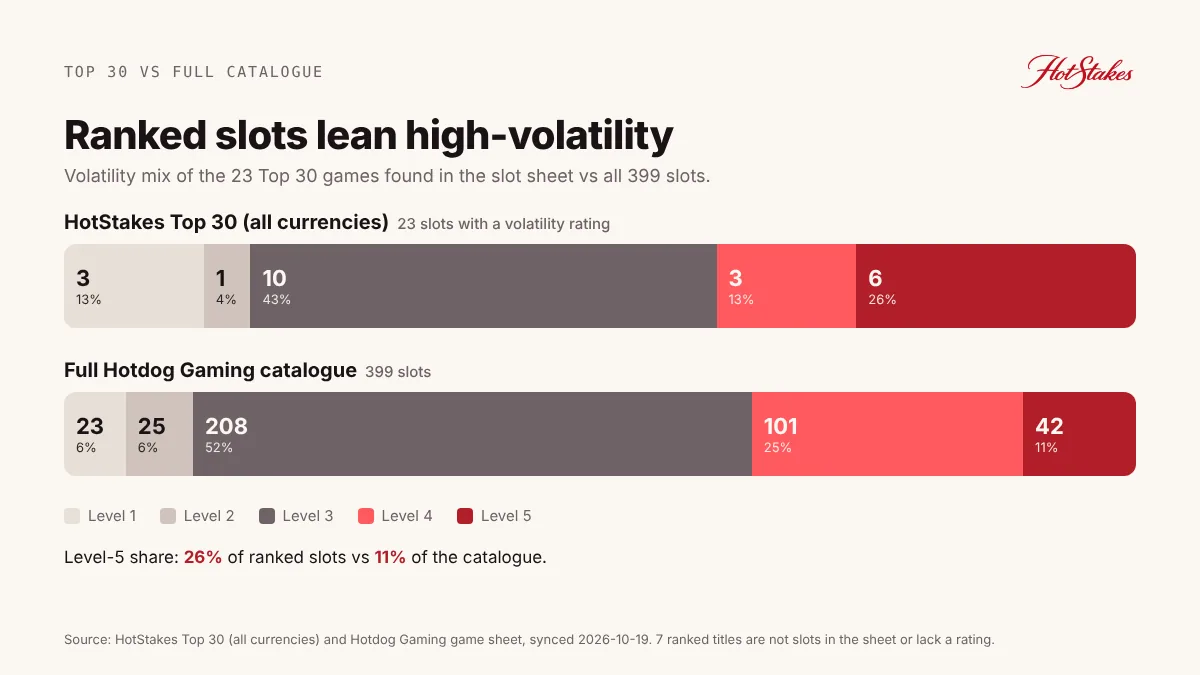
Of the 30 games in the all-currency Top 30, 23 appear in the slot sheet with a volatility rating. Ten of those 23 are level 3 and six are level 5, so high-volatility games are over-represented: level 5 is 26% of the ranked slots against 11% of the full catalogue. Their median fixed RTP is 97.5%, above the catalogue median of 96.73%.
One more trap: 19 slots, including Black Myth: Wukong (94.13%–97.37%), are listed with a variable RTP range rather than one figure. The range alone cannot tell you which setting you are playing; the in-game info or paytable screen at your site can.
Takeaway: popular is not the same as low risk, and on variable-RTP games, check the exact figure where you play.
How to use RTP and volatility together
- Check the RTP in the game’s own info screen, not a review, especially on titles listed with a variable RTP. Higher is cheaper over time.
- Match volatility to your budget. Small budget, long session: stay at levels 1–3. Level 4–5 games need a bankroll that can survive long dry runs.
- Read the max win as a ceiling, not a target. A 5,000x cap is reachable in theory and rare in practice.
- Set a loss limit before you start. No combination of RTP and volatility changes the fact that the house edge works against you over time.
Compare RTP, volatility and max win for every ranked title on our MYR slot rankings or browse the full list in the slot directory. If table games are more your speed, our baccarat house edge explainer shows how the same maths applies live.
FAQ
Is a higher RTP always better?
Over a long period, yes: a higher RTP means a lower average cost per spin. Over one session, volatility usually matters more to what you actually experience.
Does high volatility mean a lower RTP?
Not in this data. Across 380 Hotdog Gaming slots with fixed RTPs, the median RTP is between 96.10% and 96.75% at every volatility level, and the correlation between the two is close to zero.
Can I tell volatility from the paytable?
Partly. A very high max win and rare features are signs of high volatility, but the provider’s rating is the clearer guide. Hotdog Gaming rates every slot from 1 to 5.
Does RTP change while I play?
The configured RTP does not change mid-session, but your actual return will swing around it. The UK Gambling Commission notes RTP is an average over many game plays, not each play.
HotStakes is an independent directory. Some links on this site are affiliate links; we may earn a commission at no cost to you, and it never changes our rankings. Gambling involves risk — only play with money you can afford to lose, and if it stops being fun, seek help.
 Next story →Southeast Asia Scam Compounds: Scale, Trafficking, Crackdown


Start the discussion