

Dragon Tiger House Edge: Why Every Table Says 3.73%
Dragon Tiger's 3.73% house edge comes from one tie rule. We do the maths, compare baccarat, sic bo and roulette, and price an hour of play.
In this article
- Where the 3.73% comes from: one rule about ties
- What our five StakeGO Dragon Tiger tables say
- The Tie and Suited Tie bets: where the edge gets big
- Dragon Tiger vs baccarat, sic bo and roulette
- The real cost is speed: expected loss per hour
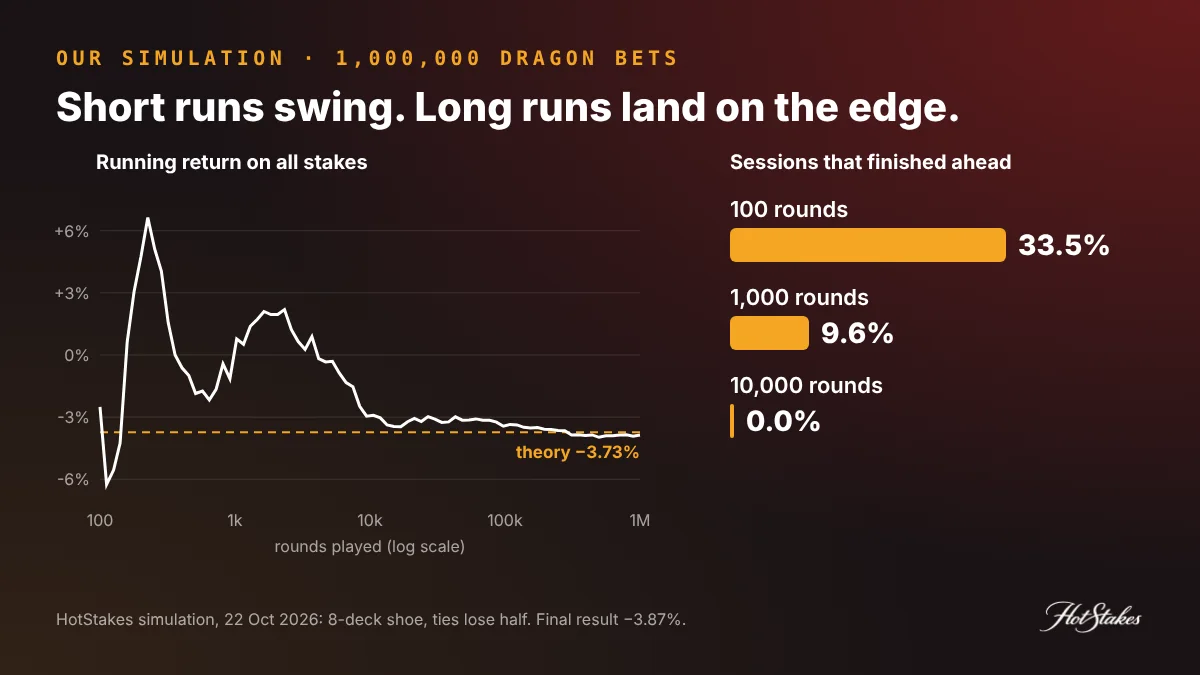
- What 1,000,000 simulated rounds look like
- No betting system changes the edge
- FAQ
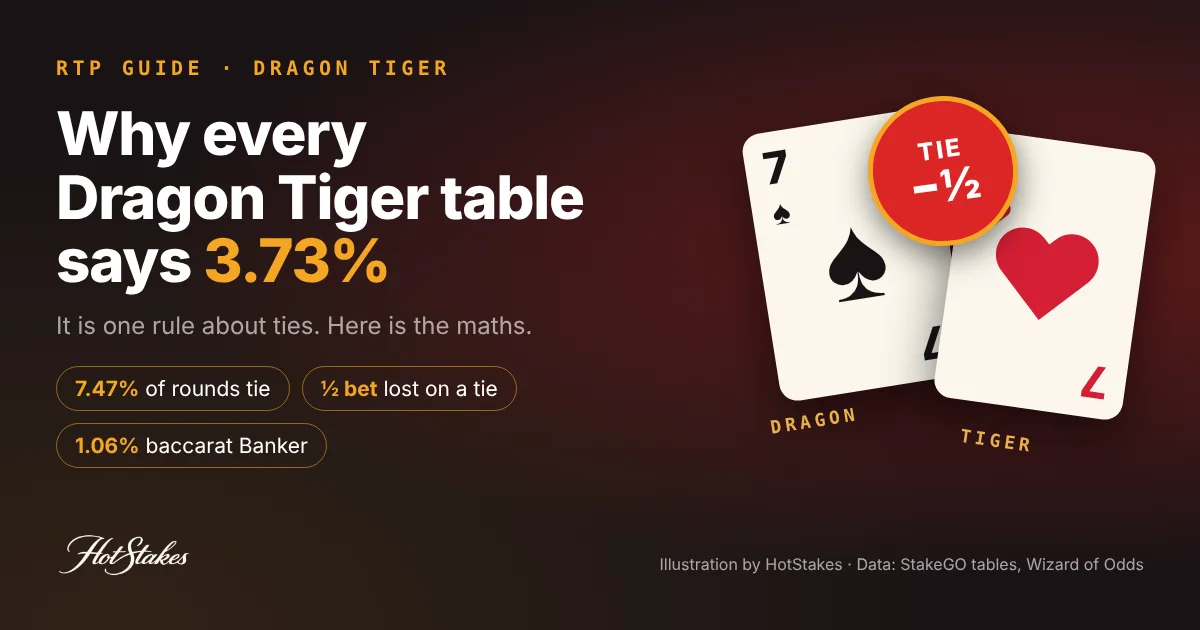
Dragon Tiger looks like a coin flip: one card each, high card wins, even money. It is not quite a coin flip. The Dragon Tiger house edge is 3.73% because about 7.47% of rounds end in a tie, and on a tie your Dragon or Tiger bet loses half. That one rule explains every 3.73% in our data. Below we do the maths ourselves, check it against the tables’ own rule sheets, compare it with baccarat, sic bo and roulette, and price what it costs per hour.
Where the 3.73% comes from: one rule about ties
The game is simple. One card goes to the Dragon, one to the Tiger. Ace is low, King is high, suits do not matter for the main bet. If you back the higher card, you win even money.
The catch is the tie. Here is the full derivation, using the rules analysed by Wizard of Odds and confirmed on our tables’ rule sheets: eight 52-card decks, and half the main bet lost on a tie.
Step 1: how often a tie happens
- The shoe: 8 decks × 52 cards = 416 cards. Each rank (say, the 7) appears 32 times.
- First card: whatever it is, 415 cards remain.
- Second card: only 31 of those 415 share its rank.
- So P(tie) = 31 ÷ 415 = 7.47%. Counting every ordered pair gives the same thing: 12,896 tie pairs out of 172,640.
- The rest splits evenly: Dragon wins 192 ÷ 415 = 46.27%, Tiger wins 46.27%.
Step 2: what the tie does to your Dragon bet
Bet 1 unit on Dragon. Multiply each outcome by its chance and add them up:
- Win (46.27%): +1 unit → +0.4627
- Lose (46.27%): −1 unit → −0.4627
- Tie (7.47%): −0.5 unit → −0.0373
The wins and losses cancel out exactly. All that is left is the tie: −0.5 × 31/415 = −3.735%. Wizard of Odds gets the same figure from its own combination table (house edge 3.73%).
That makes the edge easy to sanity-check. It is always half the tie probability. If a table took your whole bet on a tie, the edge would double to 7.47%.
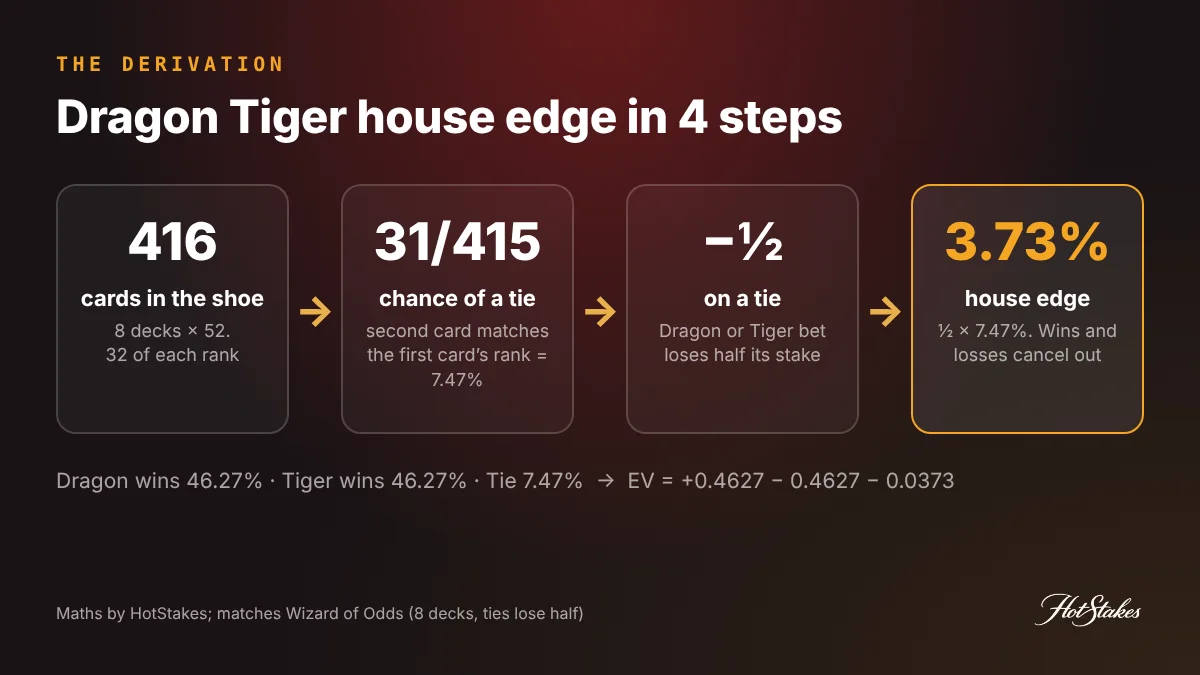
Takeaway: Dragon and Tiger are perfectly balanced against each other. The house earns its 3.73% entirely from the tie rule.
What our five StakeGO Dragon Tiger tables say
HotStakes keeps a dataset of 55 StakeGO live tables (last synced 20 Oct 2026). Every Dragon Tiger table in it lists the same edge:
| Table | Studio | Listed edge | Test cert in our data |
|---|---|---|---|
| Dragon Tiger MD01 | Bulgaria | 3.73% | GLI |
| Blaze Dragon Tiger WD01 | Poland | 3.73% | Not listed |
| Prime Dragon Tiger WD03 | Poland | 3.73% | Not listed |
| Legend Dragon Tiger WD31 | Poland | 3.73% | Not listed |
| Valor Dragon Tiger VD01 | Georgia | 3.73% | Not listed |
We also opened the rule sheets linked from two of these listings on 22 Oct 2026, for MD01 and WD01. Both say the same things:
- Cards come from an 8-deck shoe.
- On a tie, you lose half of a Dragon or Tiger bet (WD01: “half your main bet … is returned”).
- Tie pays 11:1 and Suited Tie pays 50:1.
- Stated RTPs: 96.27% for Dragon or Tiger, 89.64% for Tie, 86.02% for Suited Tie.
96.27% RTP is just 100% minus 3.73%. The rule sheets, our data and the maths all agree. “Not listed” in the cert column means our data has no lab named for that table, not that the table failed a test.
Takeaway: Same rules, same edge, at all five tables. The studio or dealer does not change the 3.73%.
The Tie and Suited Tie bets: where the edge gets big
The Tie bet wins only 7.47% of the time. To be a fair bet it would need to pay about 12.4 to 1 (415 ÷ 31 − 1). Every common paytable pays less, and each step down costs you about 7.5 percentage points:
| Bet | Pays | Win chance | House edge |
|---|---|---|---|
| Dragon or Tiger | 1:1, half lost on tie | 46.27% | 3.73% |
| Tie (our tables) | 11:1 | 7.47% | 10.36% |
| Tie (other studios) | 10:1 | 7.47% | 17.83% |
| Tie (common elsewhere) | 8:1 | 7.47% | 32.77% |
| Suited Tie (our tables) | 50:1 | 1.69% | 13.98% |
| Big/Small side bet (7 loses) | 1:1 | 46.15% | 7.69% |
The working for the two tie bets on our tables:
- Tie at 11:1: 12 × 31/415 − 1 = −43/415 = −10.36%.
- Suited Tie at 50:1: the second card must match rank and suit, and 7 of the 415 cards do. 51 × 7/415 − 1 = −58/415 = −13.98%.
Paytable assumption: these figures use the 11:1 and 50:1 payouts printed on the MD01 and WD01 rule sheets. The 8:1 and 10:1 rows come from Wizard of Odds’ provider comparison. Always read the paytable on the table you actually play.
Takeaway: On our tables the Tie costs nearly three times what the main bet costs. At an 8:1 table it costs almost nine times as much.
Dragon Tiger vs baccarat, sic bo and roulette
A 3.73% edge sounds small. Next to the other big live-casino games in our data, it is not.
| Game and bet | House edge | Expected loss per 100 bets of 10 units |
|---|---|---|
| Baccarat, Banker | 1.06% | 10.6 units |
| Baccarat, Player | 1.24% | 12.4 units |
| European roulette, any even-money bet | 2.70% | 27.0 units |
| Sic bo, Big or Small | 2.78% | 27.8 units |
| Dragon Tiger, Dragon or Tiger | 3.73% | 37.3 units |
| Dragon Tiger, Tie at 11:1 | 10.36% | 103.6 units |
Where these come from:
- Baccarat: our StakeGO baccarat and speed baccarat tables list 1.06–1.24%. That matches Banker 1.06% and Player 1.24% on the Wizard of Odds house edge table.
- Sic bo: our two sic bo tables list 2.78%. That is the Big/Small edge, which loses on any triple (Wizard of Odds, sic bo).
- Roulette: our single-zero tables list 2.7%, the standard European figure. Some VR-series roulette tables list 2.9% for certain bet modes, so check the table page.
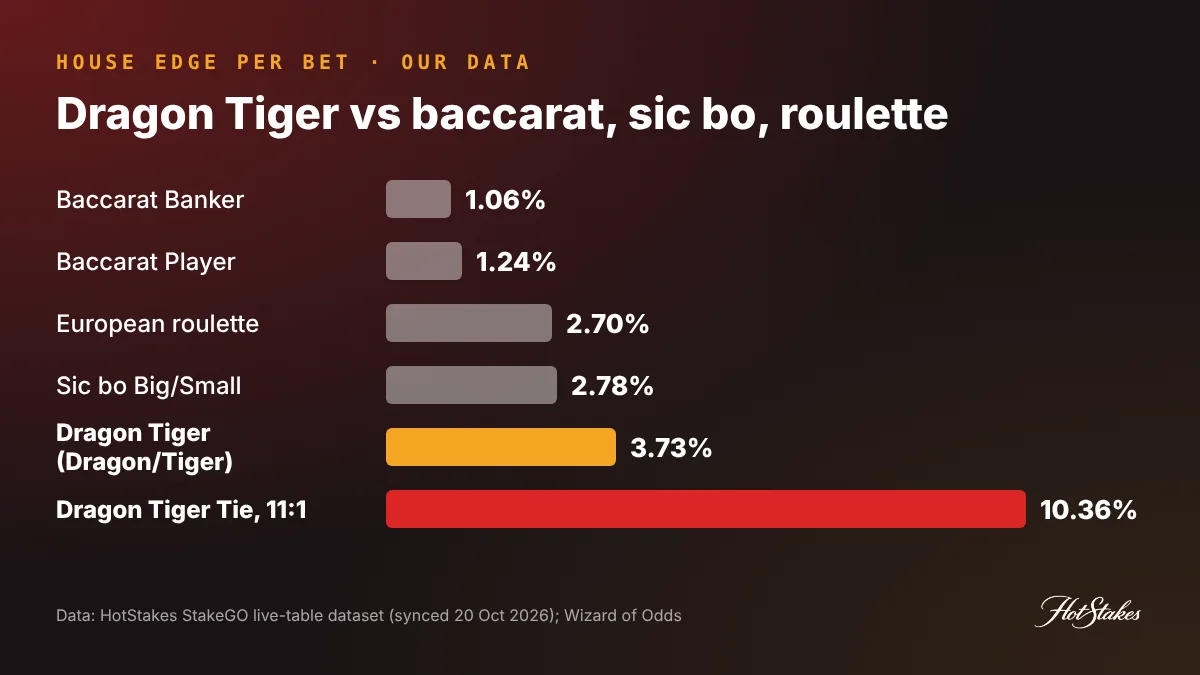
The two games look alike, but they price ties very differently. Baccarat Banker and Player bets push on a tie: you get your whole stake back. Dragon Tiger keeps half. That single difference is most of the gap between 1.06% and 3.73%. For the bigger picture of why every edge is positive, see why the house always wins.
Takeaway: Per bet, Dragon Tiger costs about 3.5 times the baccarat Banker bet and more than roulette or sic bo even-money bets.
The real cost is speed: expected loss per hour
House edge is a cost per bet. What you actually lose depends on how many bets you make. Dragon Tiger is built for speed: one card each, no drawing rules, a result in seconds.
| Game and bet (10 units a round) | Rounds per hour (assumed) | Expected loss per hour |
|---|---|---|
| Baccarat, Banker (1.06%) | 60 | 6.4 units |
| Baccarat, Player (1.24%) | 60 | 7.4 units |
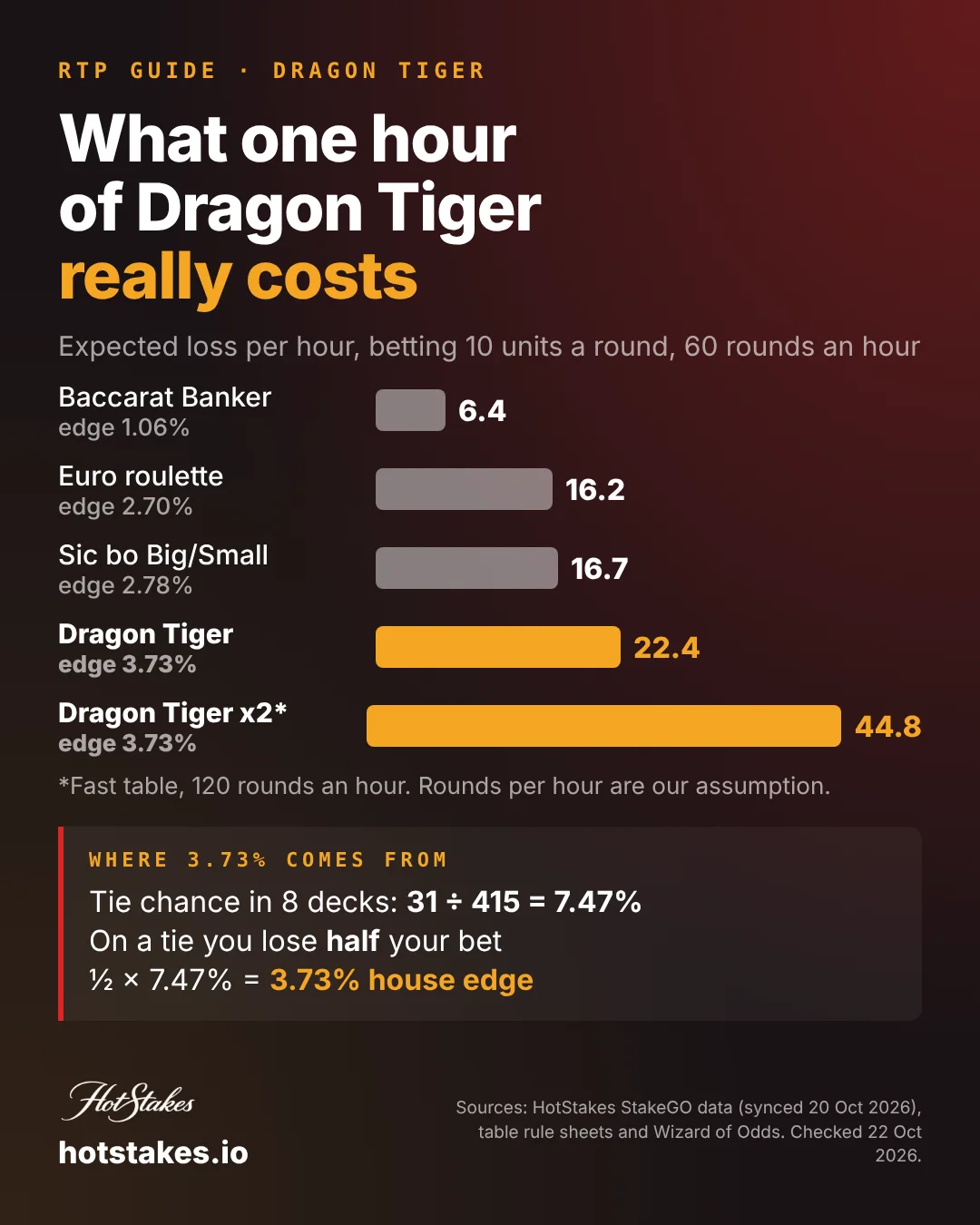
| European roulette (2.70%) | 60 | 16.2 units |
| Sic bo, Big/Small (2.78%) | 60 | 16.7 units |
| Dragon Tiger, Dragon (3.73%) | 60 | 22.4 units |
| Dragon Tiger, Dragon (3.73%) | 120 | 44.8 units |
| Dragon Tiger, Tie at 11:1 (10.36%) | 60 | 62.2 units |
If one Dragon Tiger table deals twice as many rounds an hour as your baccarat table, your expected hourly loss is about 7 times higher (44.8 vs 6.4 units), on the same stake.
Our RTP calculator does this sum for any stake and RTP.
Takeaway: A fast game with a small edge can cost more than a slow game with a bigger one. Count rounds, not just percentages.
What 1,000,000 simulated rounds look like
An edge is a long-run average. To show how wide the short run is, we simulated 1,000,000 Dragon bets in Python on 22 Oct 2026. Each round drew two cards from a full 8-deck shoe (a simplification: a real shoe is dealt down), with ties losing half. This is our simulation, not casino data.
- Overall: the simulated player lost 3.87% of total stakes, close to the theoretical 3.73% (the gap is normal random noise at this sample size). Ties came up 7.47% of the time.
- 100-round sessions (10 units a bet): 33.5% finished ahead. The average session lost 39 units. The worst 5% lost 195 units or more; the best 5% won 120 or more.
- 1,000-round sessions: only 9.6% finished ahead.
- 10,000-round blocks: none of the 100 blocks finished ahead.
- The streak trap: after about 2,000 rounds the simulated player was still about 2% up. Over the next million rounds that lead disappeared.
This is the pattern a casino manager sees too. A paper in UNLV’s Gaming Research & Review Journal on baccarat volatility notes that, as decisions pile up, results move closer to the expected percentage, and that there is “no natural evening-up process” after a bad run. The same is true from the player’s side. The UK Gambling Commission makes the same point about RTP: it is an average over a large number of plays, not what you get back each time.
Our RTP vs volatility guide explains this spread in more detail.
Takeaway: One evening can go either way. Hundreds of hours cannot.
No betting system changes the edge
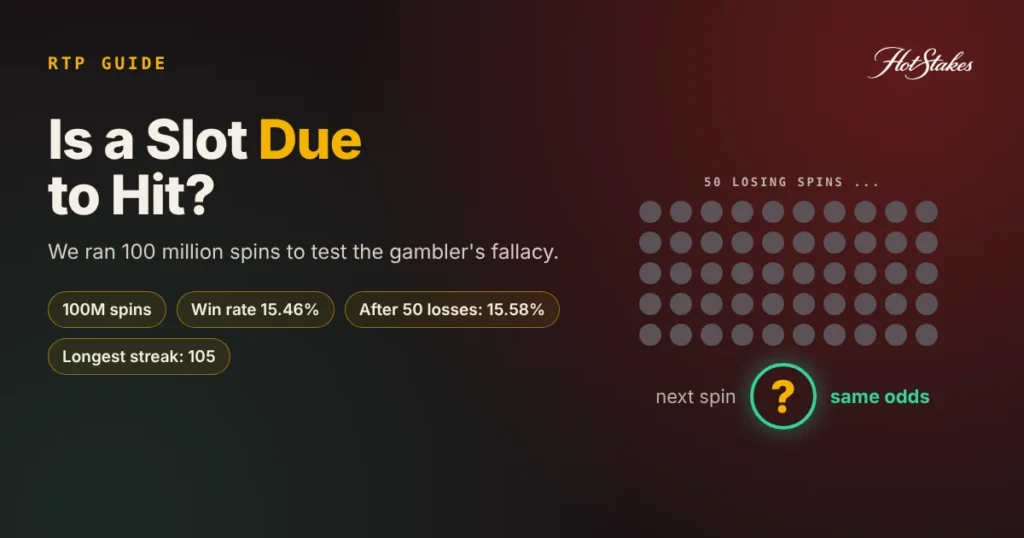
Dragon Tiger tables show “roads” of past results, and plenty of sites sell patterns built on them. The maths does not care. Each round’s 3.73% is fixed by the shoe and the tie rule. Strictly, cards already dealt nudge the next round’s odds by a tiny amount, but roads record who won, not which cards left the shoe, so they carry no meaningful information. Doubling after a loss, betting with streaks or against them, or skipping rounds only changes how much you stake. Every unit you stake on Dragon still carries a 3.73% expected cost. The same logic is behind our piece on why no game is ever “due”.
What you can control is the cost:
- Know which bet you are on. Dragon or Tiger at 3.73% costs far less than Tie at 10.36% or more.
- Check the paytable. Tie at 8:1 costs more than three times as much as Tie at 11:1.
- Set a round limit, not just a money limit. On a fast table, rounds add up quickly.
- Compare per hour. If you want the same evening for less, a lower-edge game at the same pace costs less.
- Stop if it stops being fun. In Singapore, the National Council on Problem Gambling helpline is 1800-6-668-668 (MHA). Malaysia has no national gambling helpline we could verify; the Health Ministry’s mental health support line is Talian HEAL 15555 (Bernama).
UK rules require casinos to show players “a players’ guide to the house edge” (Gambling Commission). Wherever you play, look for that figure before you sit down. If you are comparing licensed sites, our operator list is a place to start.
Takeaway: You cannot shrink the 3.73% with a system. You can only choose how many times you pay it.
FAQ
What is the house edge in Dragon Tiger?
3.73% on the Dragon or Tiger bet with 8 decks and ties losing half. All five StakeGO Dragon Tiger tables in our data list 3.73%, which matches the 96.27% RTP on their rule sheets.
Why do you lose half your bet on a tie in Dragon Tiger?
It is the rule that gives the house its edge. Dragon and Tiger win equally often, so without the tie rule the game would be even. Ties happen in about 7.47% of rounds, and losing half then costs 3.73% on average.
Is the Dragon Tiger Tie bet worth it?
It has a much higher edge than the main bet: 10.36% at 11:1 (our tables), 17.83% at 10:1 and 32.77% at 8:1. The Suited Tie at 50:1 has a 13.98% edge.
Is Dragon Tiger better odds than baccarat?
No. Baccarat Banker has a 1.06% edge and Player 1.24%, because baccarat main bets push on a tie. Dragon Tiger’s main bet is 3.73%, about 3.5 times the Banker edge.
Can a strategy or road pattern beat Dragon Tiger?
No. Road patterns record past winners, not the cards left in the shoe, and every unit staked on Dragon or Tiger carries the same 3.73% expected cost. Betting systems change your stake, not the edge.
HotStakes is an independent directory. Some links on this site are affiliate links; we may earn a commission at no cost to you, and it never changes our rankings. Gambling involves risk — only play with money you can afford to lose, and if it stops being fun, seek help. This article is general information, not legal advice.
 Next story →Fake Friend Call Scam: The “Guess Who” Script Exposed





Start the discussion