

Fake Slot Games: How to Check a Slot Is Genuine
Can a casino slot be a fake copy with changed odds? A 2-minute check, what lab seals really prove, and what no player can verify.
In this article
Yes, a fake slot game can exist: a copied game client running on a server its maker never approved, where the maths can be changed and no lab certificate applies. These pirated copies turn up mostly on unlicensed and grey-market sites. You can run a few useful checks in about two minutes: the casino’s licence, the game’s help screen, the RTP, where the game loads from, and whether any seal really leads somewhere. None of them proves a game is genuine. A properly licensed casino is the protection that actually works.
Below: how cloning works, a numbered 2-minute check, a “what you can verify vs what you can’t” table, and what we found when we tried to verify lab seals on 28 Oct 2026.
What a fake slot game actually is
Start with how a genuine game reaches you. As our series pillar on how slot games reach online casinos explains, a studio builds the game, a lab tests it, and the casino rents it, often through a middleman. The game’s results are decided on a remote server, not in your browser.
A pirated or cloned slot breaks that chain. Someone copies the part you see, the graphics, sounds and buttons, and connects it to their own server. That server decides every spin.
- The look is copied. Same symbols, same music, sometimes the same help text.
- The maths is not guaranteed. Whoever runs the server can set the payout rate however they like.
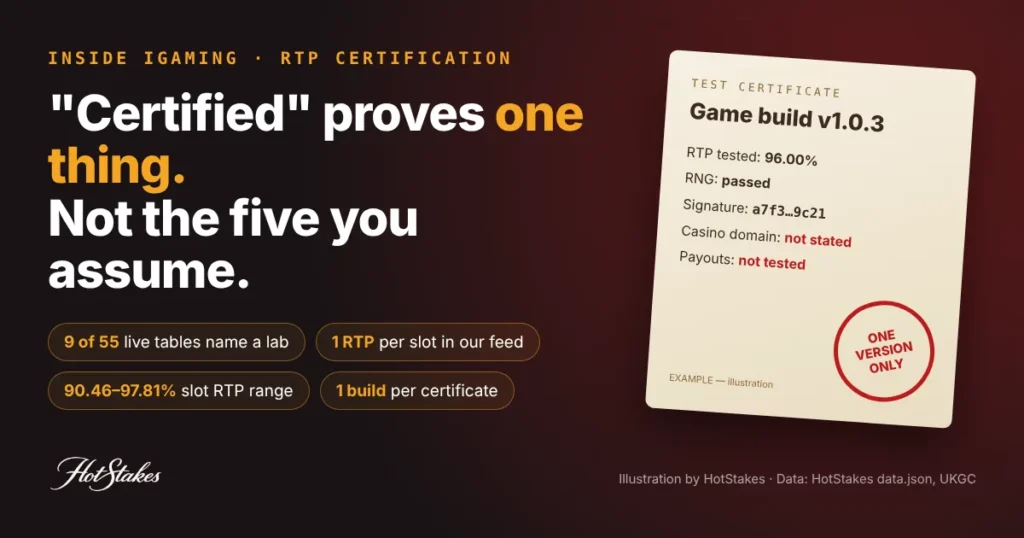
- No certificate covers it. A lab certifies a specific version from a specific owner. A copy served from an unknown server was never tested.
How common is it? Industry monitoring data reported by iGaming Business on 31 July 2026 put detected fake games at about 8,500 worldwide, with over 6,800 in Brazil alone. That is an industry figure, not a regulator’s, but the pattern is clear: fakes cluster in grey and unregulated markets.
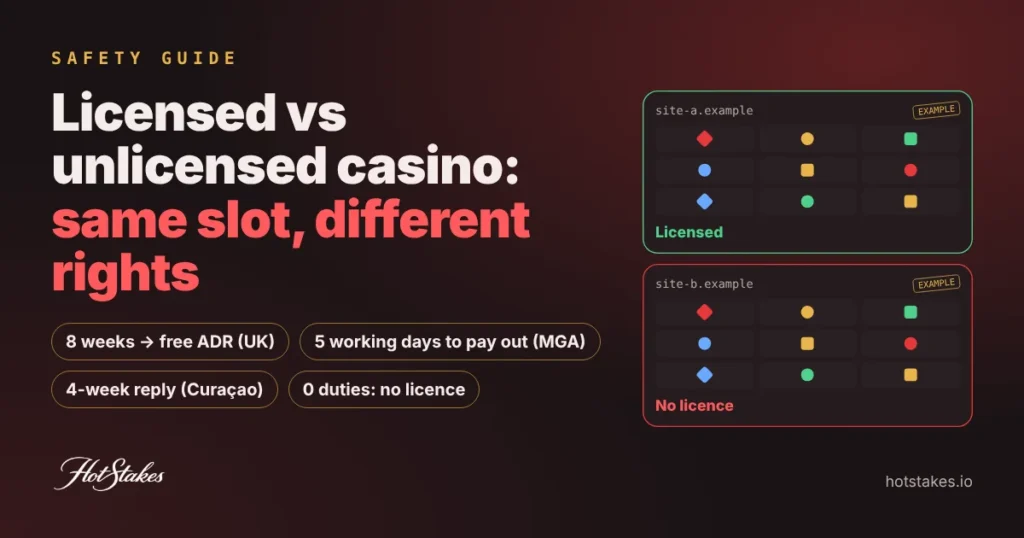
A related problem is genuine games leaking to illegal sites. In January 2025 the UK Gambling Commission warned that “third party resellers are distributing games supplied by operators to the illegal market“. Those are real games in the wrong place, not clones. Either way, the unlicensed site gives you no protection. Part 2 of this series, licensed vs unlicensed casino, covers what that means for your money.
Takeaway: a fake slot is a genuine-looking front end on an unchecked server. You see the front end. You never see the server.
What the rules say a genuine game needs
In regulated markets, a game must be tested before it goes live, and the result is on file with the regulator. Three examples:
- UK: the Gambling Commission’s testing strategy requires an approved third-party test house to check game maths and RNG “prior to release”. Results go into a games register, and “Game and RNG testing must be carried out by an approved Test House“. The Commission’s public list showed 14 approved test houses (as of 2 March 2026) when we read it.
- Ontario: games must be certified by an independent testing lab registered with the AGCO before they can be offered. The AGCO does not test igaming technology itself; it registers the labs.
- New Jersey: the Division of Gaming Enforcement publishes its internet gaming permit holders and states that “Any site not included on this list is NOT approved“.
These rules are enforced. In April 2023 the AGCO issued C$70,000 in monetary penalties to three licensed operators for allegedly offering games not approved by the Registrar or certified by a registered lab, in one case from unregistered suppliers. A regulator noticed uncertified games. On an unlicensed site, nobody is looking.
Our explainer on what slot RTP certification really proves goes deeper on what labs test.
Takeaway: “genuine” means the tested version, from a known supplier, served from an approved system. Only a regulator can see all three.
Is this slot genuine? The 2-minute check
Do these in order. Stop at the first serious red flag.
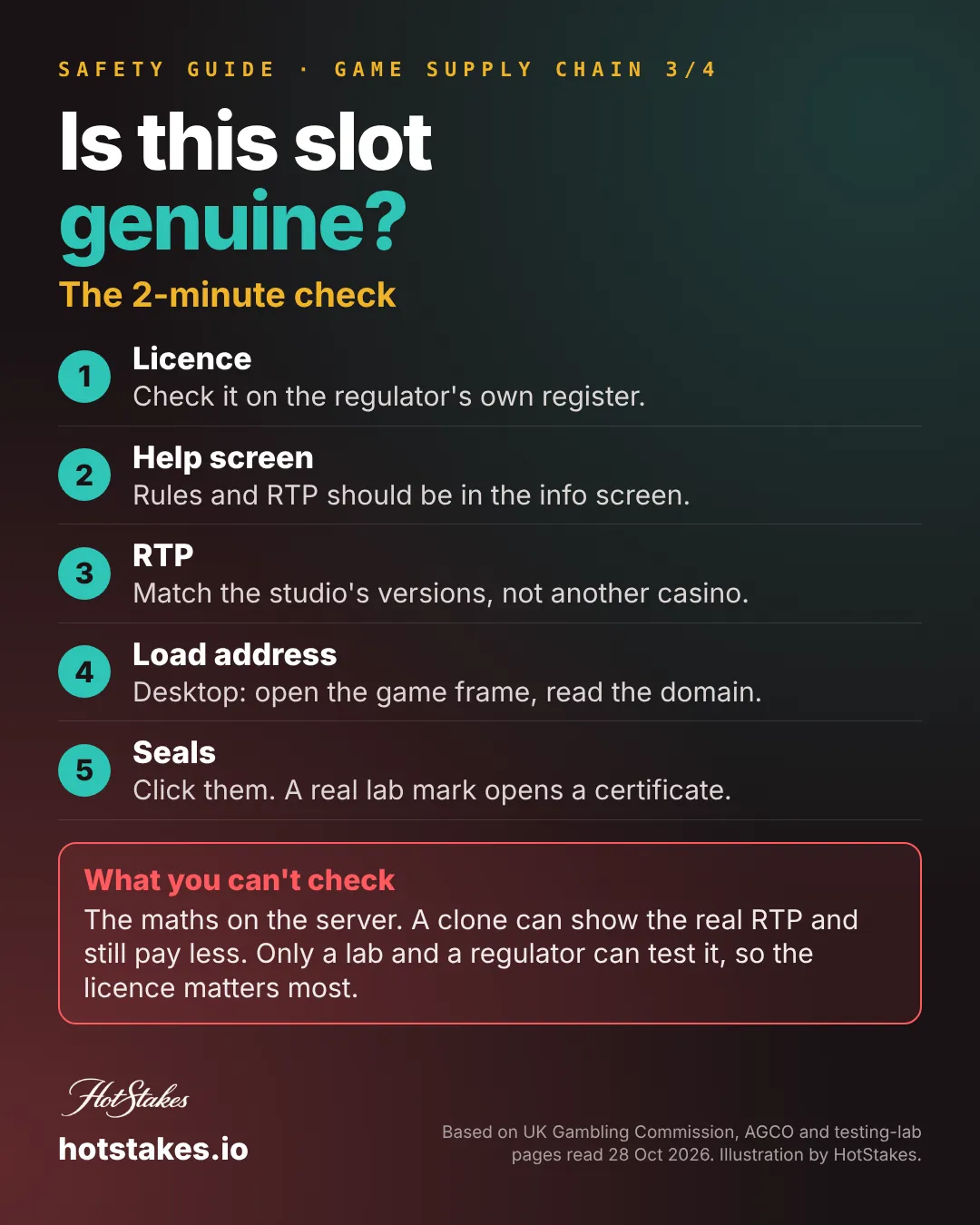
- Check the casino’s licence (30 seconds). Find the licence number in the footer and look it up on the regulator’s own register, or use our licence check tool. No verifiable licence means the rest of the checks barely matter.
- Open the game’s info or help screen. Genuine games normally show rules, paytables and an RTP figure. UK rules (RTS 3) say rules must be “easily available to the customer before they commit to gamble”, and the information it lists includes the RTP percentage (or the odds of winning). A missing help screen is a warning sign.
- Compare the RTP with the studio’s own figures. Many studios publish an info sheet for each game listing its RTP. If the help screen shows a number the studio never lists for that game, treat it as a red flag. If it matches one of several published versions, that is normal (see below).
- See where the game loads from. On a desktop browser, right-click inside the game. Most browsers offer an option to open or view the frame (wording varies). Read the web address only. Odd signs: a bare number address, a misspelled lookalike of the studio’s name, or a domain with no link to the game’s maker. This is a weak signal. Genuine games often load from a middleman’s domain you won’t recognise.
- Click any seal. A real “Gaming Labs Certified” mark is designed to open a certificate page. A seal that is a plain picture, or that links back to the casino, proves nothing.
- Scan for small oddities. Studio name missing from the loading screen, garbled translations, a currency shown in the wrong format, or features the help screen does not describe.
If something looks wrong, stop playing, take screenshots of the help screen and your balance, and use our casino complaint guide. At a licensed site, the regulator can act on it.
Takeaway: two minutes catches lazy fakes. A careful clone copies the help screen too.
Different RTP is not proof of a fake
This is where many fake-slot guides go wrong. One game can legitimately exist in several RTP versions. The studio offers the settings, and the casino picks one, within the limits of its licence. A slot showing 96% on one site and 94% on another can be completely genuine.
Our guide to minimum RTP by country shows how those limits vary. The difference matters to you, because a lower setting costs more over time. But it is a choice, not a forgery.
- Normal: the help screen shows one of the RTP versions the studio publishes.
- Red flag: the help screen shows an RTP the studio never offers, or no RTP at all.
- Can’t tell: the help screen shows a correct figure but the server pays less. Only a lab and regulator can catch that.
And don’t try to “test” a game with a few hundred spins. Short sessions are dominated by volatility, as our explainer on RTP vs volatility shows. A losing streak is not evidence of a fake, and a winning one is not evidence of a real game.
Takeaway: compare the RTP against the studio’s list, not against another casino.
What you can verify vs what you can’t
Here is how each check maps to what it actually proves.
| Check | Can a player do it? | What it proves | What it doesn’t prove |
|---|---|---|---|
| Casino licence on regulator’s register | Yes, in 30 seconds | Someone with powers oversees the site | That every game on it is genuine |
| Help screen with rules and RTP | Yes | The site shows what rules require | That the server pays that RTP |
| RTP matches studio’s published versions | Usually, if the studio publishes a sheet | The displayed setting exists | That the copy uses it |
| Game loading address | Yes, on desktop | Very little; odd domains are a hint | Which server decides your spins |
| Lab seal links to a certificate | Sometimes | A product owner got a certificate | That this casino runs that version |
| Game’s real maths on the server | No | Only labs and regulators can test it | – |
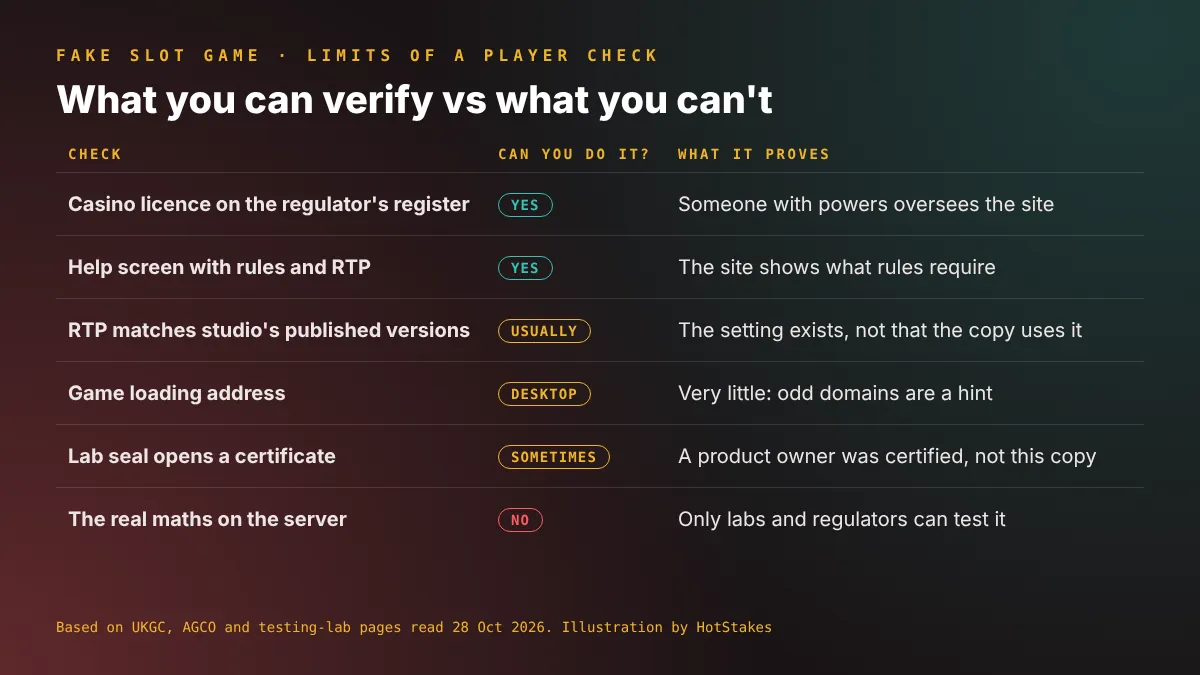
Takeaway: every player check has a ceiling. The licence is the only one that brings in someone who can look at the server.
Real vs cloned: what it can look like
The mock-up below uses an invented game, “Paper Kite Parade”, from an invented studio. It shows the kind of small differences a lazy clone can leave behind.
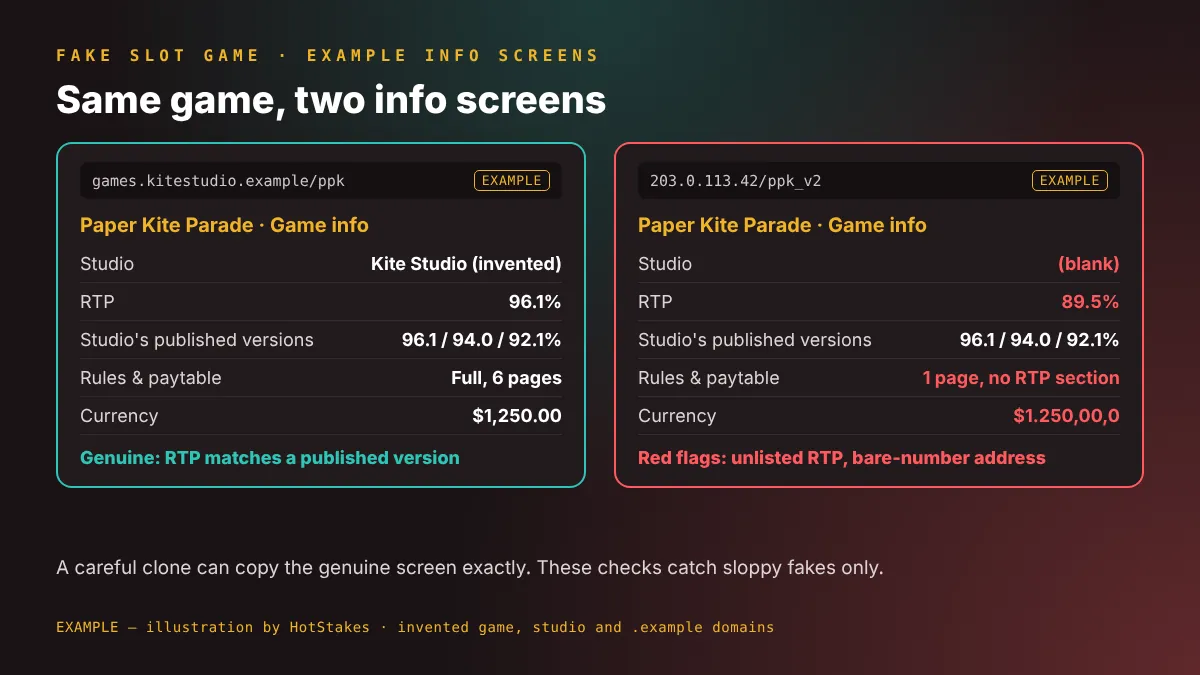
The path behind the screen is the real difference. A genuine game travels from the studio’s server, often via an aggregator, to a licensed casino. A clone runs a copied client against an unofficial server.
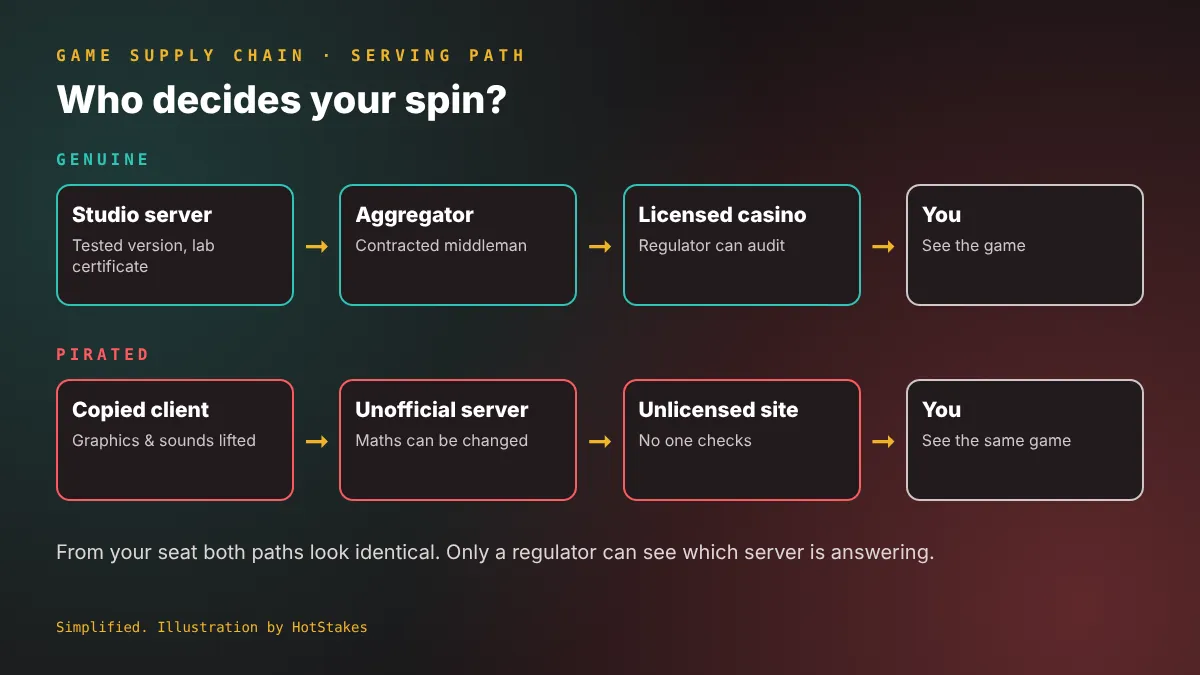
Takeaway: the screen can be copied perfectly. The serving path can’t be seen from your seat.
We tried to verify lab seals: what the public can look up
On 28 Oct 2026 we opened the public websites of four testing labs, GLI, eCOGRA, BMM and iTech Labs, looking for anything a player could use to check a seal or certificate.
- GLI: no search box. Its mark FAQ says the “Gaming Labs Certified” mark carries an embedded link, and “When the mark is selected by a website user it displays a Certificate of Integrity“. Those pages sit on access.gaminglabs.com. The ones we opened say they may not be used to represent “formal approval” of the product.
- eCOGRA: its seal page explains who may display the seal. We found no public certificate lookup on the pages we read.
- BMM: its partner logo page states the logo “does not indicate that a specific product is certified“. We found no public lookup.
- iTech Labs: the homepage and client portal page we read offered no public certificate search.
So a seal is mostly an image. If you click a GLI mark, check that the address bar shows access.gaminglabs.com, not the casino’s own domain. Even then, the certificate is about a product owner, not about the copy in front of you.
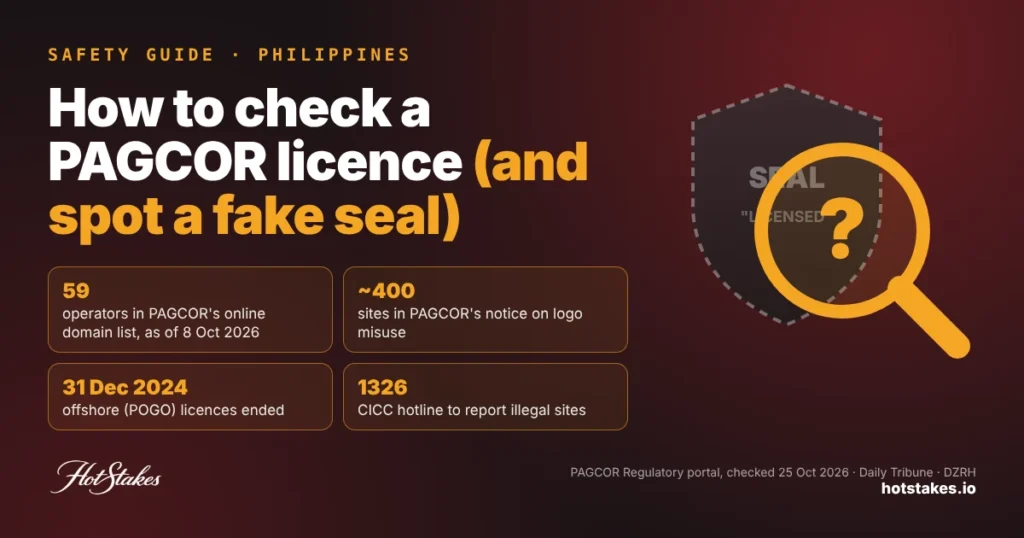
Regulator logos get faked too. PAGCOR has warned about sites using its logo without permission. Our pillar on how to spot an unlicensed online casino covers fake licence badges in detail.
Takeaway: verify the casino’s licence on the regulator’s site. Treat seals as decoration until a click proves otherwise.
FAQ
Can an online slot be a fake copy with changed odds?
Yes. A pirated copy pairs a copied game client with an unofficial server, and whoever runs that server controls the maths. No lab certificate covers the copy. Fakes are found mainly on unlicensed and grey-market sites.
How can I check if a slot is genuine?
Check the casino’s licence on the regulator’s register, open the game’s help screen, compare its RTP with the studio’s published versions, see where the game loads from, and click any seal. These checks catch sloppy fakes but cannot prove a game is genuine.
Does a different RTP mean the slot is fake?
No. Many genuine games come in several RTP versions and the casino picks one. It is a red flag only if the RTP shown is one the studio never publishes for that game, or if no RTP is shown at all.
Can I verify a testing lab seal myself?
Sometimes. A GLI mark is designed to open a Certificate of Integrity on access.gaminglabs.com. On 28 Oct 2026 we found no public certificate search on the GLI, eCOGRA, BMM or iTech Labs sites. A seal that links nowhere proves nothing.
What is the best protection against fake slot games?
Play only at casinos licensed by a regulator that requires game testing, such as the UK Gambling Commission or Ontario’s AGCO. They require certified games from known suppliers, and they can investigate and fine when that fails.
HotStakes is an independent directory. Some links on this site are affiliate links; we may earn a commission at no cost to you, and it never changes our rankings. Gambling involves risk — only play with money you can afford to lose, and if it stops being fun, seek help. This article is general information, not legal advice. Read our full disclaimer.
 Next story →Siam66 Review 2026: Licence, Bonus Terms & Safety Check
Start the discussion