

Crash Game RTP Explained: Cash Out at 1.5x or 10x?
Crash game RTP is the same at 1.5x or 10x. We simulated 100,000 rounds to show what really changes and why crash strategies fail.
In this article
- How the crash multiplier curve works
- Is cashing out early better? Our 100,000-round simulation
- Why crash game strategies don’t beat the edge
- Provably fair: what the hash proves, and what it doesn’t
- Crash games vs fast games vs slots: our data
- What regulators say about crash games
- Before you play a crash game: 6 checks
- FAQ
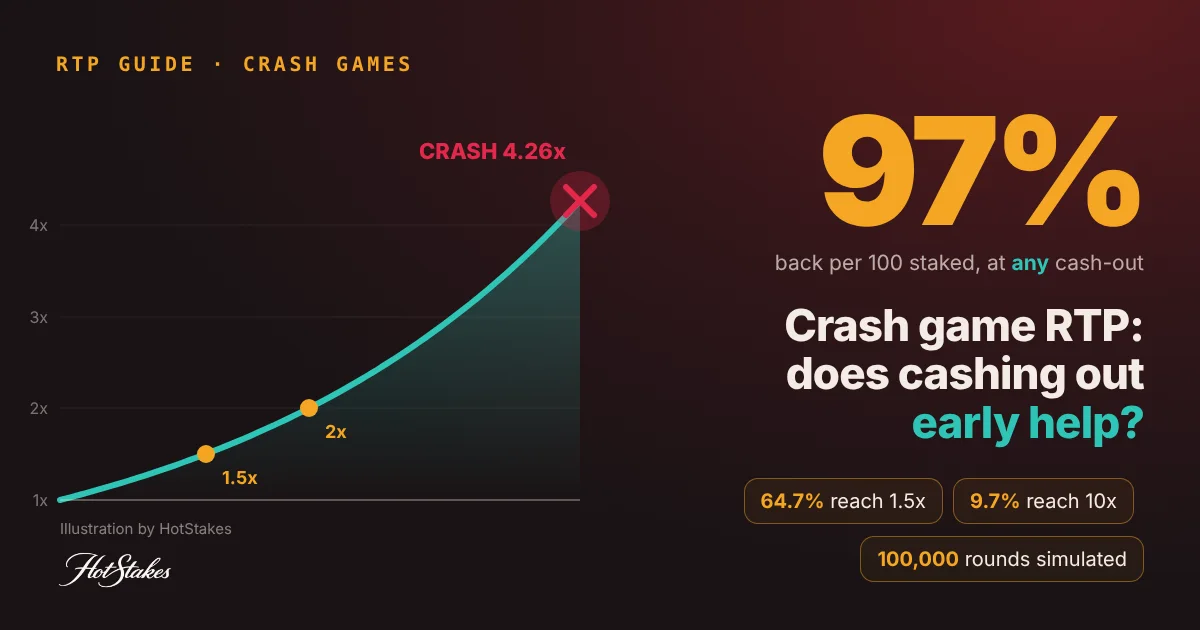
A crash game multiplies your bet on a rising curve until it “crashes”. Cash out before the crash and you win the multiplier; miss it and you lose the stake. On a 97% RTP crash game, your cash-out target does not change the price: whether you take 1.5x or 10x, you get back about 97 for every 100 staked over the long run. The target only changes how often you win and how wild the swings are. We ran 100,000 rounds to prove it.
How the crash multiplier curve works
Every round, the game draws a crash point before the curve starts. A random number generator picks it. The animation just reveals it slowly.
The crash point is not equally likely to land anywhere. Low crashes are common. High ones are rare. Academic work on crash games models it with a simple rule: the chance the round crashes at or below x is 1 − 1/x, before the house takes its cut (Scott, Sher and Daigle, UNLV Gaming Research & Review Journal, 2026).
The 0.97 ÷ x rule
Shave 3% off that fair curve and you get a 97% RTP game. The chance of the multiplier reaching your target is then:
P(crash ≥ x) ≈ 0.97 ÷ x
| Cash-out target | Chance the curve gets there | Expected return per 100 staked |
|---|---|---|
| 1.2x | 80.8% | 97 |
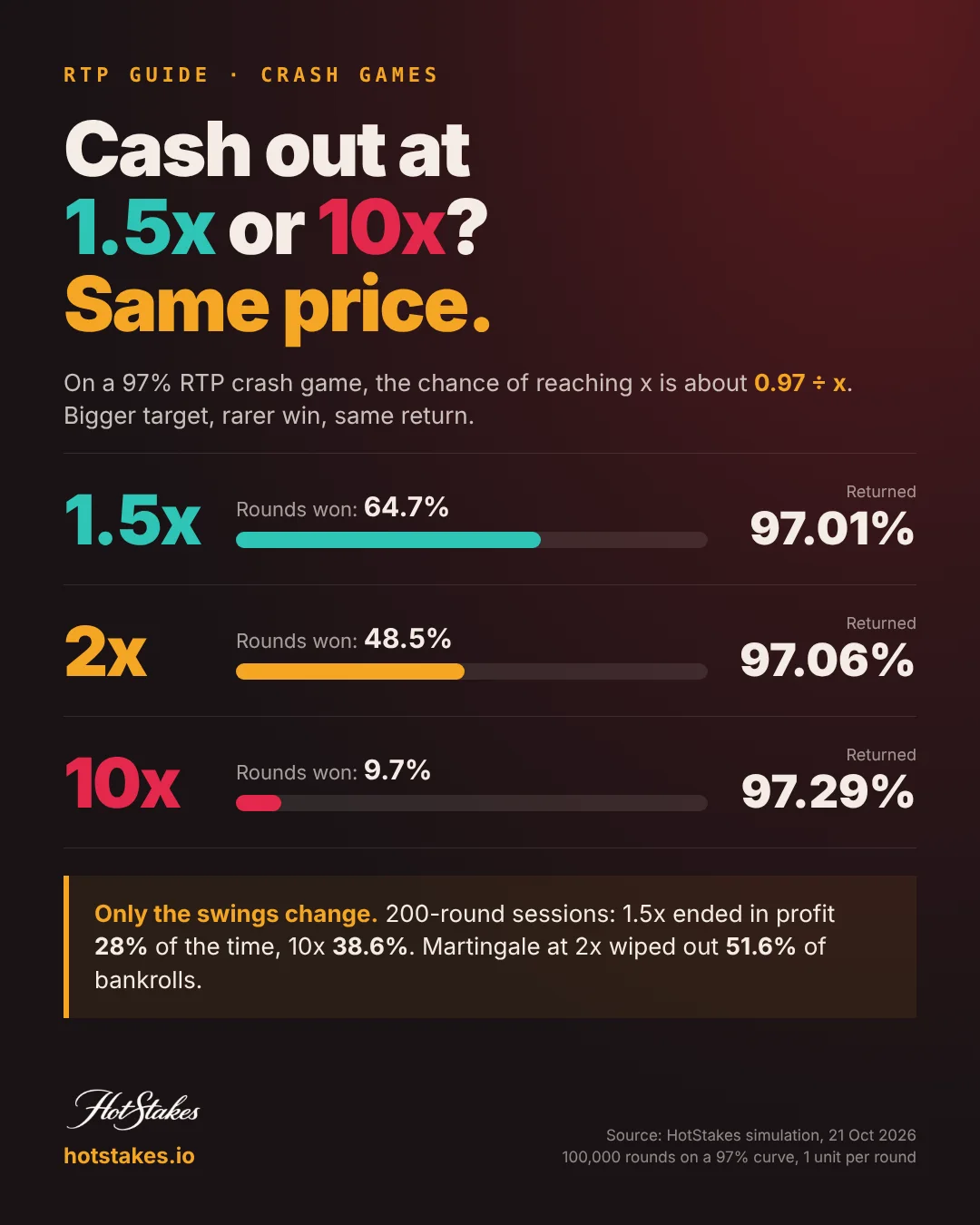
| 1.5x | 64.7% | 97 |
| 2x | 48.5% | 97 |
| 5x | 19.4% | 97 |
| 10x | 9.7% | 97 |
| 100x | 0.97% | 97 |
Look at the last column. The win gets bigger exactly as fast as the chance of getting it shrinks. Target × chance = 0.97, every time.
In this simple model the 3% edge also shows up as about 3% of rounds that bust instantly at 1.00x, before anyone can cash out.
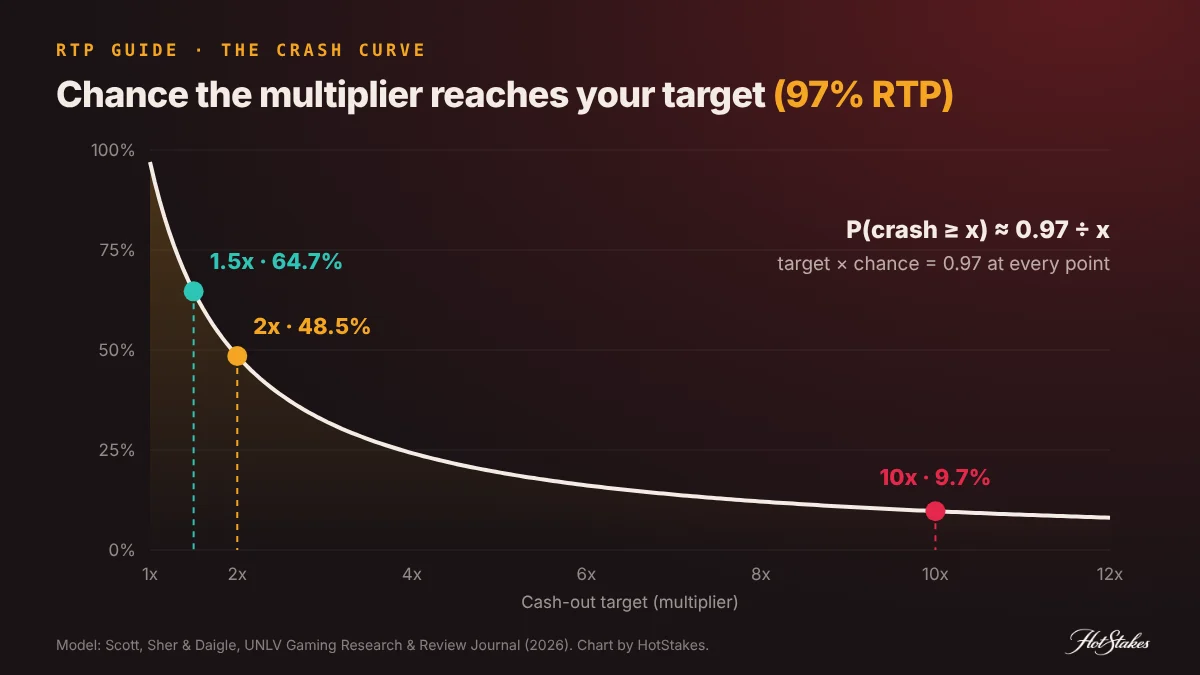
Takeaway: A crash game’s RTP is built into the curve itself. Your target picks a point on the curve, not a better price.
Is cashing out early better? Our 100,000-round simulation
We wanted to see the rule hold up outside a formula. So we simulated it. Method (HotStakes simulation, 21 Oct 2026):
- 100,000 rounds drawn from the 97% curve (crash point = 0.97 ÷ a uniform random number, floored at 1.00x), Python with NumPy, fixed seed.
- The same 100,000 crash points were played three ways: auto-cashout at 1.5x, 2x and 10x, 1 unit per round.
- We then cut the rounds into 500 sessions of 200 rounds each, to see what one evening of play looks like.
| Auto-cashout | Rounds won | Return to player | Avg result per 200-round session | Sessions ending in profit | Middle 90% of sessions |
|---|---|---|---|---|---|
| 1.5x | 64.67% | 97.01% | −5.99 units | 28.0% | −21.5 to +10 |
| 2x | 48.53% | 97.06% | −5.88 units | 29.8% | −30 to +18 |
| 10x | 9.73% | 97.29% | −5.42 units | 38.6% | −70 to +60 |
All three land within a third of a point of 97%. The small gaps are random noise, not an edge.
What changes is the spread. At 1.5x, a 200-round session stayed between −21.5 and +10 units nine times out of ten. At 10x, the same range was −70 to +60.
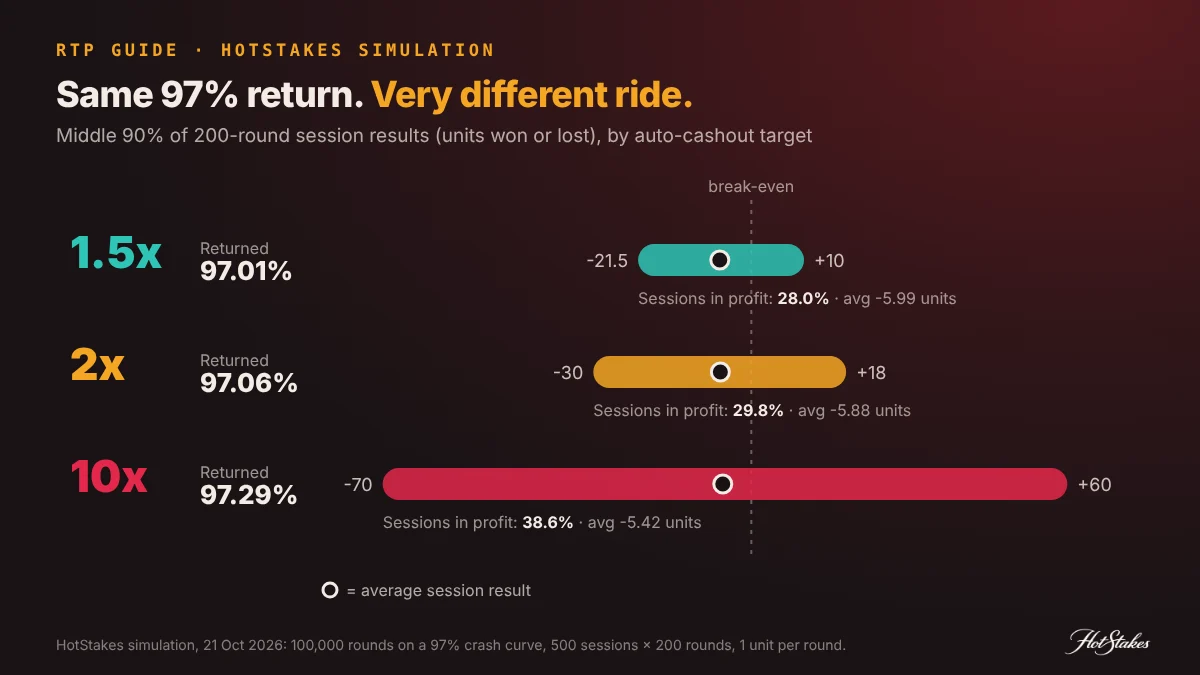
Here is the counter-intuitive part. The “safe” 1.5x player ended a session in profit less often (28.0%) than the 10x player (38.6%).
Why? Low variance means small, steady results. Over 200 rounds the 3% edge has room to grind through. High variance gives luck more room, in both directions.
Takeaway: Cashing out early buys a smoother ride, not better odds. Both players pay the same 3%.
Why crash game strategies don’t beat the edge
“Always cash out early”
Our table shows it. More frequent wins, same 97% return. A 1.2x target wins about four rounds in five, and the fifth round takes back what the four paid.
Takeaway: A high win rate is not the same as winning money.
Martingale on crash
Martingale means doubling your bet after every loss at a 2x target, so one win recovers everything. We tested it on the same simulated rounds: 1-unit base bet, 100-unit bankroll, sessions of up to 200 rounds.
- 43.6% of sessions ended in profit, usually a small one.
- 51.6% of sessions were wiped out: a losing streak outran the bankroll.
- Average result: −15.79 units per session, about 3.1% of everything staked.
The loss rate per unit staked barely moved. Martingale just made players stake far more, so they lost more in total.
Takeaway: Doubling up changes how you lose (rarely but heavily), not whether you lose.
Reading the history bar
The strip of recent crash points invites pattern-spotting. “Five low rounds, a big one is due.” It isn’t.
In Great Britain, the Gambling Commission’s technical standards say game results must be “acceptably random”, and that a compensated game, one that adjusts to past results, “is not permitted”. Testing lab GLI’s standard for online gaming says one draw “shall not provide information” on future draws (GLI-19, section 3.2.4). Our guide on whether a slot can be “due” to hit covers the same myth for slots.
Takeaway: The history bar is a record, not a forecast.
Small print can move RTP a little, never above 100%
Real games are not perfect formulas. Instant-bust rules, maximum-win caps and rounding can nudge the return at different targets. The UNLV researchers found exactly that in one game they modelled: expected loss of about 3.33% at 1x, peaking at about 4.25% at 20x. Their conclusion: “Setting an auto-bet at any multiplier will not yield a positive expected value.”
The same paper shows how noisy short samples are. A sample of 1,041 rounds from one crash game returned 103.11% to players, above its advertised 97%. A week of over 4.3 million bets on another returned 93.1%. Neither tells you the true RTP. Only the maths does.
Takeaway: If a game’s rules page lists a different RTP for different modes or caps, the lower one is what you’re paying.
Provably fair: what the hash proves, and what it doesn’t
Many crash games, especially at crypto casinos, call themselves “provably fair”. The idea is a cryptographic commitment. The server picks a secret seed for the round, publishes its hash first, and reveals the seed afterwards. As the UNLV paper puts it, “The hashed seed is then given to the player prior to their wager.” Anyone can then re-hash the seed and recompute the crash point.
- It proves: the result was fixed before you bet and wasn’t swapped once you’d placed your stake.
- It does not prove: that the odds are good. The house edge is written into the very formula you’re verifying.
- It does not prove: that the operator is licensed, that withdrawals get paid, or that the RTP on the page matches the formula, unless you actually check it.
Takeaway: Provably fair means “not tampered with”, not “in your favour”.
Crash games vs fast games vs slots: our data
How do crash games compare with the rest of a provider’s catalogue? We pulled every Hotdog Gaming title of type “Crash” and “Fast Game” from the HotStakes database (synced 20 Oct 2026) and set them against the 424 slots in the same database.
| Game | Type | RTP | Volatility (1–5) | Max win |
|---|---|---|---|---|
| Crash | Crash | 97.14% | 5 | not listed |
| Pilot | Crash | 96.5% | not listed | €10,000 cap |
| Pilot Coin | Crash | 96.5% | not listed | 5,000 per round, shared by lobby |
| Pilot Cup | Crash | 96.5% | not listed | 5,000 per round, shared by lobby |
| Ninja Hop | Fast Game | 97.67% | 3 | 318x |
| Lucky Mine | Fast Game | 97.50% | not listed | 5,000x |
| Hilo | Fast Game | 97.22% | 5 | not listed |
| Plinko, Plinko Classic, Lucky Drop-Olympus | Fast Game | 96.5% | not listed | 1,000x |
| Chicken Fryer | Fast Game | 95.65% | not listed | 50x |
| Lucky Drop-Coco 2 | Fast Game | 95.50% | not listed | 1,000x |
| Golden Clover, Chili Fiesta, Gold Rush: Wild Dig | Fast Game | 95.03–95.15% | not listed | 10,000x |
| Chicken Alive | Fast Game | 93.01% | 3 | 25x |
| 424 slots (average) | Slots | 96.44% | 3.3 (avg) | 5,000x (median) |
What stands out:
- All four crash games beat the slot average, but only just. They average 96.66% against 96.44%.
- “Fast games” are a mixed bag. The 12 average 95.95%, from 97.67% (Ninja Hop) down to 93.01% (Chicken Alive). Six of the 12 sit below the slot average.
- Chicken Alive costs about twice as much per bet as the average slot: a 6.99% house edge against 3.56%.
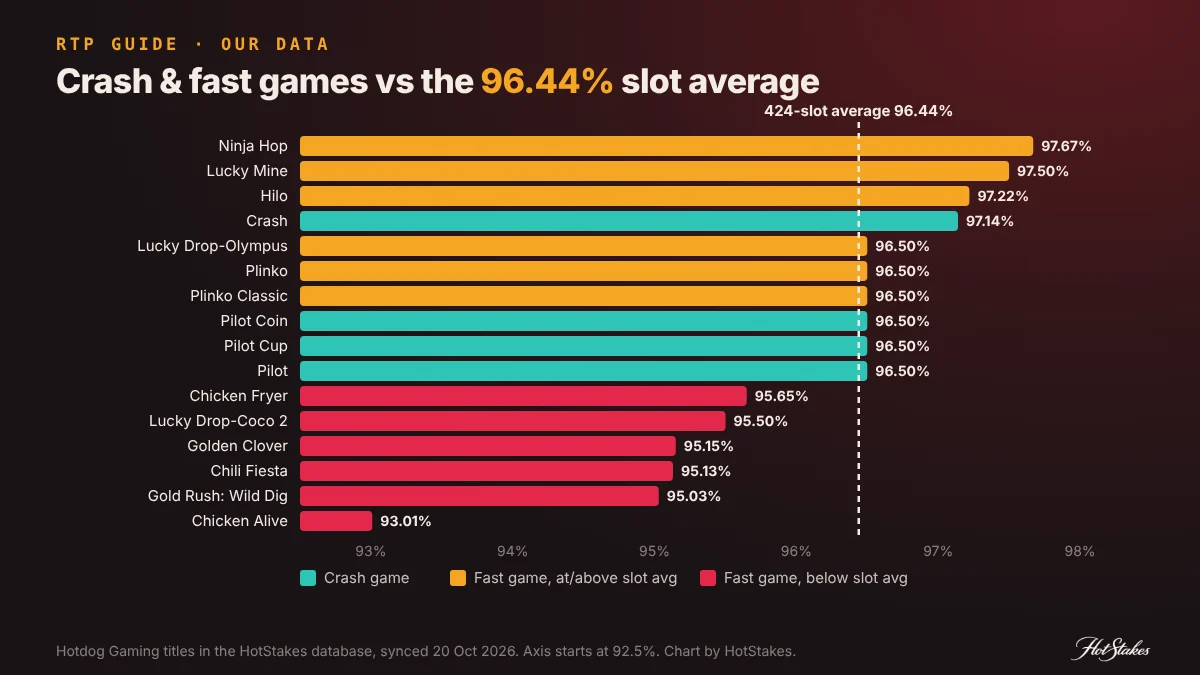
A tenth of a point sounds tiny. But crash rounds are short, so you can play hundreds an hour. The edge is charged on every one. Our RTP calculator turns any RTP and total stake into an expected cost, and our RTP vs volatility guide explains why the two numbers measure different things.
Takeaway: “Instant” doesn’t mean better value. Read the RTP of each game; it ranges by almost five points inside one provider.
What regulators say about crash games
Britain’s Gambling Commission flagged crash games in its April 2025 money-laundering risk update. It noted they have been offered by crypto casinos that are not licensed by the Commission, and that licensed casinos are showing more interest. Its verdict on the product itself was blunt: “Crash games are highly volatile and can lead to significant losses for players.”
The same regulator’s rules say players must be able to see the game’s rules and its “return to player (RTP) percentage” or equivalent before they bet. That is a good benchmark anywhere: if a crash game won’t show you its RTP, skip it.
Takeaway: Regulators see crash games as fast, volatile and easy to lose money on. Treat them as entertainment with a price, like every other casino game. Our guide to why the house always wins shows how that price adds up.
Before you play a crash game: 6 checks
- Find the RTP in the rules. Note any different figure for special modes, side bets or caps.
- Check the maximum win. A cap cuts off the top of the curve. Some lobby games share one cap among all players.
- Pick your target for fun, not profit. Low targets mean frequent small wins; high targets mean long dry runs. The price is the same.
- Set a session budget before the first round. Rounds last seconds, so time and money move fast.
- Skip doubling systems. In our simulation, Martingale wiped out the bankroll in just over half of sessions.
- Treat “provably fair” as a minimum, not a recommendation. Check who licenses the site too.
If chasing losses is creeping in, stop and talk to someone. UK players can call the National Gambling Helpline on 0808 8020 133; in Singapore, the NCPG helpline is 1800-6-668-668.
FAQ
What is crash game RTP?
It is the share of all stakes the game pays back over a very large number of rounds. A 97% RTP crash game returns about 97 for every 100 bet in the long run, so the house keeps about 3%. Any single session can land far above or below that.
Is cashing out early better in crash games?
No. On a 97% curve the chance of reaching x is about 0.97 ÷ x, so every target returns about 97%. In our 100,000-round simulation, 1.5x returned 97.01% and 10x returned 97.29%. Early cash-outs win more often but pay less.
Is there a crash game strategy that works?
No strategy changes the built-in edge. Research in UNLV’s Gaming Research & Review Journal found no clear winning strategy, and our simulation of Martingale at 2x wiped out the bankroll in 51.6% of sessions.
What are the odds in aviator style games?
In plane-themed crash games with a 97% RTP, the chance of reaching 2x is about 48.5%, 10x about 9.7% and 100x about 0.97%. Check each game’s rules, as RTP and caps differ.
Does provably fair mean I can win?
No. Provably fair uses a published hash to prove the result was set before you bet and not changed afterwards. The house edge is part of the formula being verified, so the game is still priced in the operator’s favour.
HotStakes is an independent directory. Some links on this site are affiliate links; we may earn a commission at no cost to you, and it never changes our rankings. Gambling involves risk — only play with money you can afford to lose, and if it stops being fun, seek help. This article is general information, not legal advice.
Prefer to play only where licences are checked? Browse vetted operators by currency. 18+ only.
 Next story →Should I Quit Gambling? What Your Habit Costs a Year







Start the discussion