

Live Blackjack RTP: Why 99.5% Isn’t What Most Players Get
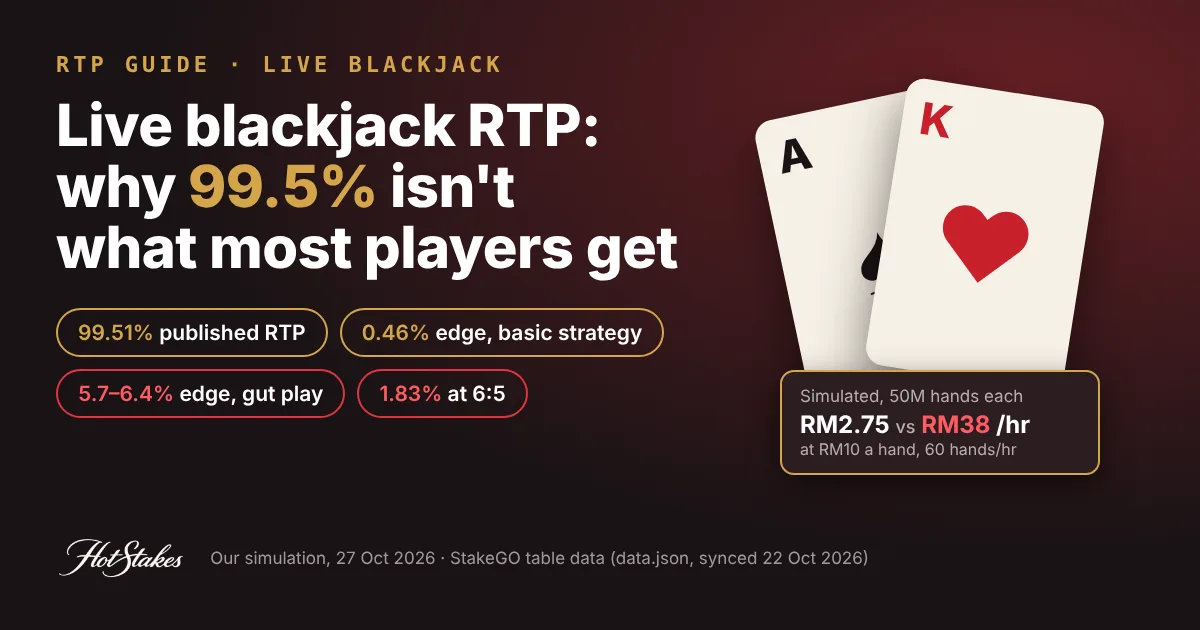
We simulated 50M hands per strategy: basic strategy gave a 0.46% edge, never bust 6.36%, mimic the dealer 5.69%. What 99.5% RTP really means.
In this article
- What “99.5% RTP” on a live blackjack table actually means
- Our 5 live blackjack tables vs other live games
- We simulated 50 million hands per strategy
- What it costs per hour at RM10 a hand
- 6:5 vs 3:2 blackjack: one rule, four times the edge
- Blackjack side bets house edge: Perfect Pairs and 21+3
- How to get closer to the published RTP
- FAQ
Live blackjack RTP is usually published at about 99.5%, but that figure assumes you play every hand by basic strategy. Most players do not. We simulated 50 million hands per strategy on 27 Oct 2026: basic strategy gave a 0.46% house edge, while “never bust” gave 6.36% and “mimic the dealer” 5.69%, about 12 to 14 times more. A 6:5 blackjack payout pushed even perfect play to 1.83%. Below: what the number means, what each style costs per hour at RM10 a hand, and why side bets cost more still.
What “99.5% RTP” on a live blackjack table actually means
RTP (return to player) is the share of all money bet that a game pays back over a very long run. The house edge is the other side: 100% minus RTP. So 99.51% RTP means a 0.49% house edge, or about RM4.90 lost per RM1,000 bet, on average.
Blackjack has a catch slot RTPs do not: your decisions change the return. So whose decisions does the published number assume?
- Regulators expect a defined strategy. The UK Gambling Commission’s technical standards say that for games with an element of skill, RTP “should be calculated using either the auto-play strategy or a standard/published strategy” (UKGC RTS 3C).
- Published maths assumes near-perfect play. Wizard of Odds, the most-cited blackjack maths reference, notes that its “house edge figures are based on optimal or near-optimal player strategy” (Wizard of Odds).
- For blackjack, that strategy is basic strategy. The fixed chart of when to hit, stand, double and split for every hand against every dealer card.
The same Wizard of Odds page lists 0.75% as the blackjack edge “for comp purposes”, higher than the optimal figure because it reflects “player errors and average type of bet made”. In other words, comp maths assumes real players do worse than the headline.
Takeaway: 99.5% is the RTP of a player who makes the right call on every hand. It is a ceiling, not a promise. Our RTP vs volatility guide explains why even that ceiling only shows up over a very long run.
Our 5 live blackjack tables vs other live games
HotStakes lists 55 StakeGO live tables (data synced 22 Oct 2026). Five are blackjack. Their published figures, and the published edges of the other live games in the same data, look like this.
| Live game (StakeGO data) | Published figure | House edge | Average cost per RM1,000 bet |
|---|---|---|---|
| Speed Blackjack IBJ02, VIP Blackjack IBJ04, Oasis BJ 2 IBJ05 | 99.51% RTP | 0.49% | RM4.90 |
| Gravity Blackjack IBJ01, Take Deal or Risk Blackjack IBJ03 | 99.46% RTP | 0.54% | RM5.40 |
| Baccarat (classic and speed tables) | 1.06%-1.24% edge | 1.06%-1.24% | RM10.60-RM12.40 |
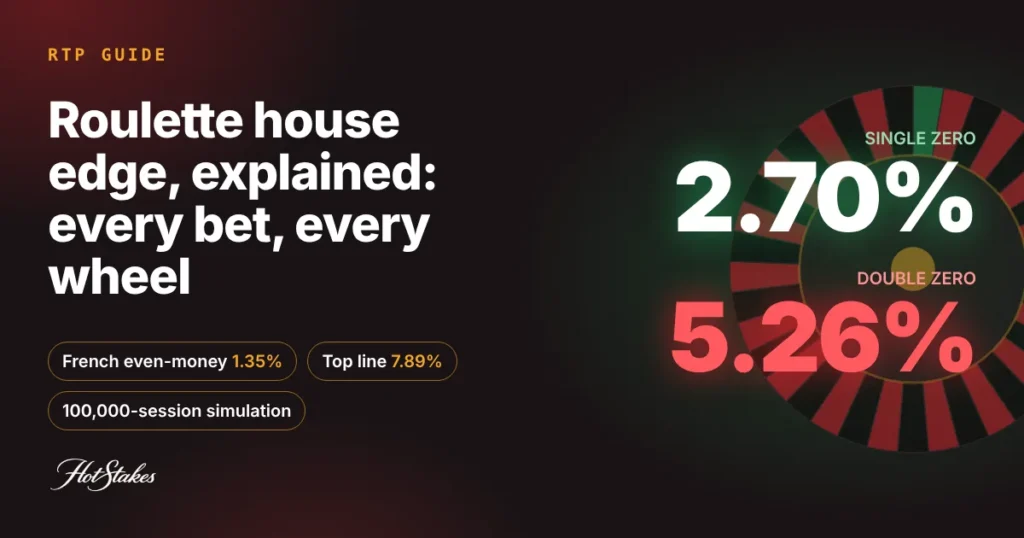
| Roulette (single zero) | 2.7% edge | 2.7% | RM27.00 |
| Sic bo | 2.78% edge | 2.78% | RM27.80 |
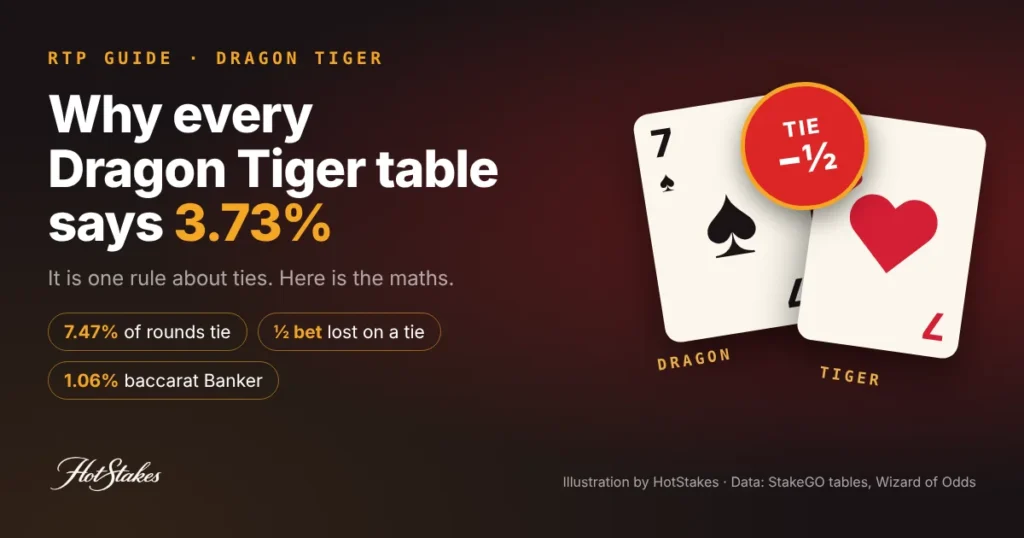
| Dragon tiger | 3.73% edge | 3.73% | RM37.30 |
Some roulette tables list 2.9% for certain bets or bonus options. Figures are as listed in our data, not independently tested.
On paper, blackjack wins clearly. But the table-level data we hold has no rules field, so we cannot tell you each table’s deck count, soft 17 rule or payout. Check the rules panel at the table before you play. You can browse all of them on our live tables page.
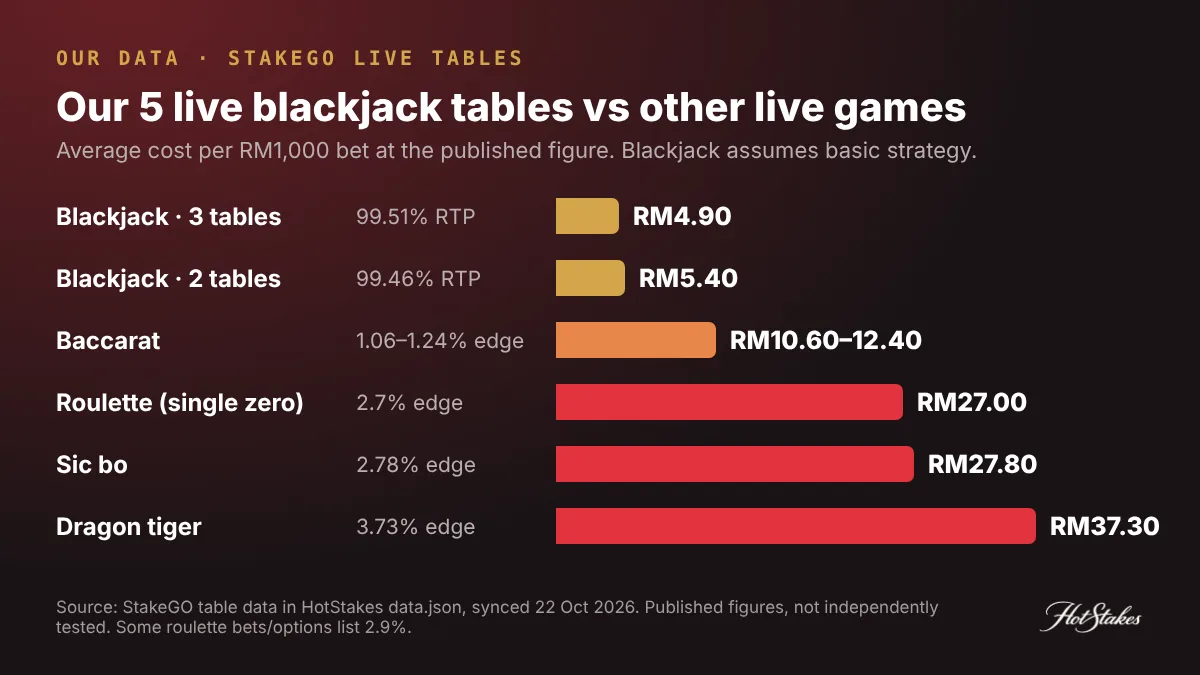
Takeaway: At the published figures, blackjack is the cheapest live game in our data. Our guides to speed baccarat and roulette house edge cover the others. The catch is that only blackjack’s figure depends on you.
We simulated 50 million hands per strategy
To see what the number looks like for real playing styles, we wrote a Monte Carlo simulator and ran it on 27 Oct 2026. Each strategy got 50,000,000 rounds at a flat 1-unit bet.
The rules we used
These are a common multi-deck rule set, not the confirmed rules of any specific table:
- 8 decks, reshuffled after 75% of the shoe is dealt
- Dealer stands on soft 17 and checks for blackjack
- Blackjack pays 3:2 (6:5 in one run)
- Double on any first two cards, double after split allowed
- Split up to 4 hands; split Aces get one card each
- No surrender, no insurance, no side bets
The four styles we tested
- Basic strategy: the standard chart for these rules.
- Never bust: stand on any hard 12 or more, hit soft hands below 17, never double or split.
- Mimic the dealer: hit until 17, stand on any 17, never double or split.
- Basic strategy at 6:5: perfect play, but blackjack pays 6:5.
The results
| Strategy | House edge (95% margin) | Effective RTP | Ahead after 1 hour |
|---|---|---|---|
| Basic strategy, 3:2 | 0.46% (±0.03) | 99.54% | 47.5% of sessions |
| Basic strategy, 6:5 | 1.83% (±0.03) | 98.17% | 45.0% |
| Mimic the dealer | 5.69% (±0.03) | 94.31% | 31.4% |
| Never bust | 6.36% (±0.03) | 93.64% | 29.6% |
“Ahead after 1 hour” is the share of 60-hand blocks that finished with a net profit. Edge is per initial bet.
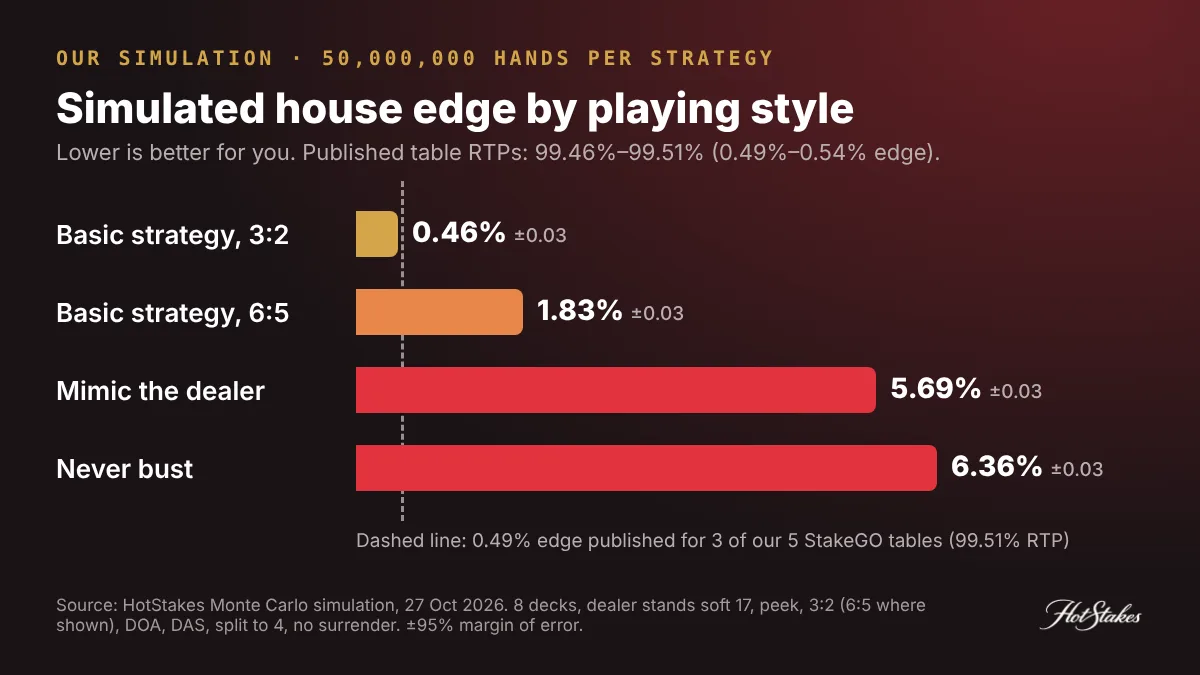
Our basic strategy result (99.54%) lands right next to the 99.46%-99.51% published for our five tables. That is reassuring, but it does not prove those tables use our rules.
Does our simulator agree with published maths?
We checked it against Wizard of Odds’ published figures. Two of three checks matched closely, and we report the third as is:
- Never bust, Wizard’s version. Wizard of Odds lets this player double and split by basic strategy and reports 3.91% (Wizard of Odds). We ran that version too and got 3.97% (±0.03). Our stricter version above, with no doubles or splits, costs much more.
- 6:5 payout. Wizard of Odds puts the cost at 1.39 percentage points on 8 decks (rule variations). Ours: 1.83% minus 0.46% = 1.37 points.
- Mimic the dealer. Wizard reports 5.48%. We got 5.69%. Its exact rule set is not spelled out on that page, so a rule or shuffle difference may explain the gap. Both say the same thing: about 12 times worse than basic strategy.
Takeaway: Two “safe-feeling” strategies, never busting and copying the dealer, turn a 0.46% game into a 5.7%-6.4% game. That is worse than any other live game in our data.
What it costs per hour at RM10 a hand
House edge only becomes real money once you add speed. We assumed 60 hands an hour at a live table. That is our assumption, not a measured figure. For comparison, Wizard of Odds uses 70 hands an hour for land-based blackjack comps (source).
The maths is simple: edge × bet × hands per hour.
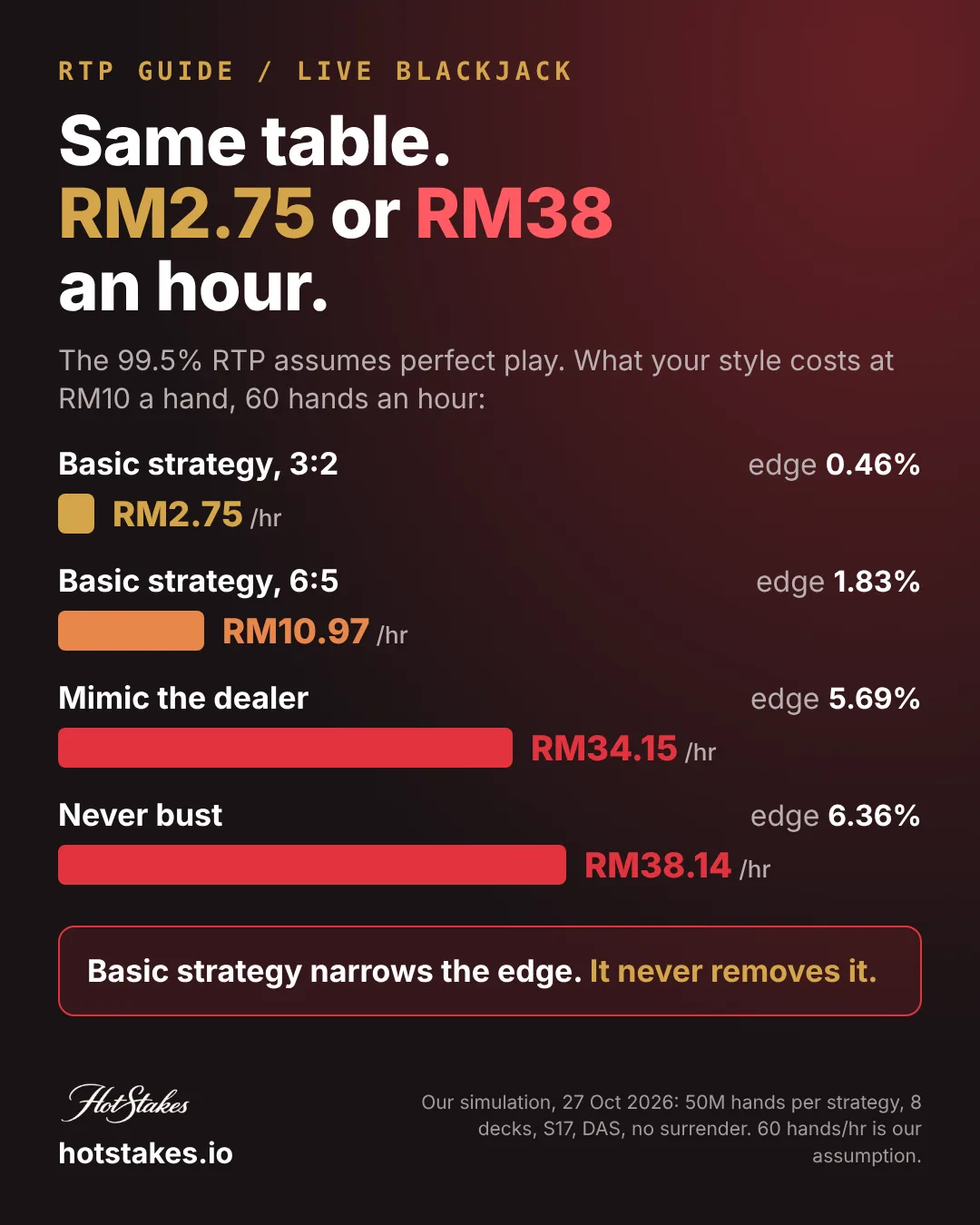
| Strategy | Expected loss per hour (RM10 × 60 hands) | Per RM1,000 bet |
|---|---|---|
| Basic strategy, 3:2 | RM2.75 (±0.19) | RM4.58 |
| Basic strategy, 6:5 | RM10.97 (±0.19) | RM18.28 |
| Mimic the dealer | RM34.15 (±0.16) | RM56.92 |
| Never bust | RM38.14 (±0.17) | RM63.57 |
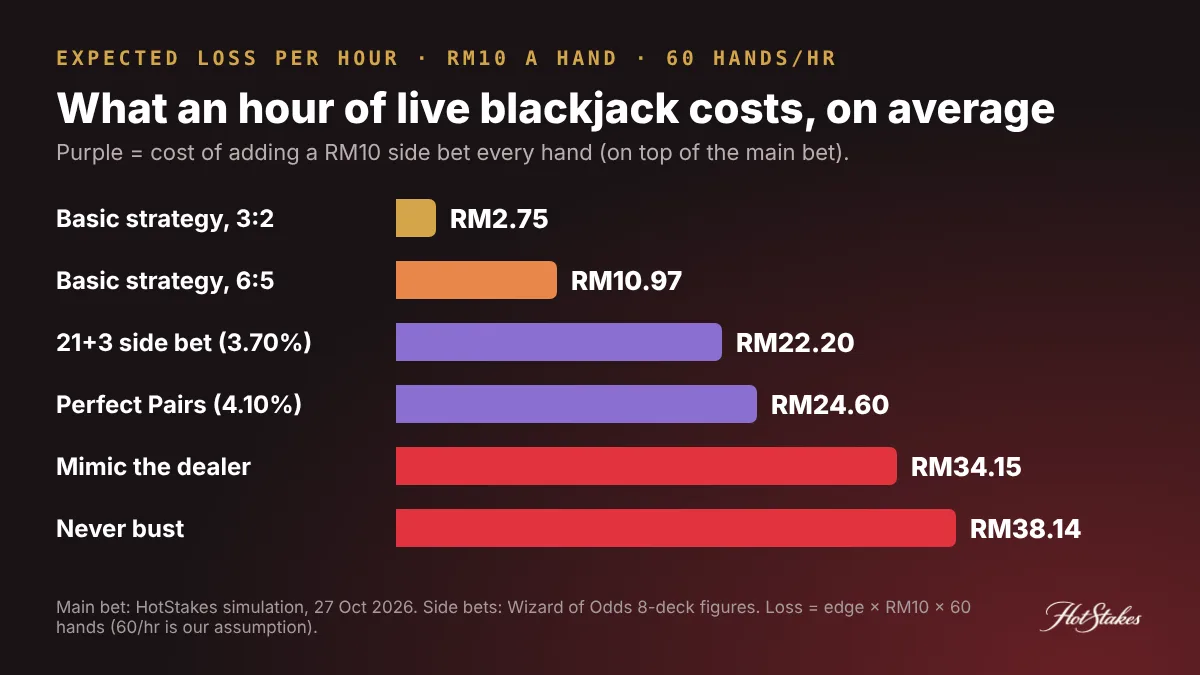
Notice the “ahead after 1 hour” column above. With basic strategy, nearly half of one-hour sessions still end in profit. That is why a 0.46% edge feels like nothing. It only shows up over thousands of hands, which is exactly how the house plans it. Our why the house always wins guide explains how small edges add up.
Takeaway: At the same table and stake, your playing style can move the cost from under RM3 to almost RM40 an hour. Try your own numbers in our RTP calculator.
6:5 vs 3:2 blackjack: one rule, four times the edge
A blackjack (an Ace with a 10-value card) pays 3:2 at a standard table. RM10 wins RM15. At 6:5 it wins RM12.
That sounds small. You get a paid blackjack in about 4.5% of rounds (4.53% in our simulation). Losing RM3 each time adds up to roughly 1.4% of every bet. In our run, the edge went from 0.46% to 1.83%.
Takeaway: Check the payout printed on the table or in the rules panel. If it says 6:5, even perfect play costs about four times more.
Blackjack side bets house edge: Perfect Pairs and 21+3
Most live blackjack tables offer optional side bets. The published 99.5% does not include them. Their edges depend on the pay table and deck count:
| Side bet | House edge, 8 decks | Cost per hour if you add RM10 a hand | Source |
|---|---|---|---|
| Perfect Pairs | 2.17%-7.95% by pay table; 4.10% for the 25/12/6 table | about RM24.60 at 4.10% | Wizard of Odds |
| 21+3 | 2.74%-12.89% by version; about 3.70% for the version Wizard says is used at live dealer tables | about RM22.20 at 3.70% | Wizard of Odds |
Wizard of Odds’ own 21+3 page has a deck-label inconsistency for that live-dealer version, so treat 3.70% as approximate.
Takeaway: One RM10 side bet a hand can cost eight to nine times more per hour than the main bet played well.
How to get closer to the published RTP
- Learn basic strategy for your table’s rules. It is the single biggest change, worth about 5 to 6 percentage points over gut play in our run.
- Read the rules panel first. Look for the blackjack payout (3:2, not 6:5), soft 17, decks and doubling rules.
- Skip side bets. They carry several times the main-game edge.
- Do not copy the dealer. Dealers follow fixed rules because they have no choices. You do.
- Price your hour before you start. Edge × bet × hands per hour. Decide a loss and time limit before the first hand.
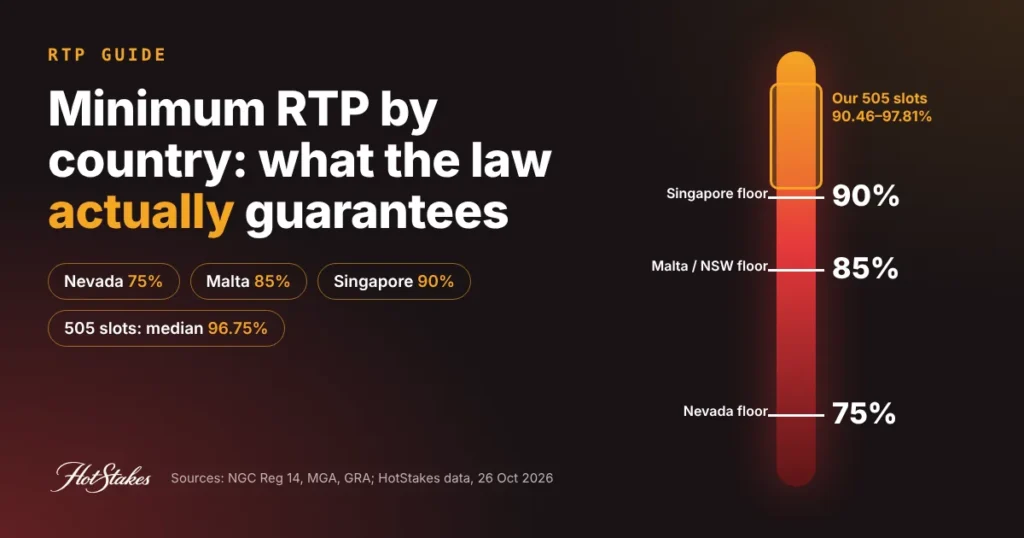
Card counting is not covered here. This guide is about what the published figure means for ordinary play. Also note that some regulators set minimum RTPs by law; our minimum RTP by country guide covers the rules in Asia and beyond.
Takeaway: Basic strategy narrows the edge. It never removes it.
FAQ
What is the RTP of live blackjack?
It depends on the table’s rules and assumes perfect basic strategy. The five StakeGO live blackjack tables in our data publish 99.46% and 99.51%, and our basic strategy simulation produced 99.54%. With common gut strategies, our simulation found an effective RTP of only 93.6%-94.3%.
Does the published blackjack RTP assume perfect play?
Yes. UK technical standards say skill-game RTP is calculated using an auto-play or standard/published strategy, and maths references base blackjack figures on optimal or near-optimal play. For blackjack that means basic strategy.
What is the blackjack house edge with basic strategy?
In our 50-million-hand simulation (8 decks, dealer stands on soft 17, 3:2, double after split, no surrender) it was 0.46%, plus or minus 0.03 points. Rules change it: 6:5 raised it to 1.83%.
How much does 6:5 vs 3:2 blackjack cost?
About 1.4 percentage points. Wizard of Odds puts it at 1.39 points on 8 decks; our simulation found 1.37. At RM10 a hand and 60 hands an hour, that is about RM8 more per hour.
What is the house edge on blackjack side bets?
According to Wizard of Odds, Perfect Pairs runs about 2.2%-8.0% on 8 decks depending on the pay table, and 21+3 about 2.7%-12.9% depending on the version. Both are several times the main game’s edge.
Can basic strategy beat live blackjack?
No. Basic strategy minimises the house edge but does not remove it. In our simulation it still lost 0.46% of every initial bet over the long run, even though about 47.5% of one-hour sessions ended ahead.
HotStakes is an independent directory. Some links on this site are affiliate links; we may earn a commission at no cost to you, and it never changes our rankings. Gambling involves risk — only play with money you can afford to lose, and if it stops being fun, seek help. This article is general information, not legal advice. Read our full disclaimer.
 Next story →Fake Online Casino Scam: What Malaysia’s Raids Reveal
Start the discussion