

No Deposit Bonus Explained: What a Free 10 Is Really Worth
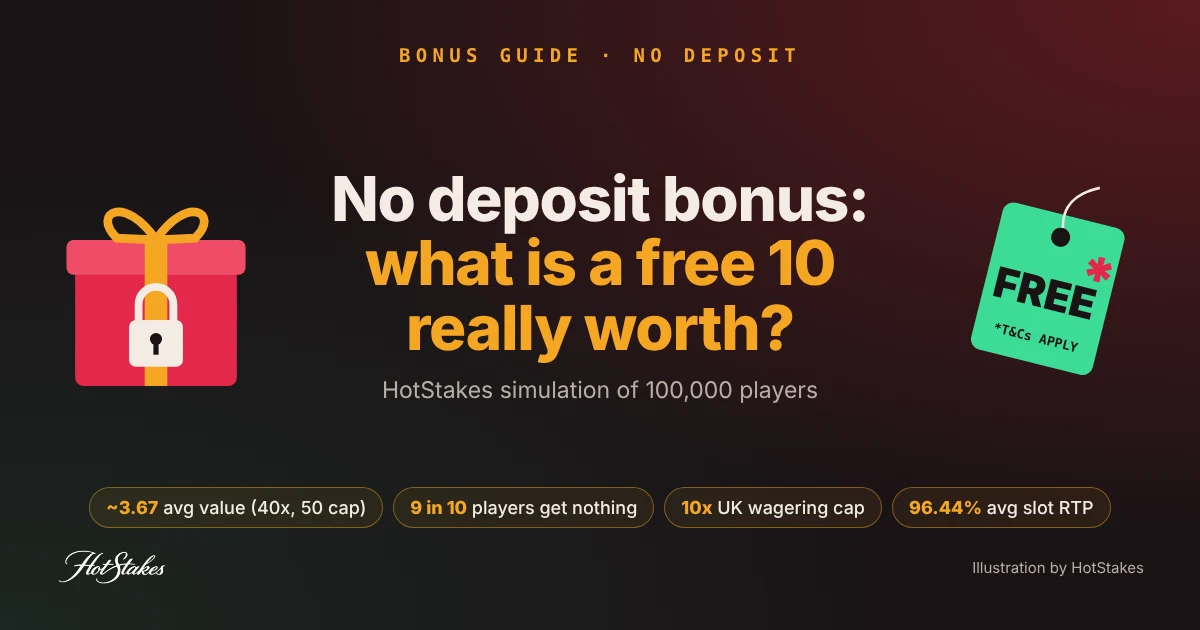
We simulated 100,000 players: a free 10 at 40x with a 50 cap is worth about 3.67, and 9 in 10 get nothing. The maths, the fine print, the scams.
In this article
- What a no deposit bonus actually is
- What a free 10 is worth: the textbook maths
- HotStakes simulation: what happens to 1,000 players
- The max cashout cap: where your upside goes
- The other conditions in a no deposit bonus
- Why casinos give away free money
- What the rules say (the UK benchmark)
- When “free credit” is the bait
- Is a no deposit bonus worth it? A 60-second check
- FAQ
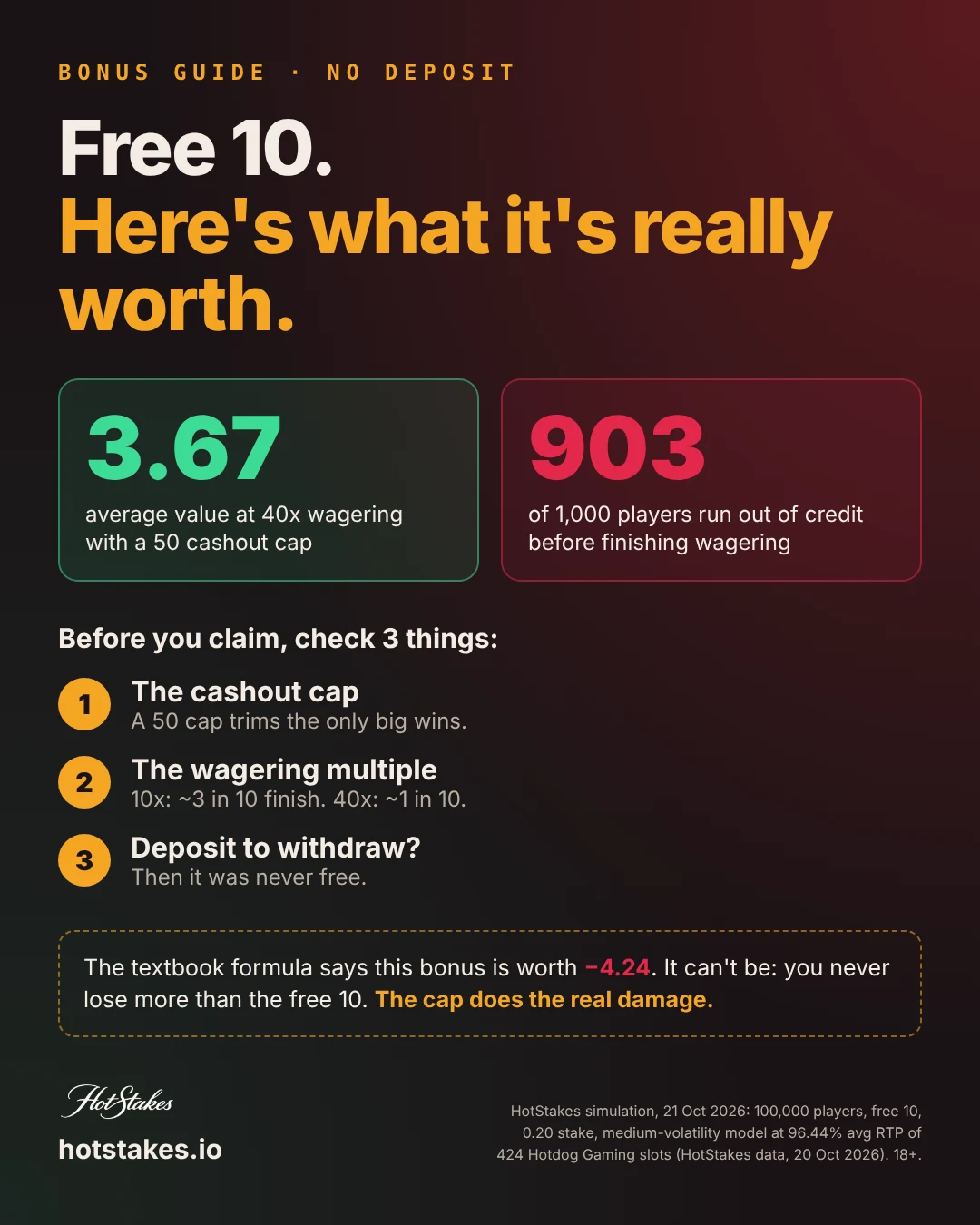
A no deposit bonus gives you bonus credit or free spins just for signing up. It is not cash: you must bet it through a set number of times before anything can be withdrawn, and the winnings are usually capped. On a typical “free 10” with 40x wagering and a 50 cashout cap, our simulation puts the average value at about 3.67, and roughly 9 in 10 players finish with nothing. Below: the maths, a 1,000-player simulation, the fine print that matters and a 60-second check.
What a no deposit bonus actually is
You register, and the casino puts something in your account without asking for a deposit. It comes in two main forms:
- Free credit (“free 10”, “free credit casino”): a fixed amount of bonus funds you can bet on eligible games.
- Free spins (“50 free spins, no deposit”): spins at a fixed value on one or a few named slots. Whatever they win usually lands as bonus funds, not cash.
Either way, the money is locked. You must place bets worth a multiple of the bonus (the wagering requirement) before it turns into withdrawable cash. Our wagering requirements guide covers the mechanics in full.
Takeaway: “No deposit” describes how you get the bonus, not how you get money out of it.
What a free 10 is worth: the textbook maths
A slot’s RTP (return to player) is the long-run share of stakes it pays back. The 424 Hotdog Gaming slots in our database average 96.44% RTP (HotStakes data, synced 20 Oct 2026), so the average house edge is 3.56%.
The formula everyone uses
Expected cost = total bets × house edge. Bonus value = bonus − expected cost. Run a free 10 through it:
| Wagering on a free 10 | Total bets needed | Expected cost at 96.44% RTP | Textbook value |
|---|---|---|---|
| 10x (UK cap) | 100 | 3.56 | +6.44 |
| 30x | 300 | 10.68 | −0.68 |
| 40x | 400 | 14.24 | −4.24 |
| 50x | 500 | 17.80 | −7.80 |
| 60x | 600 | 21.36 | −11.36 |
By this sum, anything above about 28x looks like a losing deal. That works for a deposit match bonus, where your own money is on the line. For a no deposit bonus, it is wrong.
Why that formula is wrong for a no deposit bonus
You can’t lose more than the 10 you were given. When the credit runs out, you simply stop. You never pay the house edge on the bets you didn’t get to make.
So the true value is never negative. To find it, we simulated 100,000 players per scenario (method below). The result, for a 0.20 stake per spin:
| Free 10 at | Players who finish wagering | Average value, no cap | With 100 cap | With 50 cap |
|---|---|---|---|---|
| 10x | 28.9% | 7.85 | 7.38 | 6.36 |
| 30x | 12.0% | 6.50 | 5.60 | 4.15 |
| 40x | 9.8% | 6.28 | 5.21 | 3.67 |
| 50x | 8.2% | 5.87 | 4.75 | 3.23 |
| 60x | 7.1% | 5.51 | 4.29 | 2.85 |
Two things jump out. Going from 30x to 60x barely moves the uncapped value, because most players bust early either way. The cap does more damage than the extra wagering. Try your own numbers in our wagering calculator.
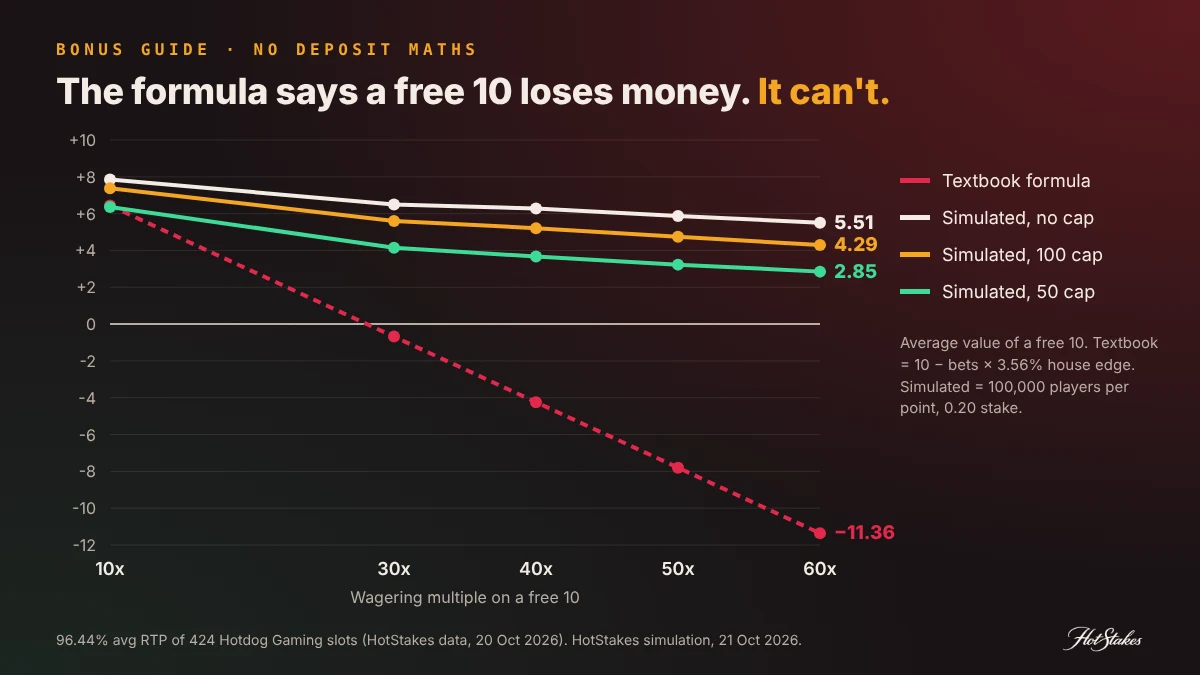
Takeaway: A free 10 is worth something, but on most offshore terms it’s closer to 3 to 5 than to 10.
HotStakes simulation: what happens to 1,000 players
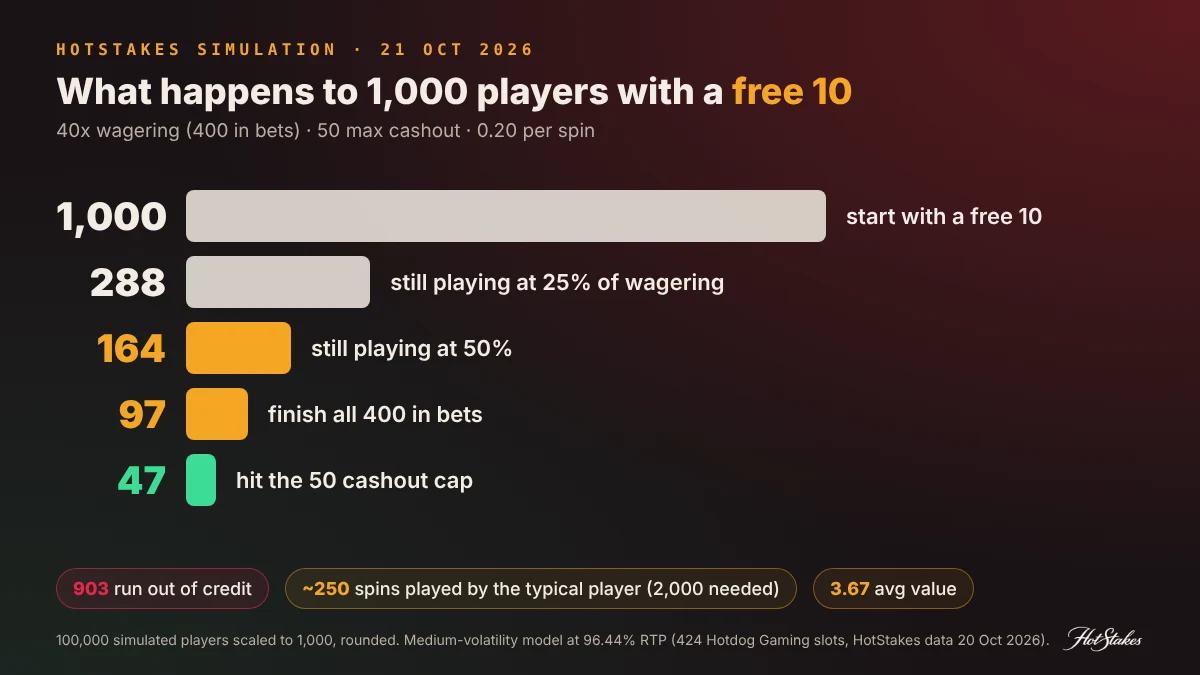
Averages hide how lumpy this is. Here is how we modelled it (HotStakes simulation, 21 Oct 2026):
- Game: one medium-volatility slot model with RTP set to 96.44%. It pays something on about 53% of spins (many of them less than the stake), with a top win of 1,000x.
- Offer: free 10, 40x wagering (400 in bets), 50 max cashout.
- Player: flat 0.20 bet per spin, plays until the wagering is done or the balance can’t cover a spin.
- Scale: 100,000 players, repeated with three random seeds. Each funnel figure moved by 3 per 1,000 or less.
This is a model, not a real game’s maths. Real slots differ, and higher-volatility games bust more players sooner. Here is one run, scaled to 1,000 players:
- 712 are out of credit before reaching a quarter of the wagering.
- 124 more bust between a quarter and halfway.
- 67 get past halfway and still bust.
- 97 finish the 400 in bets. Of those, 7 end with less than 10, 43 with between 10 and 50, and 47 hit the 50 cap.
The typical player made about 250 spins before the credit ran out. Finishing would take 2,000.
And the “free 50 spins” version
Fifty spins at 0.10 each stake 5.00 in total. On our model they return about 4.82 on average, credited as bonus funds. With 10x wagering on those winnings and a 50 cap, 27.1% of players finish and the average value is 3.45. At 40x it drops to 9.3% finishing and 2.38 on average. Our free spins wagering guide breaks down spin value in more detail.
Takeaway: Expect to lose the credit. About 1 player in 10 gets anything out, and a handful get the capped maximum.
The max cashout cap: where your upside goes
For a no deposit bonus, the only way to come out well ahead is a big early win. The cap is designed to cut exactly that outcome.
In the 1,000-player run, the 47 capped players together lost about 2,520 in balance above the 50 limit. Spread across everyone, that is roughly 2.52 per player, about a quarter of the face value of the bonus. The highest balance in that run was 469.14; it paid out 50.
Caps are often written as a fixed amount (“max cashout 50”) or a multiple of the bonus (“5x the bonus amount”). Both work the same way.
Takeaway: Read the cap before the wagering. A low cap turns a lottery ticket into a small, rare prize.
The other conditions in a no deposit bonus
| Condition | Typical wording | Why it matters |
|---|---|---|
| Max bet per spin | “Max bet 5 while bonus is active” | Breaking it can cost the bonus and its winnings. |
| Game weighting / excluded games | “Slots 100%, table games 10% or 0%” | A 10% game needs ten times the betting. |
| Eligible game | “Spins valid on one named slot only” | You can’t pick a higher-RTP game. |
| Expiry | “Bonus expires 72 hours after credit” | Short windows push faster, bigger play. |
| Verification (KYC) | “Valid debit card / ID required” | No verified identity, no withdrawal. |
| One per person / household | “One per player, address, IP or card” | A second account in the household can void both. |
| Deposit to withdraw | “Minimum deposit required before first withdrawal” | Turns “no deposit” into “deposit later”. |
As a real-world check, we read the public no deposit terms of Slot Games, a site run by Jumpman Gaming that states it is licensed by the UK Gambling Commission (checked 21 Oct 2026). The offer: 5 free spins on one named slot, given only after a valid debit card is added. Winnings are paid as bonus funds with 10x wagering, with “max bonus conversion to real funds equal to £50”, and the offer is for new players, once per player and once per debit card.
Break a rule and winnings can be removed. Which rules trigger that is a topic of its own; we’ll cover it separately. If identity checks hold up a payout, see our KYC withdrawal hold guide.
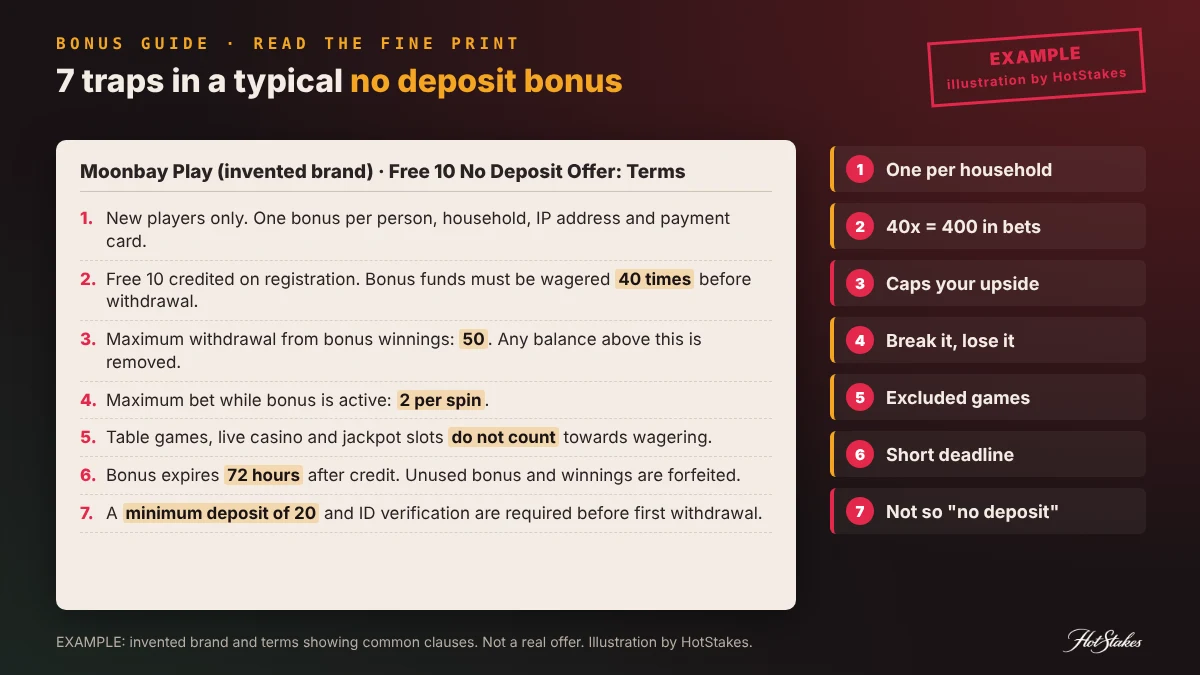
Takeaway: Read the deposit-to-withdraw rule early. If you must deposit before cashing out, the bonus wasn’t free.
Why casinos give away free money
Because it is cheap, and it buys three things.
- A customer at a known cost. In our 40x, 50-cap scenario the casino pays out about 3.67 per free 10 claimed, on average. That is a predictable acquisition cost.
- A verified account. Card and ID checks mean the new player is ready to deposit the moment the free credit runs out.
- Data. Which games you open, how fast you bet and when you stop all shape the next offer you see.
Takeaway: The bonus is a marketing cost. The casino has already worked out the number above.
What the rules say (the UK benchmark)
- 10x wagering cap: Since 19 January 2026, Gambling Commission licensees can’t apply wagering requirements to incentives “over a maximum of 10 times”.
- No mixed-product offers: The same package bans promotions that require “two or more types of gambling, such as betting and playing slots”.
- “Free” must mean free: The ASA says ads must state significant conditions such as wagering and time limits, and an offer shouldn’t be called “free” if the customer must risk their own money to qualify.
- ID before play, not at cashout: The Commission says licensed sites must “ask you to prove your age and identity before you gamble”.
- Bet limits stated up front: Its player guide says firms must be clear about “restrictions on the size of bets” with bonus funds.
None of this binds sites outside Britain, where 40x to 60x and low caps are common.
Takeaway: Use the UK rules as a yardstick. An offer far worse than 10x, from a site with no regulator you can name, deserves a hard second look.
When “free credit” is the bait
On unlicensed sites, “free credit, no deposit” is often the opening line, not the offer. The credit is shown as a balance that grows, then a “fee”, “tax” or “deposit to verify” stands between you and the money.
We searched “free credit casino Malaysia no deposit” on 21 Oct 2026. Five of the nine results sat on unrelated university, newspaper or news-wire domains, the mark of pages planted to borrow someone else’s reputation. We are not linking to them.
Singapore Police have described the end-game: victims told they “would need to deposit more money in order to cash out their winnings”, then the site disappears. See the full pattern in our withdrawal fee scam script and the 9 red flags of fake gambling apps. In Malaysia, report scams to NSRC on 997; in Singapore, call the ScamShield Helpline on 1799.
Takeaway: If a “free” balance needs a payment before it can leave, it was never a bonus. Stop paying.
Is a no deposit bonus worth it? A 60-second check
In our own directory, none of the 14 operator listings advertises a no deposit bonus (HotStakes data, synced 20 Oct 2026); nine advertise percentage welcome bonuses instead, including those for MYR players. If you do meet one elsewhere, run this check:
- Licence first. Name the regulator and check its register. No regulator, no claim.
- Find the cap. A 50 cap on a free 10 puts the average near 3.67 at 40x.
- Find the multiple. 10x leaves about 3 in 10 players finishing; 40x about 1 in 10.
- Check the deposit-to-withdraw rule. If a deposit is required to cash out, treat it as a deposit offer.
- Note max bet, games and expiry. Set your stake to the limit before the first spin.
- Expect to lose the credit. Treat it as a free look at the site, not as income.
- Never pay to release “winnings”. That is a scam, not a condition.
Takeaway: A licensed no deposit bonus is a small, free lottery ticket. Worth taking only if the terms are clear and you’d be happy walking away with nothing.
FAQ
What is a no deposit bonus?
Bonus credit or free spins a casino gives you for registering, without a deposit. Winnings are usually bonus funds that must be wagered a set number of times, and are often capped, before they can be withdrawn.
Is a no deposit bonus worth it?
It can’t cost you your own money, so its value is above zero. In our simulation, a free 10 at 40x wagering with a 50 cap was worth about 3.67 on average, and about 9 in 10 players finished with nothing.
Can you really win money from a no deposit bonus?
Yes, but rarely, and only up to the cap. In our 40x simulation about 97 of 1,000 players finished wagering, and 47 of them were held to the 50 maximum cashout.
Why do I have to verify my identity or card for a free bonus?
Licensed operators must confirm age and identity, and card checks help enforce one offer per person. In Britain, sites must verify you before you gamble rather than only when you withdraw.
Is a “free credit casino” a scam?
Not always, but “free credit” is a common hook on unlicensed sites. If you are asked to pay a fee, tax or deposit to release winnings, stop: it is a recognised scam pattern. Report it to your national scam line.
HotStakes is an independent directory. Some links on this site are affiliate links; we may earn a commission at no cost to you, and it never changes our rankings. Gambling involves risk — only play with money you can afford to lose, and if it stops being fun, seek help. This article is general information, not legal advice.
Prefer to play only where licences are checked? Browse vetted operators by currency. 18+ only.
 Next story →Should I Quit Gambling? What Your Habit Costs a Year

Start the discussion