

Deposit Match Bonus Explained: What 100% Is Really Worth
Same 100% deposit match bonus: worth +64 or cost 114, depending on one word in the terms. The maths, sticky vs non-sticky and a 60-second checklist.
In this article
- How a 100% deposit match bonus works
- Bonus-only vs deposit+bonus: the word that doubles the bill
- What a deposit match bonus is really worth: the expected-value maths
- Game weighting: why baccarat counts 10% (or nothing)
- Max bet, max cashout and expiry
- Sticky vs non-sticky bonus: which one is a “phantom”?
- What the rules say
- Deposit match offers in our directory
- How to read a match bonus offer in 60 seconds
- FAQ
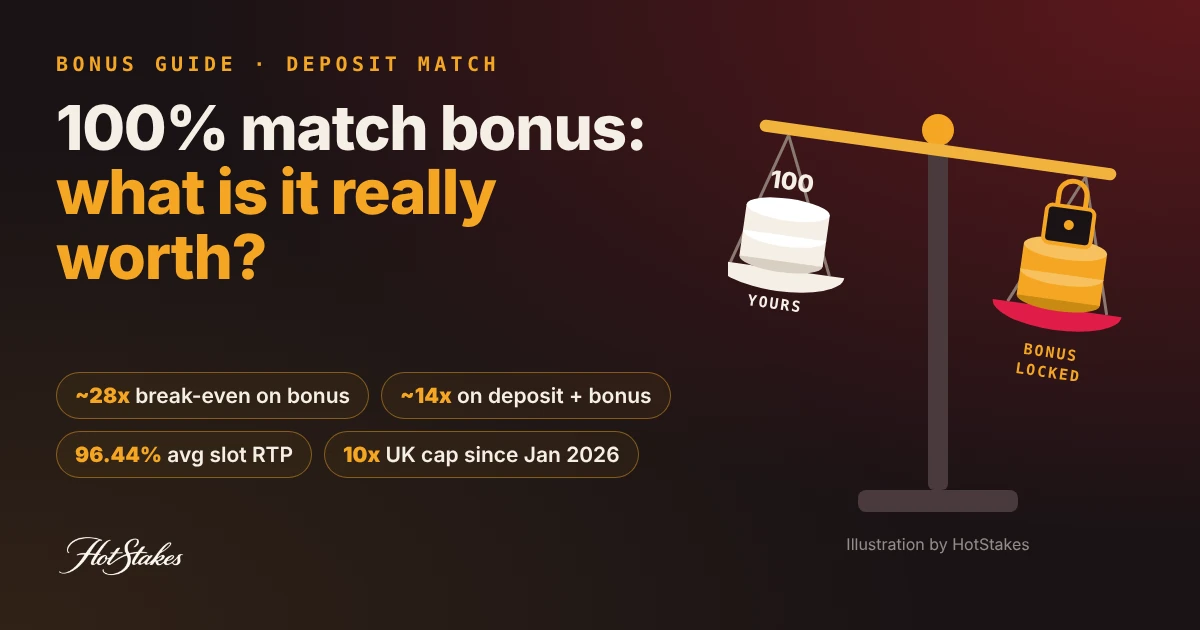
A deposit match bonus adds bonus money in proportion to what you deposit: put in 100, get 100 more with a 100% match. That bonus is not cash. You must bet it through a set number of times before anything can be withdrawn. Whether the wagering is counted on the bonus alone or on deposit plus bonus decides most of its value: at our 96.44% average slot RTP, the same 100% offer at 30x is roughly break-even on the bonus but costs about 114 on deposit plus bonus. Below: the maths, the fine print and a 60-second checklist.
How a 100% deposit match bonus works
You deposit 100. The casino adds 100 in bonus funds. Your balance now shows 200.
Only half of that is yours. The other 100 is locked until you meet the wagering requirement, which means placing bets worth a set multiple of the bonus (or of deposit plus bonus) before the casino lets you cash out.
A 50% match on the same deposit adds 50. A 200% match adds 200. The percentage only tells you how big the locked pile is, not how hard it is to turn into cash.
Most offers also carry a maximum bonus (“100% up to 500”), a minimum deposit, a time limit, a maximum bet per spin and a list of games that count less or not at all. We cover the general mechanics in our wagering requirements guide.
Takeaway: The match percentage sets the size of the bonus. The terms set its value.
Bonus-only vs deposit+bonus: the word that doubles the bill
Two offers can both say “100% bonus, 30x wagering” and be completely different products.
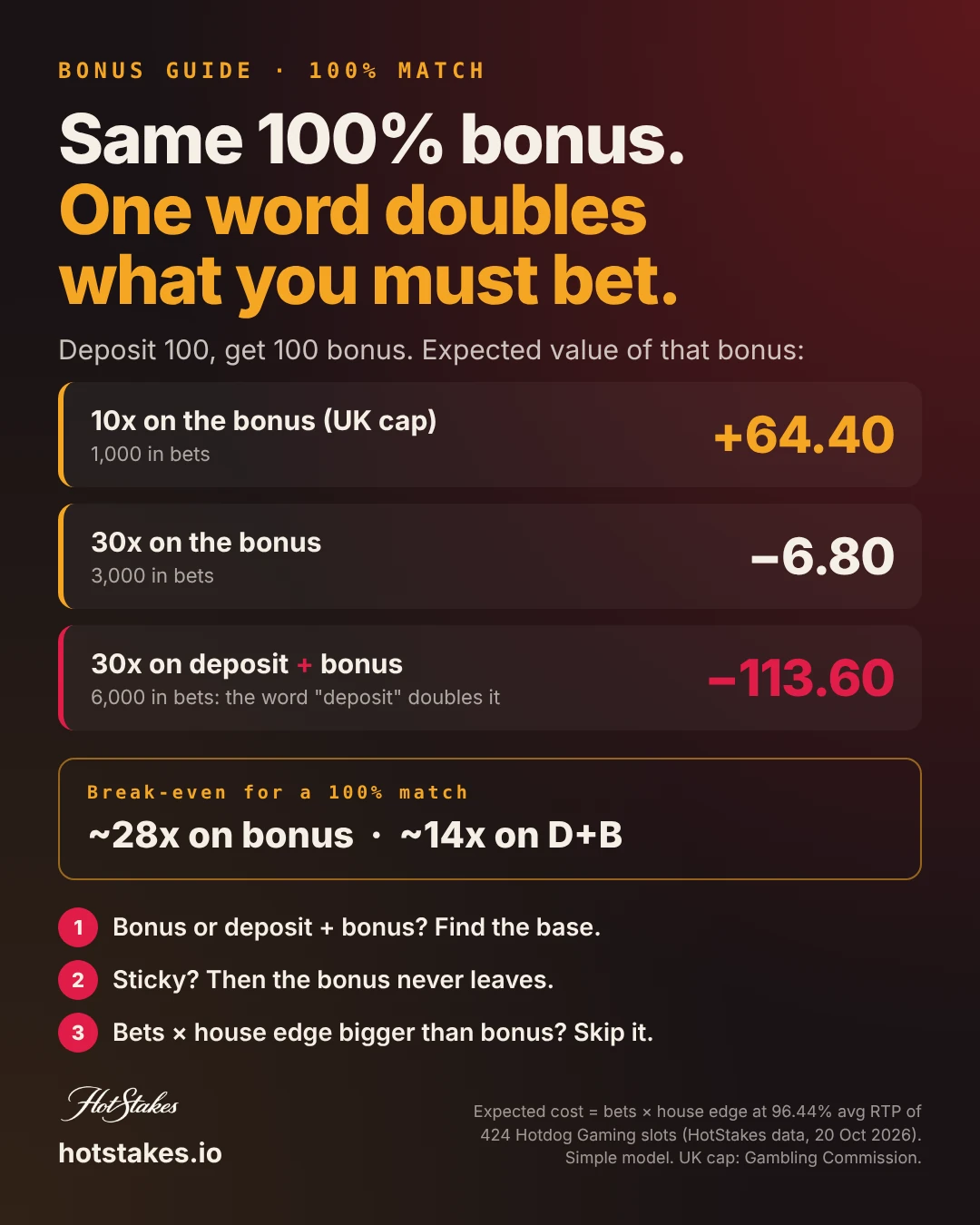
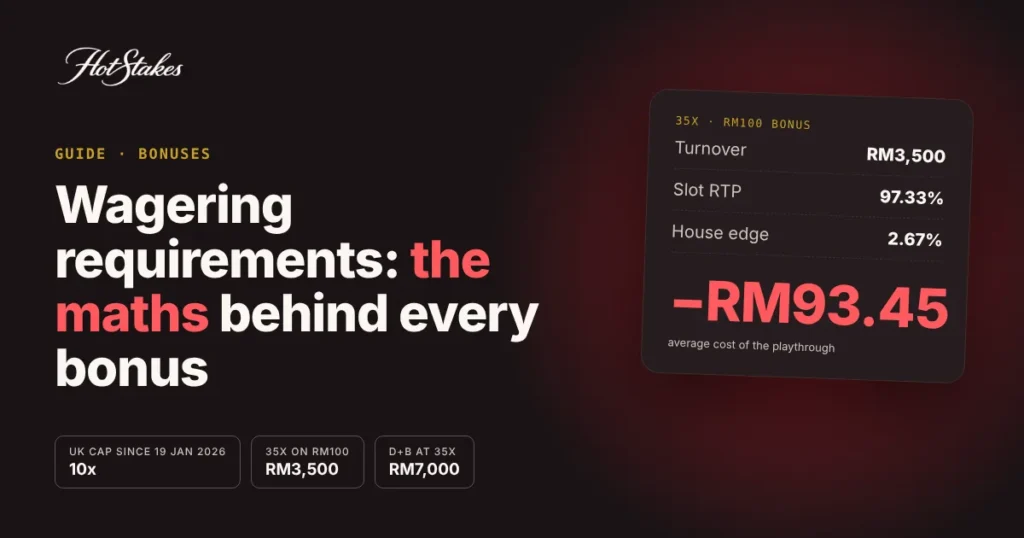
- 30x on the bonus: 100 bonus × 30 = 3,000 in bets before withdrawal.
- 30x on deposit + bonus: (100 + 100) × 30 = 6,000 in bets.
Same headline, same multiplier, twice the turnover. Twice the turnover means twice the expected loss, because every bet pays the house edge.
Look for wording like “wagering applies to deposit and bonus”, “(D+B)” or “35x (deposit + bonus)”. If the terms only say “30x”, ask support which base they mean before you deposit.
Takeaway: “D+B” in the terms doubles what you have to bet. Treat a D+B multiplier as if it were twice as high.
What a deposit match bonus is really worth: the expected-value maths
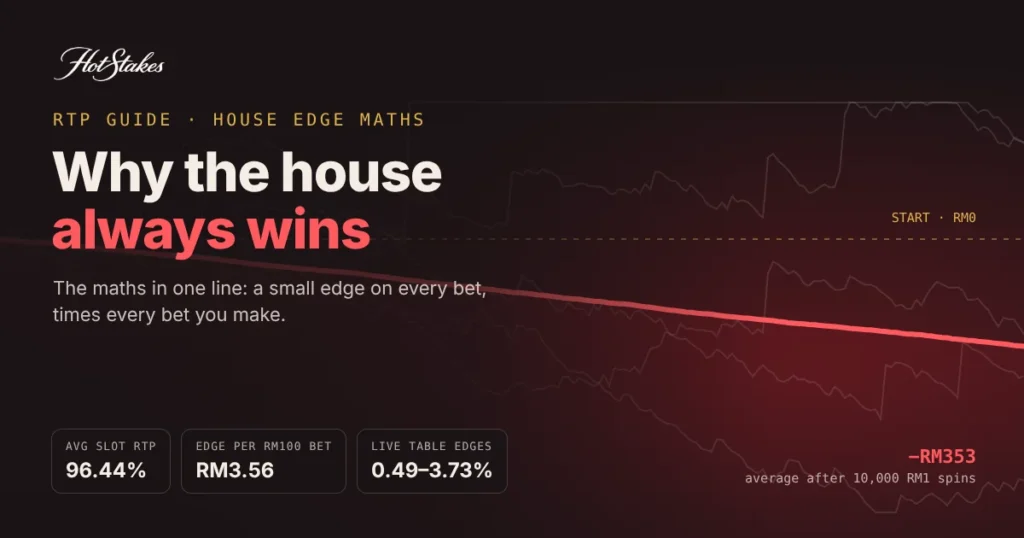
A slot’s RTP (return to player) is the long-run share of stakes it pays back. The rest is the house edge. The 424 Hotdog Gaming slots in our database average 96.44% RTP (data synced 20 Oct 2026), so the average house edge is 3.56%. Our RTP vs volatility guide explains why that number only holds over many spins.
The formula
Expected cost of the wagering = total bets × house edge.
Expected value of the bonus = bonus amount − expected cost.
For a 100 bonus at 30x on the bonus: 3,000 × 3.56% = 106.80 expected cost. 100 − 106.80 = −6.80. You are, on average, slightly worse off than if you had never taken it.
Five scenarios, same 100 deposit and 100% match
| Wagering | Total bets needed | Expected cost at 96.44% RTP | Expected value of the 100 bonus |
|---|---|---|---|
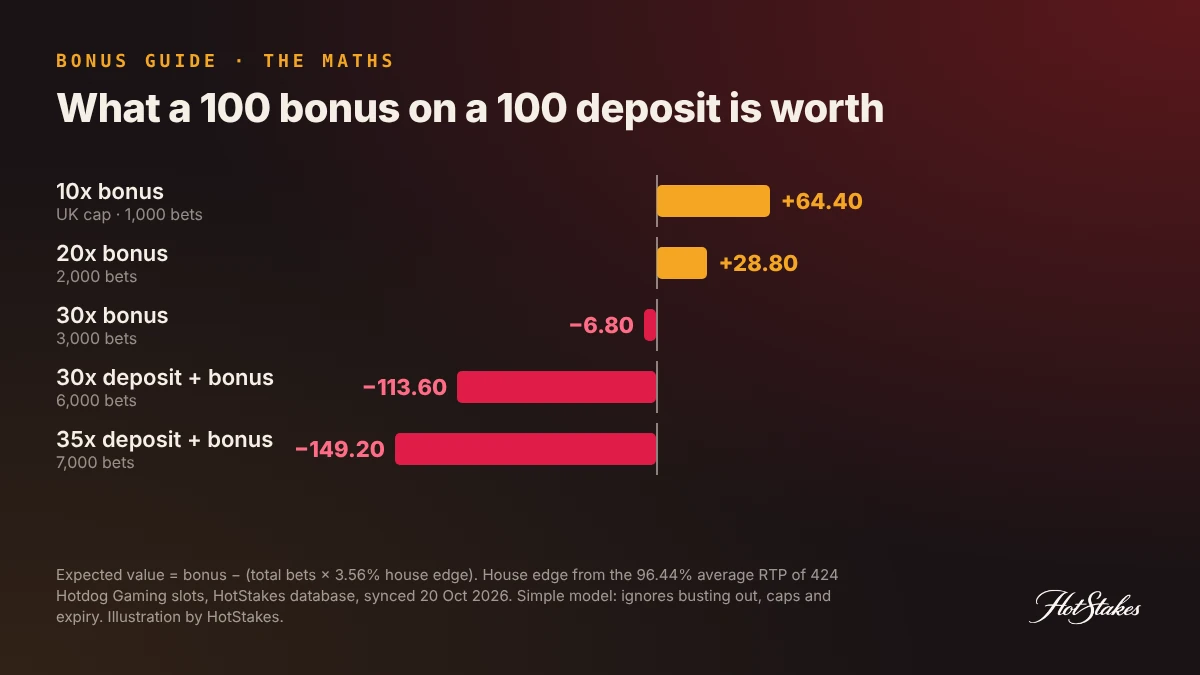
| 10x bonus (UK cap) | 1,000 | 35.60 | +64.40 |
| 20x bonus | 2,000 | 71.20 | +28.80 |
| 30x bonus | 3,000 | 106.80 | −6.80 |
| 30x deposit + bonus | 6,000 | 213.60 | −113.60 |
| 35x deposit + bonus | 7,000 | 249.20 | −149.20 |
The break-even point for a 100% match at this RTP is about 28x on the bonus (100 ÷ 3.56) or about 14x on deposit plus bonus. Anything above that line has a negative expected value before any other rule kicks in. You can run your own numbers in our wagering calculator.
Slot choice changes the cost more than four times
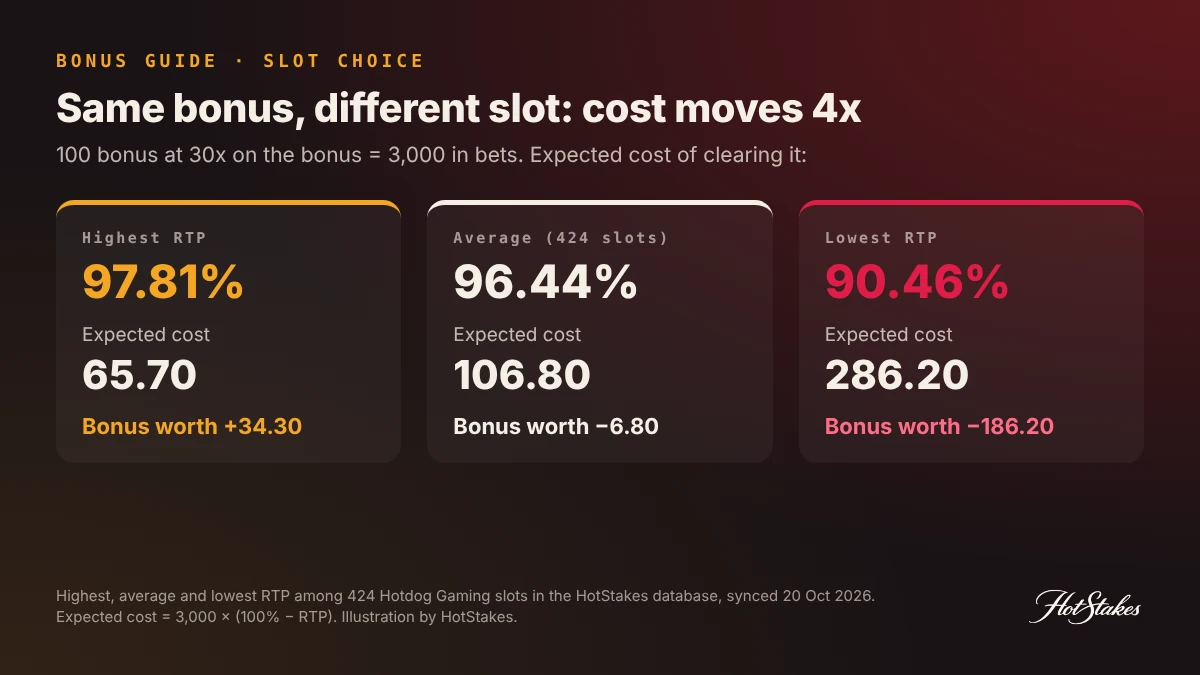
The average hides a wide spread. In our database the lowest-RTP slot returns 90.46% and the highest 97.81%. Run the same 30x-on-bonus offer through each:
- At 97.81% RTP: 3,000 × 2.19% = 65.70 expected cost. Bonus worth about +34.30.
- At 90.46% RTP: 3,000 × 9.54% = 286.20 expected cost. Bonus worth about −186.20.
Same offer, same deposit. The slot you clear it on swings the result by about 220. Check the RTP on the game page (our slot pages list it).
Why the real result is messier
The formula is an average. You can’t lose more than your balance, so on a high multiplier most players run out of money before they finish, and the bonus disappears with it. High-volatility slots make that more likely. The house edge still works on every spin you did play.
Takeaway: Multiply the total bets by the house edge. If that number is bigger than the bonus, the bonus costs you money on average.
Game weighting: why baccarat counts 10% (or nothing)
Games contribute to wagering at different rates. The UK Gambling Commission gives this example: with roulette at a 30% weighting, each £1 wagered contributes 30p.
Low-edge games are weighted down for a reason. The baccarat tables in our StakeGO live data carry a house edge of 1.06% to 1.24%. Clearing 3,000 in bets at 1.06% would cost only 31.80, which is why casinos cut table games to 10% or exclude them.
At a 10% weighting, the same 3,000 requirement means 30,000 in real baccarat bets. At 1.06% that is about 318 in expected losses, three times the bonus.
Takeaway: Divide the requirement by the weighting. A 10% game needs ten times the betting.
Max bet, max cashout and expiry
Maximum bet
Most match bonuses cap your stake per spin or hand while the bonus is active; the Gambling Commission tells firms to be clear about “restrictions on the size of bets”. Breaking it can cost you the bonus and the winnings from it, so set your bet size to the cap before you spin.
Maximum cashout
Some offers limit how much you can withdraw from bonus play, often as a fixed amount or a multiple of the bonus. A cap cuts off the rare big win, which is the only outcome that makes a high-wagering bonus pay. If the cap is low, the real value is lower than the table above.
Expiry
Bonuses usually expire after a set number of days. Unfinished wagering means the bonus and its winnings are removed. A short window pushes you to bet faster and bigger.
Takeaway: Note the max bet, the cashout cap and the deadline. Any one of them can turn a fair-looking offer into a poor one.
Sticky vs non-sticky bonus: which one is a “phantom”?
This is the second line of fine print that changes the maths.
| Sticky (“phantom”) bonus | Non-sticky (parallel) bonus | |
|---|---|---|
| Which money is used first | Deposit and bonus mixed in one balance | Your real money first; bonus only once it’s gone |
| If you win early | Still locked until wagering is done | You can usually withdraw and give up the bonus |
| At cashout | The bonus amount is removed; only winnings above it leave | No deduction if you never touched the bonus |
| Who it suits | Mostly the casino | The player, if terms allow early withdrawal |
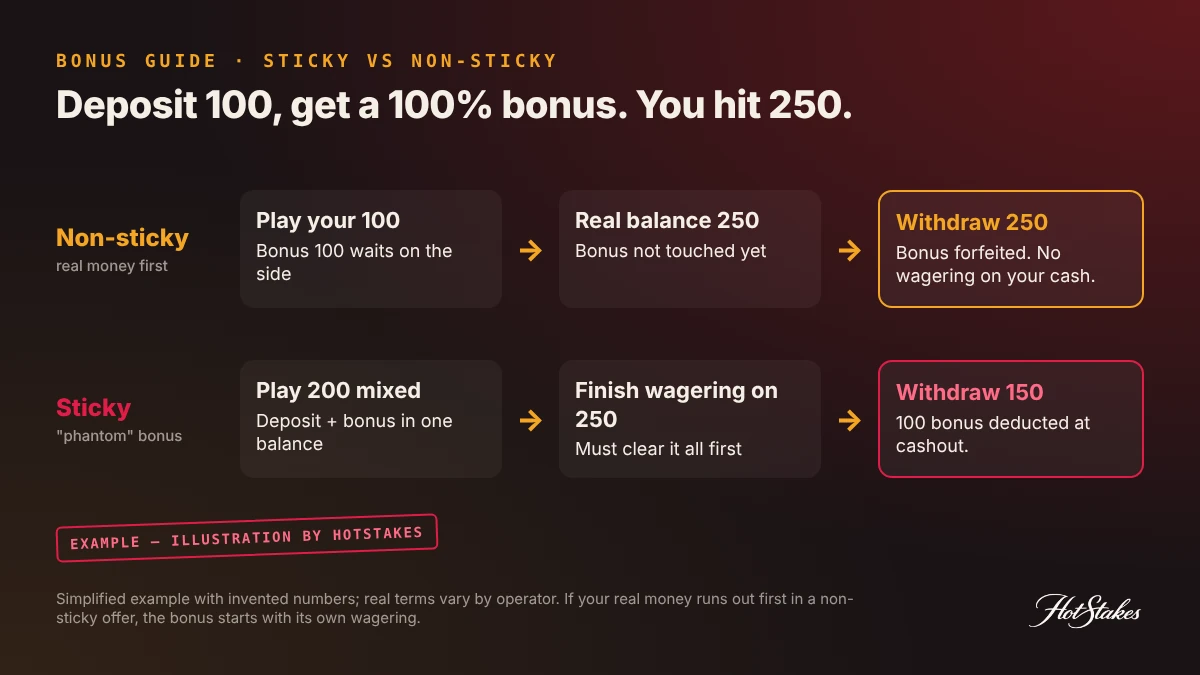
Why “phantom”? Because a sticky bonus never leaves the casino. It only lets you bet more. Deposit 100, get 100 sticky, finish wagering on 250, and you withdraw 150.
A non-sticky bonus works like a second chance. If your deposit runs up first, you can often leave with it. If it runs out, the bonus takes over with its own wagering. That makes non-sticky offers worth more on the same headline.
Takeaway: Search the terms for “sticky”, “non-withdrawable” or “bonus will be deducted”. If you find them, the bonus can’t be cashed out.
What the rules say
- UK 10x cap: Since 19 January 2026, Gambling Commission licensees can’t set wagering above 10 times. The Commission says requirements “must not exceed 10 times the incentive amount”. The same package bans offers that mix products, such as a bet that triggers casino spins (Gambling Commission announcement).
- Your own deposit (UK): After CMA action, firms committed that players can withdraw their own money without meeting play-through first. The Commission’s player guide says firms should “let you keep what is left of your deposit”.
- Advertising (UK): The ASA/CAP lists deposit or wagering requirements and time limits as likely significant conditions. Ads must “clearly and prominently communicate” them where leaving them out would mislead.
Outside Britain, none of this applies automatically. Where there is no cap, multipliers of 30x and above, sometimes on deposit plus bonus, are allowed.
Takeaway: Use the UK 10x cap as a benchmark. An offer far above it, with no regulator behind it, is worth a hard second look.
Deposit match offers in our directory
We counted the advertised headline offers as listed in our directory on 20 Oct 2026. Of 15 operator listings across nine currencies, 8 advertise a percentage welcome bonus and 7 advertise none. The percentages run from 30% to 299%. Only one is exactly 100%: Nova88 for Malaysian ringgit players (see MYR operators).
A percentage headline usually signals a deposit match, but a headline is not the terms. We have not reviewed the wagering base, multiplier or stickiness behind these offers, so check them on the operator’s site before depositing. Browse all listings on our operators page.
Takeaway: A bigger percentage is not a better offer. A 299% match at 40x D+B can be worth far less than a 50% match at 10x on the bonus.
How to read a match bonus offer in 60 seconds
- Find the base. Is the wagering on the bonus or on deposit + bonus? If D+B, double the multiplier in your head.
- Find the multiplier. At 96.44% RTP, above ~28x on the bonus (or ~14x on D+B) the bonus loses money on average.
- Check sticky or non-sticky. Can you withdraw your own winnings before the bonus kicks in?
- Check game weighting. Which games count 100%, which count less, which count nothing?
- Note the max bet. Set your stake to it before the first spin.
- Note the max cashout. A low cap kills the only outcome that makes high wagering pay.
- Note the deadline. Divide the total bets by the days you have. If that’s more than you’d normally play, skip it.
- Do the sum. Total bets × house edge vs the bonus. If the cost is bigger, decline the bonus and play with your own money.
Similar checks apply to other offers: see our guides to free spins wagering and cashback bonuses.
FAQ
What is a 100% deposit match bonus?
The casino adds bonus funds equal to your deposit, usually up to a maximum. Deposit 100 and you get 100 in bonus money. It must be wagered a set number of times before it, or winnings from it, can be withdrawn.
Is a deposit match bonus worth it?
Only if the expected cost of the wagering is smaller than the bonus. At a 96.44% average slot RTP, a 100% match breaks even at about 28x on the bonus or about 14x on deposit plus bonus. Above that, it loses money on average.
What does wagering on deposit plus bonus mean?
The multiplier is applied to your deposit and the bonus combined. With 100 deposited and 100 bonus at 30x, you must bet 6,000 instead of 3,000. That doubles the expected cost.
What is the difference between a sticky and a non-sticky bonus?
A sticky bonus can never be withdrawn; it is removed from your balance at cashout. A non-sticky bonus lets you play your real money first and usually withdraw winnings before the bonus is used, forfeiting the bonus.
Is there a limit on wagering requirements?
In Great Britain, yes. Since 19 January 2026, Gambling Commission licensees can’t set wagering above 10 times the bonus amount. Many other markets have no such cap, so check the multiplier yourself.
HotStakes is an independent directory. Some links on this site are affiliate links; we may earn a commission at no cost to you, and it never changes our rankings. Gambling involves risk — only play with money you can afford to lose, and if it stops being fun, seek help. This article is general information, not legal advice.
 Next story →Bonus Buy Slots: Does Buying the Feature Change Your Odds?


Start the discussion