

Casino Cashback Bonus Explained: What 10% Back Is Worth
10% cashback on a 96.5% RTP slot cuts the house edge from 3.50% to 3.15%. How cashback is calculated, what wagering does to it, and the catch.
In this article
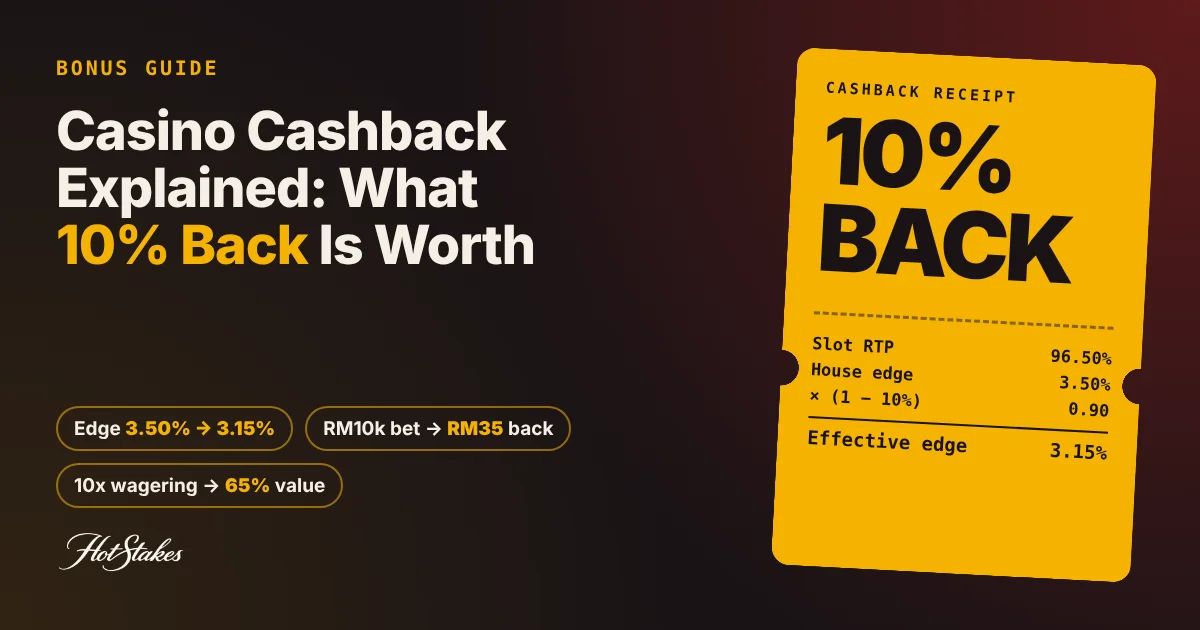
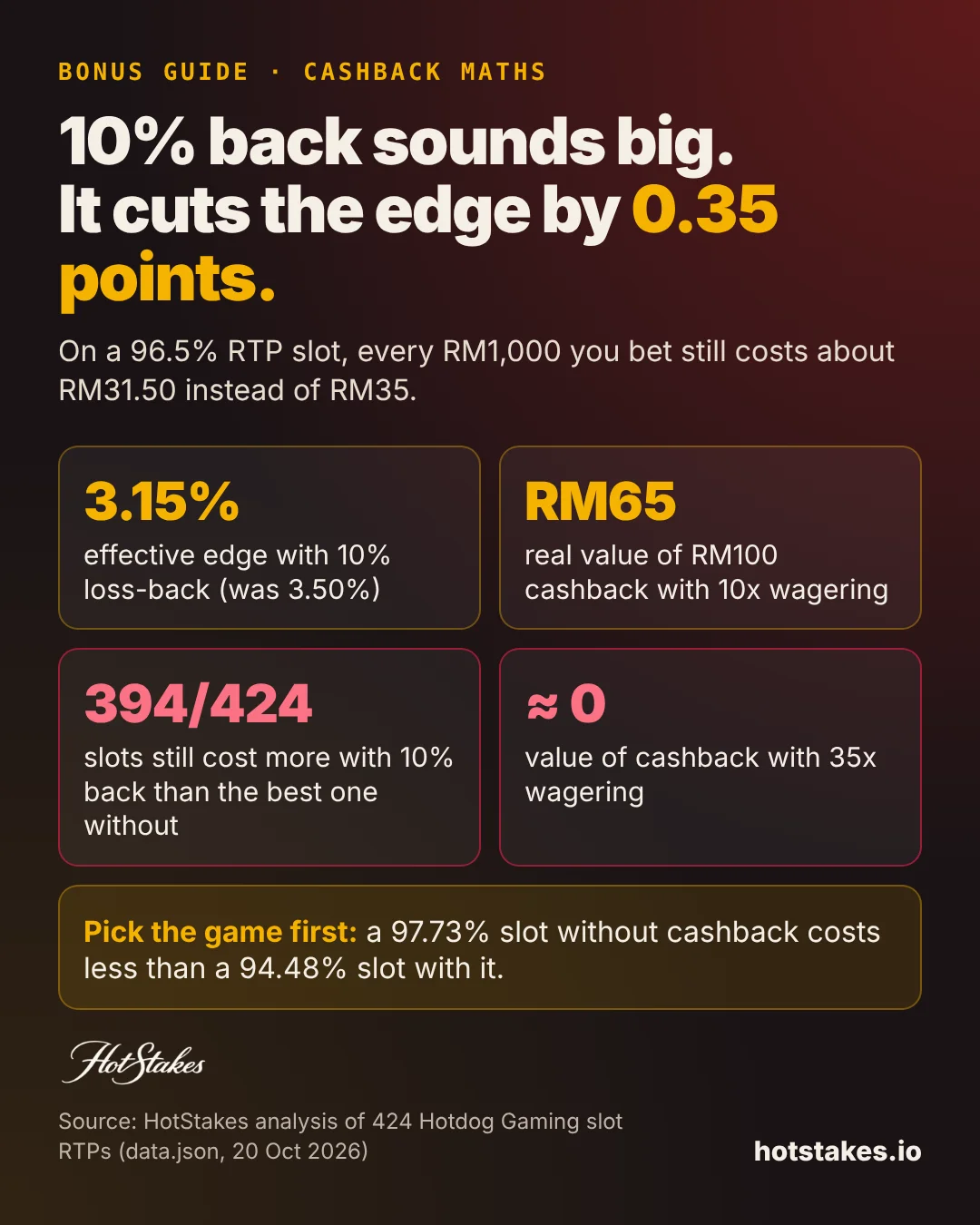
A “10% weekly cashback” banner reads like a discount on losing. It is one, but a small one. On a slot with 96.5% RTP, 10% back on net losses cuts the house edge from 3.50% to about 3.15%, so you still lose roughly RM31.50 of every RM1,000 you bet instead of RM35. This guide shows how cashback is calculated, what the payout form does to its value, and why a reward built on losses deserves a second look.
How a casino cashback bonus is calculated
Almost every casino cashback bonus runs on the same formula: net loss in a period × cashback %, then trimmed by a minimum, a cap and the game list.
“Net loss” is the part that varies. Some casinos count total stakes minus total winnings. Others count deposits minus withdrawals and remaining balance. Either way, a winning period earns nothing.
Six variables decide what the headline percentage is really worth:
| Variable | Typical wording | What it does to the value |
|---|---|---|
| Percentage | 5%, 10%, 15%, 20% | The headline. Only meaningful alongside the other five rows. |
| Basis | “Net losses” or “total stakes” | Loss-based pays only when you lose; stake-based (a rebate) pays win or lose. |
| Period | Daily, weekly, monthly | Longer periods net more winning sessions against losing ones, so fewer payouts. |
| Minimum loss | “Net loss of at least RM100” | Below it you get nothing at all. |
| Cap | “Max RM300 per week” | Losses beyond the cap earn 0% back. |
| Payout form | Cash, or bonus funds with wagering | Cash is worth face value; bonus funds are worth less, sometimes nearly nothing. |
Excluded games sit on top of all this. Live casino, table games and low-RTP or jackpot slots are often left out, so losses on them do not count.
Under those terms, the cap is hit at RM3,000 of net loss. Every ringgit lost after that earns nothing back. A RM90 losing week earns nothing either.
Takeaway: read the basis, minimum, cap and payout form before you look at the percentage.
The maths: what 10% back does to a 96.5% slot
We checked this against our own data on 20 Oct 2026, using the RTPs published for 424 Hotdog Gaming slots in the HotStakes directory. RTP is the long-run share of stakes a game pays back; the rest is the house edge (our RTP vs volatility guide explains the difference).
Worked example: Fortune Meow at 96.50% RTP
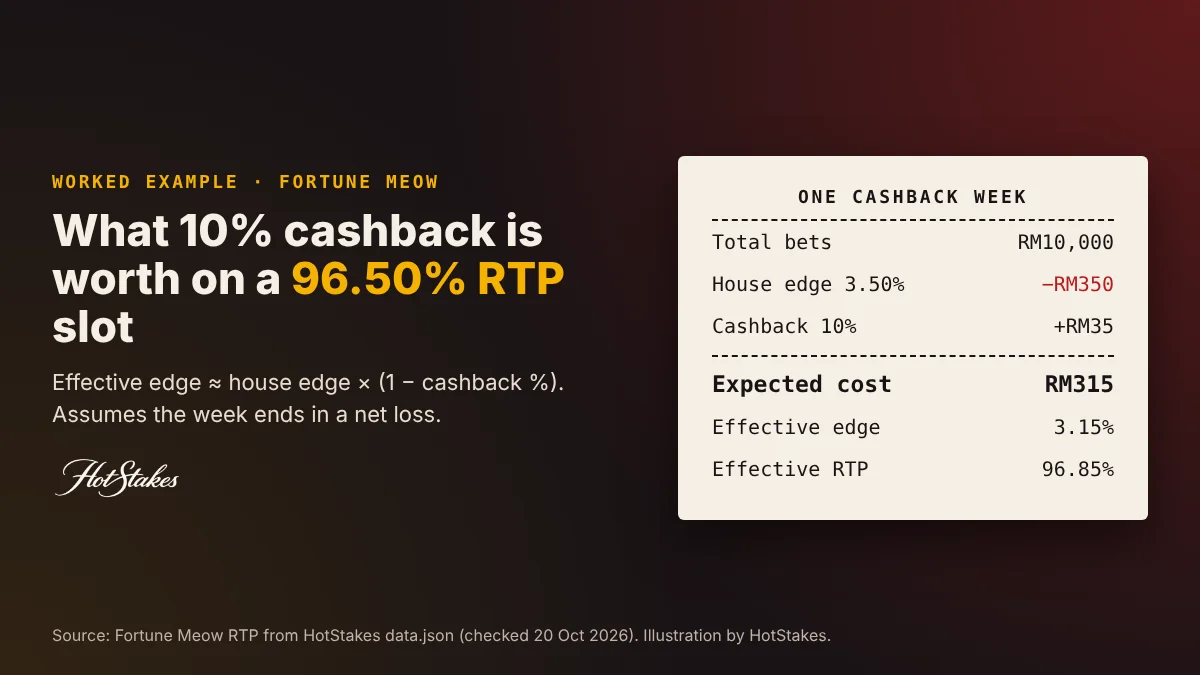
Fortune Meow lists a 96.50% RTP, so the house edge is 3.50%. Say you bet a total of RM10,000 in a cashback week.
- Expected loss: RM10,000 × 3.50% = RM350.
- 10% cashback on that loss: RM35.
- Expected loss after cashback: RM315, or 3.15% of what you bet.
- Effective RTP: about 96.85%.
That is the whole effect: 0.35 percentage points. The shortcut is simple: effective edge ≈ house edge × (1 − cashback %).
One caveat: this assumes the week ends in a net loss. Weeks you finish ahead pay no cashback, and results swing a lot on any single week, so treat 3.15% as the long-run estimate, not a promise.
Loss-back vs turnover rebate
Some offers pay a small percentage of everything you stake instead, often called a rebate. The comparison is easy once you convert both to “per RM bet”.
10% loss-back on a 3.50% edge is worth about 0.35% of turnover. An EXAMPLE 0.5% turnover rebate on the same RM10,000 would pay RM50, win or lose. A rebate that looks tiny can beat a cashback that looks generous.
Game choice beats cashback
Here is the number the promo banner will never show. In the Malaysia (MYR) Top 30 by turnover in our data, RTPs range from 94.48% (Caishen Win!) to 97.73% (Gummy Rush).
- Caishen Win! with 10% cashback: edge 5.52% → about 4.97%.
- Gummy Rush with no cashback at all: edge 2.27%.
- To close that gap with cashback alone, you would need about 59% back.
Across the full list, 394 of 424 Hotdog slots still have a higher edge with 10% cashback than Gummy Rush has without it. The average edge across all 424 drops only from 3.56% to 3.20%.
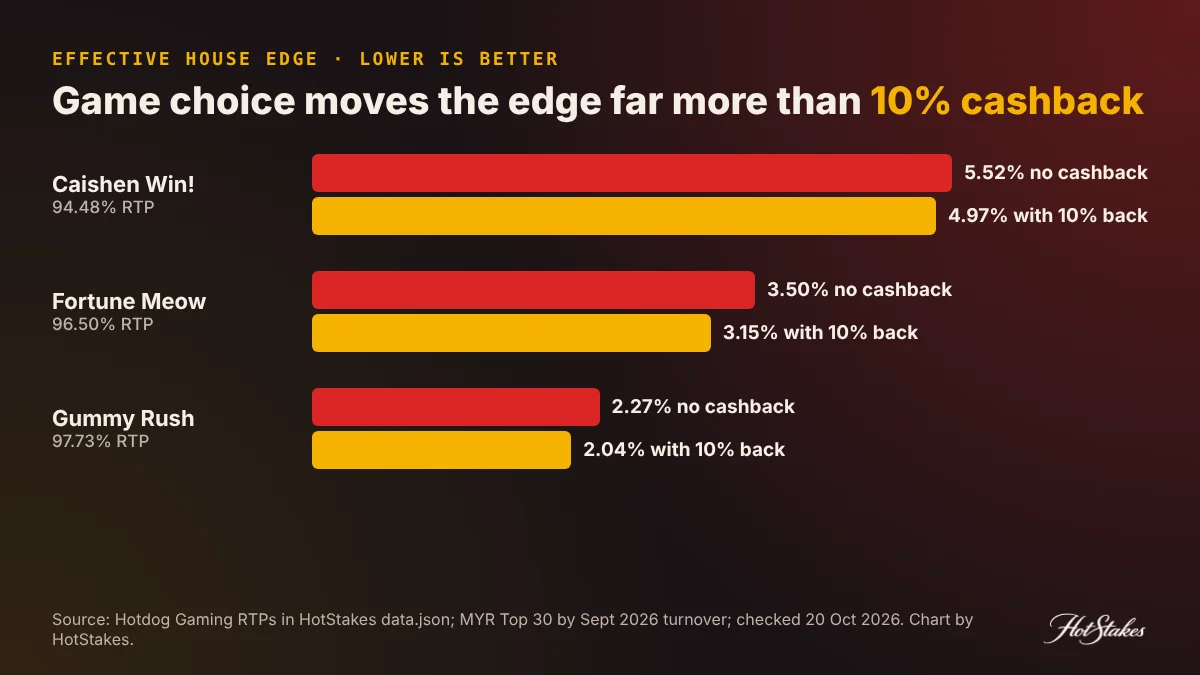
Takeaway: multiply the house edge by (1 − cashback %) to see what you really pay, then compare that with simply picking a higher-RTP game.
Cash vs bonus funds: wagering decides the value
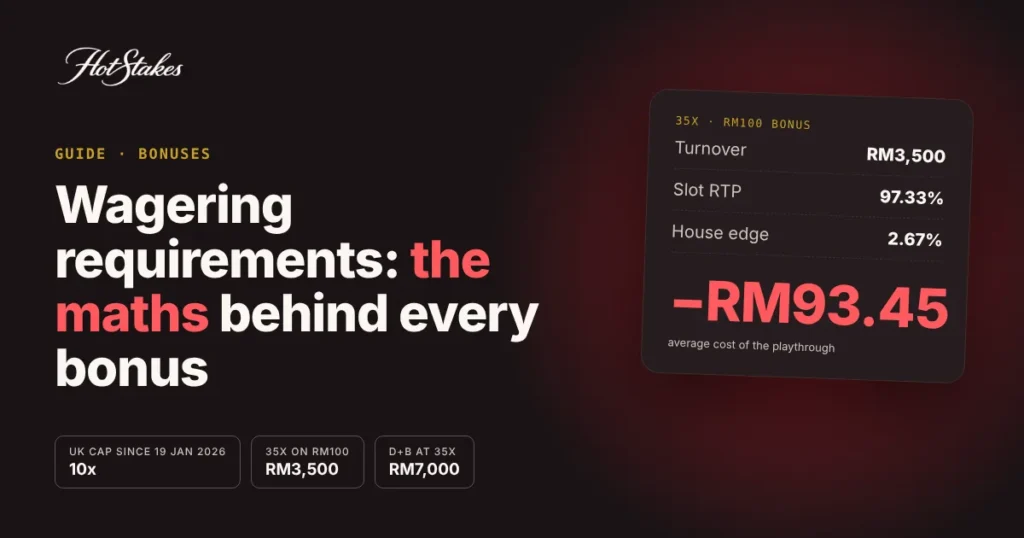
RM35 in withdrawable cash is worth RM35. RM35 in bonus funds with wagering is worth less, because you must bet it through again at the same house edge before you can withdraw. The full mechanics are in our wagering requirements guide.
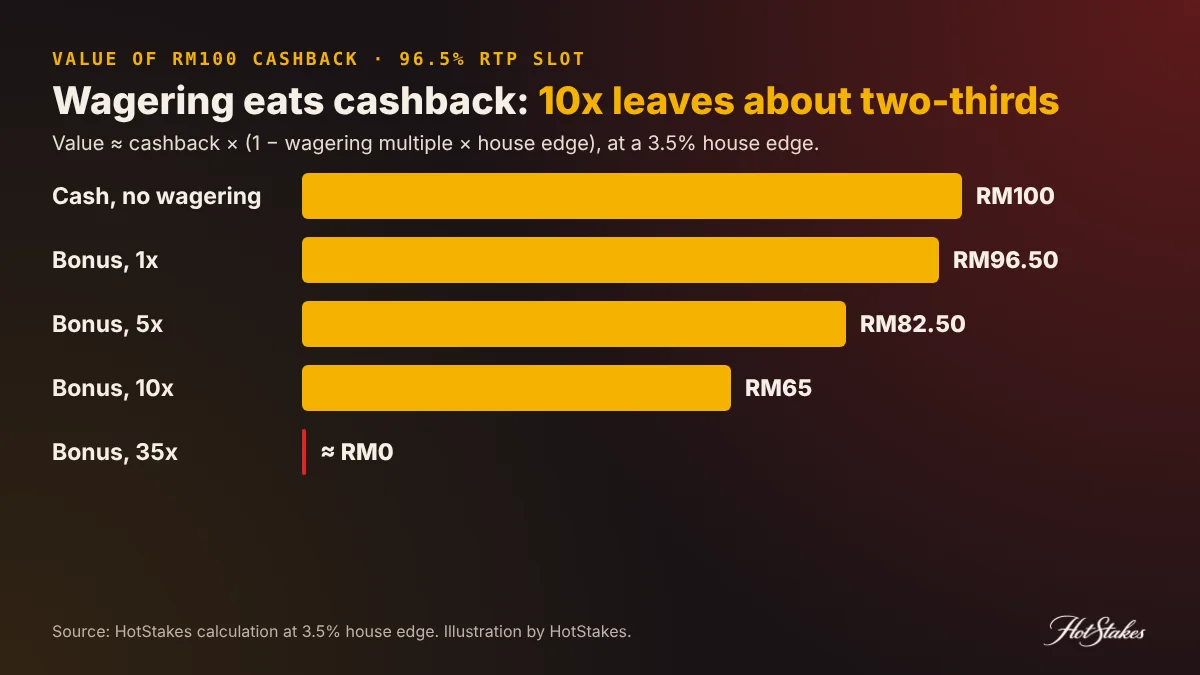
The rough rule: value ≈ cashback × (1 − wagering multiple × house edge). On a 3.50% edge slot, per RM100 of cashback:
| Paid as | You must bet | Expected cost of wagering | Approx. value of RM100 |
|---|---|---|---|
| Cash, no wagering | RM0 | RM0 | RM100 |
| Bonus, 1x | RM100 | RM3.50 | RM96.50 |
| Bonus, 5x | RM500 | RM17.50 | RM82.50 |
| Bonus, 10x | RM1,000 | RM35 | RM65 |
| Bonus, 35x | RM3,500 | RM122.50 | Close to zero |
At 35x the expected cost is larger than the bonus itself. Because you cannot lose more than the bonus, the value bottoms out near zero rather than going negative.
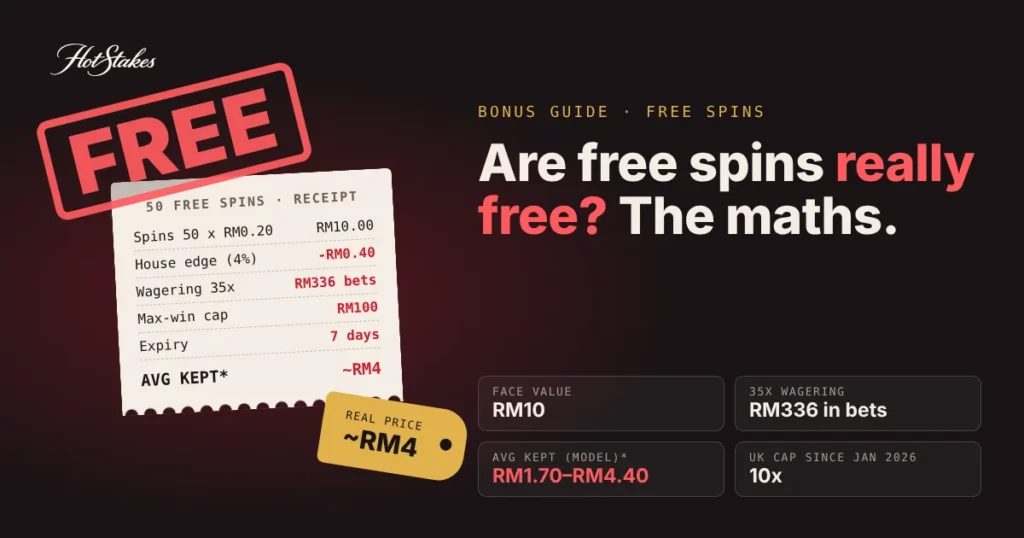
Regulators have noticed. In Great Britain, the Gambling Commission’s rewards-and-bonuses code now says operators must not apply wagering requirements “over a maximum of 10 times“. The cap took effect on 19 January 2026; the Commission said high requirements “could confuse consumers and lead them to gamble for longer“. That cap applies to British-licensed operators only, so offers elsewhere can still carry 30x or more.
Takeaway: run the numbers through our wagering calculator before counting cashback as money; the same check applies to free spins winnings.
Why “loss back” can push you to chase
A cashback offer is the only common bonus that pays more the more you lose. That is the design, and it creates three pressure points.
- The threshold. Down RM80 with a RM100 minimum? The offer quietly suggests losing another RM20 to “qualify”.
- The cushion. “I’ll get 10% back” can make the next deposit feel 10% cheaper. It is not: you still lose 90 sen of every ringgit lost.
- The period end. A losing Sunday night can feel like a race to “use” the cashback week before it resets.
These are our reading of how the terms are built, not measured effects. The research points in the same direction, though.
In an eye-tracking study of betting adverts, Lole and colleagues (2020) found reduced-risk and cash-back offers drew more fixations than other offer types. The authors warned that offers which seem safer may worsen harm for people already at risk.
A French randomised study by Challet-Bouju and colleagues (2020) found that inducements increased the money people wagered, and the largest bonus raised reported loss of control. It was small and single-session, so treat it as an early signal.
Advertising rules also reflect the “safety net” problem. The UK’s ASA advice on free bets and bonuses says “risk-free” claims should be avoided unless the customer cannot lose their own funds. Loss-back never meets that bar: you lose your own money first.
Trying to win back what you lost is one of the warning signs on the NHS gambling self-check, where it is called chasing losses. If a cashback offer is the reason you are still playing, that is worth noticing.
Free, confidential help:
- Singapore: NCPG helpline 1800-6-668-668 (ncpg.org.sg).
- Hong Kong: gambling counselling hotline 1834 633 (info.gov.hk).
- Malaysia: Talian HEAL 15555, the Health Ministry’s general mental-health line, daily 8am to midnight (The Star).
Takeaway: cashback is a partial refund on money already gone. It is never a reason to keep playing. For why the maths always ends the same way, see why the house always wins.
How to read a cashback offer in 60 seconds
- Find the basis. Net losses, deposits, or total stakes? Stake-based rebates pay even in winning weeks.
- Find the minimum and the cap. Work out the loss range where the percentage actually applies.
- Check the payout form. Cash beats bonus funds. With wagering, multiply: value ≈ cashback × (1 − multiple × edge).
- Check the game list. If your usual games are excluded, the offer is worth zero to you.
- Do the edge maths. House edge × (1 − cashback %). Compare it with a higher-RTP game, not with “nothing”.
- Set your limit before the week starts. Decide your loss limit first; the cashback should never move it.
Players banking in ringgit can compare operators and payment options on our MYR casinos page, where terms are listed per site.
Takeaway: six checks, one minute, and you will know whether “10% back” is worth its full face value, about two-thirds of it after 10x wagering, or close to nothing.
FAQ
What is a casino cashback bonus?
It is a refund of a percentage of your net losses over a set period, such as a week. It may be paid as withdrawable cash or as bonus funds with wagering requirements, usually with a minimum loss and a maximum payout.
How much is 10% cashback worth on a 96.5% RTP slot?
It lowers the house edge from 3.50% to about 3.15%, so effective RTP rises to roughly 96.85%. On RM10,000 of bets, expected loss falls from RM350 to about RM315, assuming the period ends in a net loss.
Is cashback paid in cash better than cashback paid as a bonus?
Yes. Cash is worth face value. Bonus funds must be wagered again at the house edge, so RM100 with 10x wagering on a 3.5% edge slot is worth about RM65, and at 35x it is worth close to zero.
Is cashback better than a turnover rebate?
Not always. 10% loss-back on a 3.5% edge slot is worth about 0.35% of what you bet. A 0.5% rebate on total stakes pays more and pays even in winning weeks.
Can cashback make a casino game profitable?
No. A loss-based cashback below 100% only refunds part of an expected loss, so the effective house edge stays positive. It reduces the cost of playing; it does not reverse it.
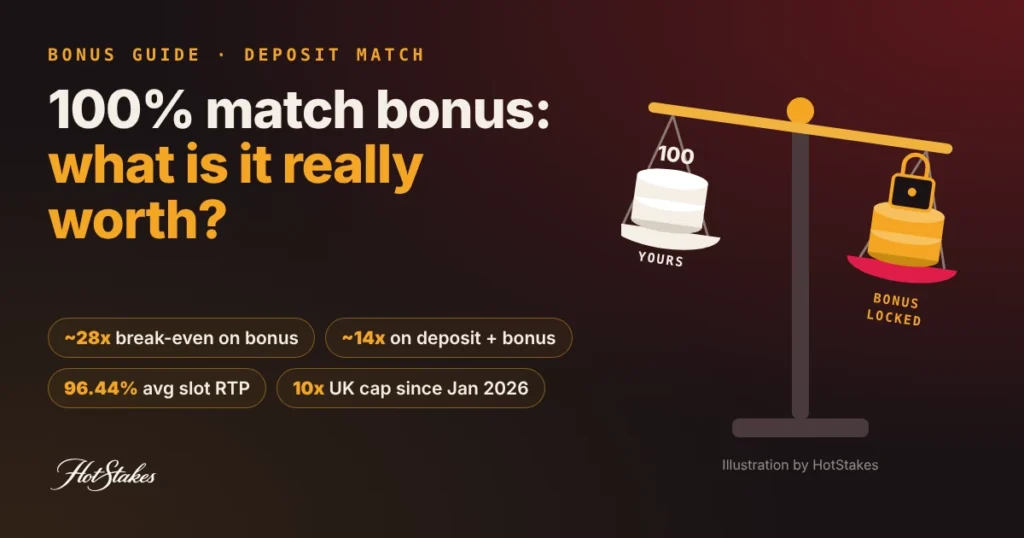
Compare cashback with a 100% deposit match bonus.
HotStakes is an independent directory. Some links on this site are affiliate links; we may earn a commission at no cost to you, and it never changes our rankings. Gambling involves risk — only play with money you can afford to lose, and if it stops being fun, seek help. This article is general information, not legal advice.
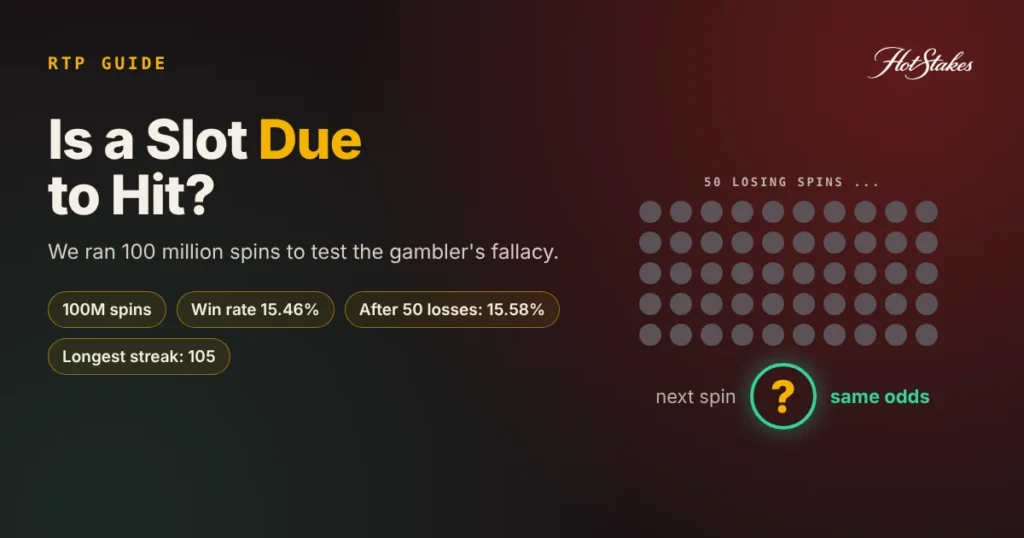 Next story →Is a Slot Due to Hit? The Hot-and-Cold Myth, Tested


Start the discussion