

Philippines POGO Ban Explained: Timeline and Numbers
The Philippines' POGO ban explained: EO 74, the 2025 Anti-POGO Act, what happened to 33,863 foreign workers and where the scam hubs moved.
In this article
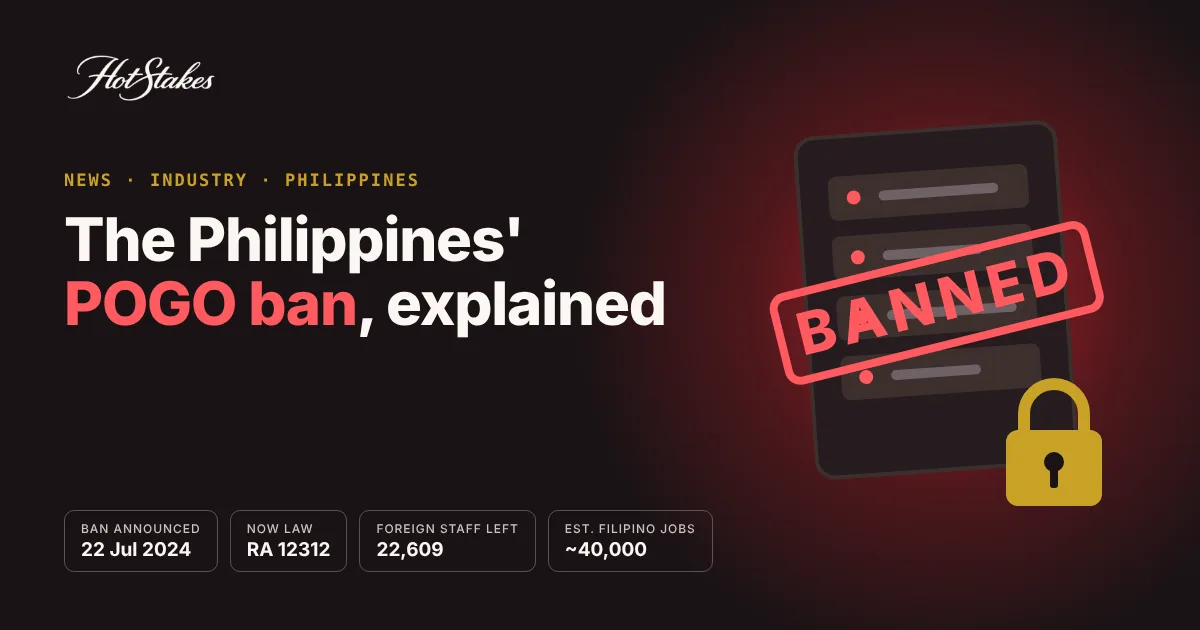
The Philippines banned its offshore gaming industry in two steps. President Ferdinand Marcos Jr. announced the ban on 22 July 2024, then made it permanent law on 23 October 2025. POGOs (Philippine offshore gaming operators) are now illegal in the Philippines, every licence has been cancelled, and the work has shifted to small hidden hubs at home and to scam centres abroad. This guide covers the timeline, the numbers and what happened to the workers.
What was a POGO, and why did Manila kill it?
A POGO was a company licensed in the Philippines to take bets from players outside the country, mostly in mainland China. Under the regulator PAGCOR, the industry later rebranded as “Internet Gaming Licensees” (IGLs). The day after the ban, PAGCOR chair Alejandro Tengco said there were 43 legal IGLs, and that the ban would cost PAGCOR about P7 billion.
The money was not enough to protect them. In his 2024 State of the Nation Address, Marcos said POGOs had moved into scamming, money laundering, prostitution, human trafficking, kidnapping, torture and murder. “Effective today, all POGOs are banned,” he said, and he told PAGCOR to “wind down and cease all operations of POGOs by the end of the year.” GMA also reported that an October 2022 study by the Philippine Institute for Development Studies had found the industry’s social costs were higher than its economic benefits.
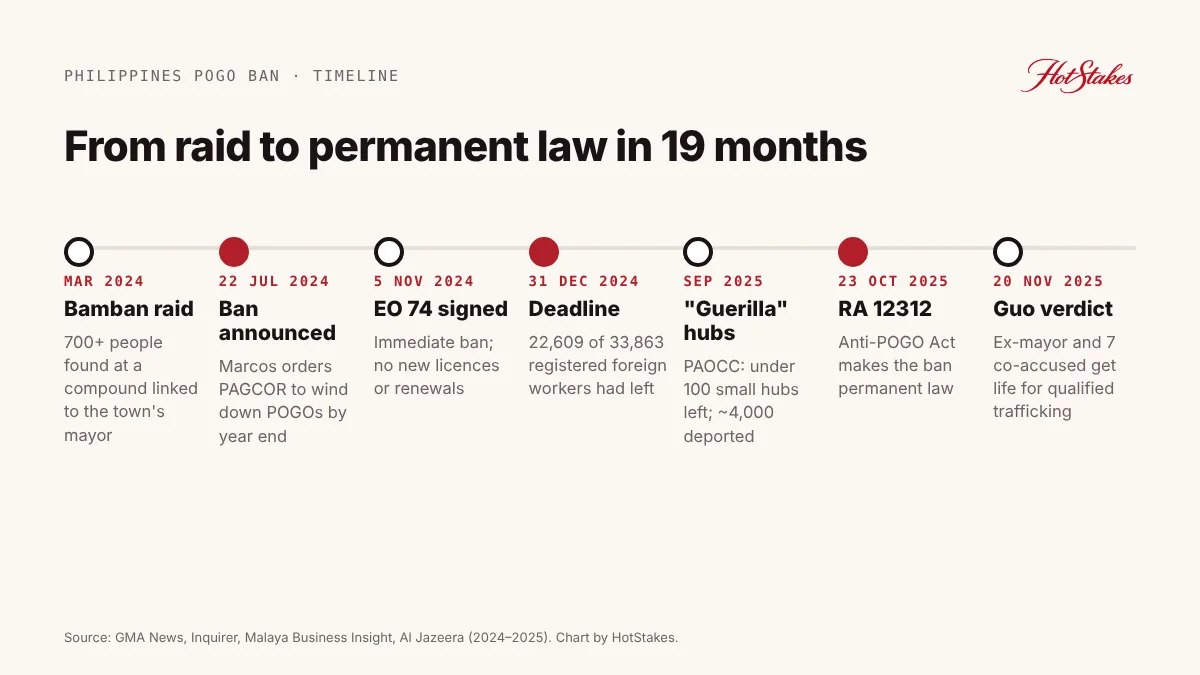
The case that changed public opinion was in Bamban, Tarlac. In March 2024, police raided a large compound linked to the town’s then-mayor, Alice Guo, after a Vietnamese worker escaped and alerted the authorities. More than 700 people were found inside, according to Al Jazeera. They included Filipino, Chinese, Vietnamese, Malaysian, Taiwanese, Indonesian and Rwandan nationals.
Takeaway: the ban was justified on crime, not on economics. Manila decided the licence fees were not worth the trafficking and scam cases attached to them.
The legal timeline: speech, executive order, law
The ban went through three legal stages, and each one was harder to reverse than the last.
- 22 July 2024, presidential announcement. The ban took effect in policy, and PAGCOR was told to shut the sector down by 31 December 2024.
- 5 November 2024, Executive Order No. 74. The order, released on 8 November, imposed an immediate ban on POGOs, IGLs and all offshore gaming operations. It also barred new licence applications and renewals. It created two technical working groups: one on jobs, chaired by PAGCOR, and one on enforcement, chaired by the Presidential Anti-Organized Crime Commission (PAOCC) with the Bureau of Immigration (BI), the National Bureau of Investigation (NBI), the Anti-Money Laundering Council (AMLC) and others.
- 23 October 2025, Republic Act No. 12312, the Anti-POGO Act of 2025. The law declares offshore gaming illegal and permanently cancels POGO licences, whether they were issued by PAGCOR, economic zones or freeports. It also cancels the work permits and visas tied to the industry and removes those agencies’ power to license offshore gaming again.
| Before July 2024 | EO 74 (Nov 2024) | RA 12312 (Oct 2025) | |
|---|---|---|---|
| Legal status | Licensed by PAGCOR as POGO / IGL | Immediate ban by executive order | Illegal by statute |
| New licences or renewals | Allowed | Barred | Licensing power removed from agencies |
| Existing licences | Active | Wind-down to 31 Dec 2024 | Permanently revoked |
| Foreign workers’ permits | Issued | Deportation of those involved | Work permits and visas cancelled |
| Can a future president undo it? | n/a | Yes, with a new order | Only Congress, by amending the law |
Takeaway: since October 2025 the ban is a statute, not a policy. Bringing POGOs back would need Congress to amend the law.
What happened to the workers
The ban affected two very different groups.
Foreign workers: leave or be deported
Foreign staff had until 31 December 2024 to leave voluntarily. In early January 2025, BI spokesperson Dana Sandoval said 22,609 of the 33,863 POGO workers registered with PAGCOR had left. More than 11,000 were still in the country and became subject to deportation. By September 2025, PAOCC executive director Gilbert Cruz said about 4,000 foreign POGO workers, mostly Chinese, had been deported as “undesirable aliens”.
Filipino workers: job fairs and benefits
Filipino employees lost their jobs instead. The Department of Labor and Employment (DOLE) estimated about 40,000 would be displaced. By December 2024 it had profiled 27,790 Filipino POGO employees in Metro Manila, Central Luzon, Calabarzon and Central Visayas. In the same briefing, DOLE reported that 202 workers had been hired on the spot at its mega job fairs and 435 had been helped with SSS unemployment benefits. Those numbers are small next to the 27,790 profiled.
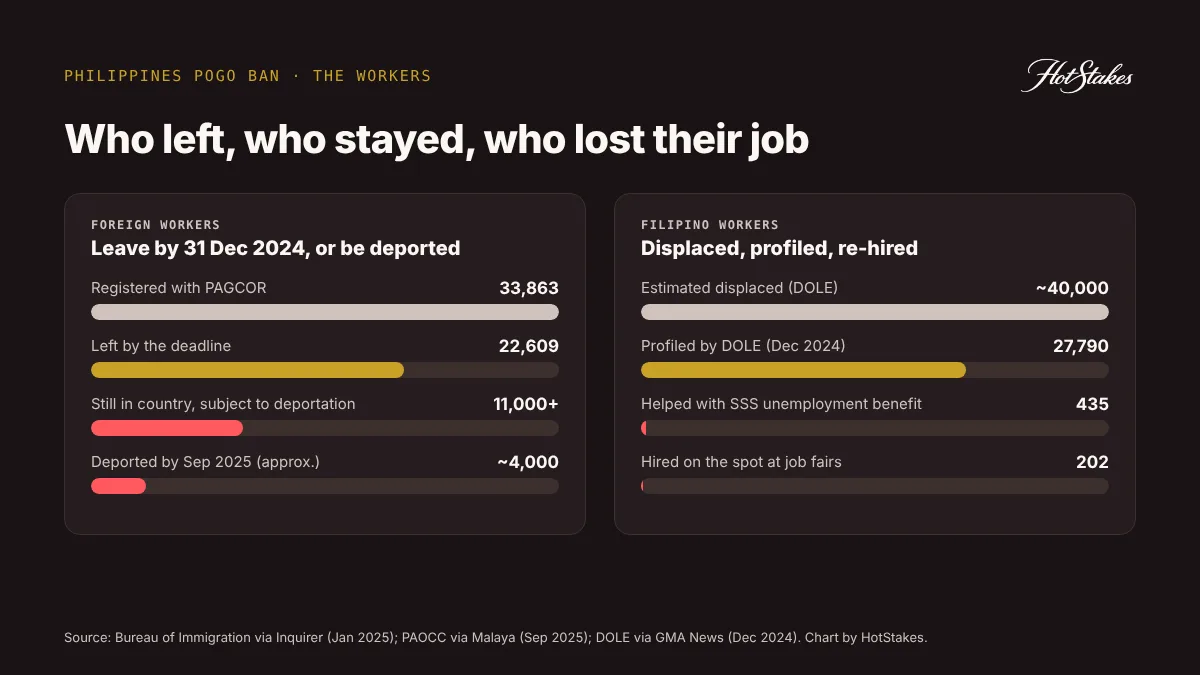
Takeaway: about two in three registered foreign workers left by the deadline. For Filipino staff, the official re-employment numbers were tiny compared with the size of the workforce.
Where the industry went
The ban closed the big licensed campuses, but it did not end the business model. Officials describe three shifts.
1. From compounds to “guerilla” hubs
In September 2025, Cruz said fewer than 100 small-scale POGO hubs were believed to still be running, often in “guerilla-type” setups. He said many were still led by foreigners, with bosses monitoring remotely by laptop or tablet instead of sitting in an office.
2. Smaller sites, same alleged scams
Raids continued after the law took effect. On 12 October 2026, BI officers enforcing the Anti-POGO Act arrested 76 foreigners, 74 Chinese and 2 Burmese nationals, at a suspected “POGO-like” site in Cubao, Quezon City. BI linked the site to alleged online investment scams. GMA reported the same week that 244 mostly Chinese workers had been arrested earlier in Zamboanga Sibugay.
3. Out of the country
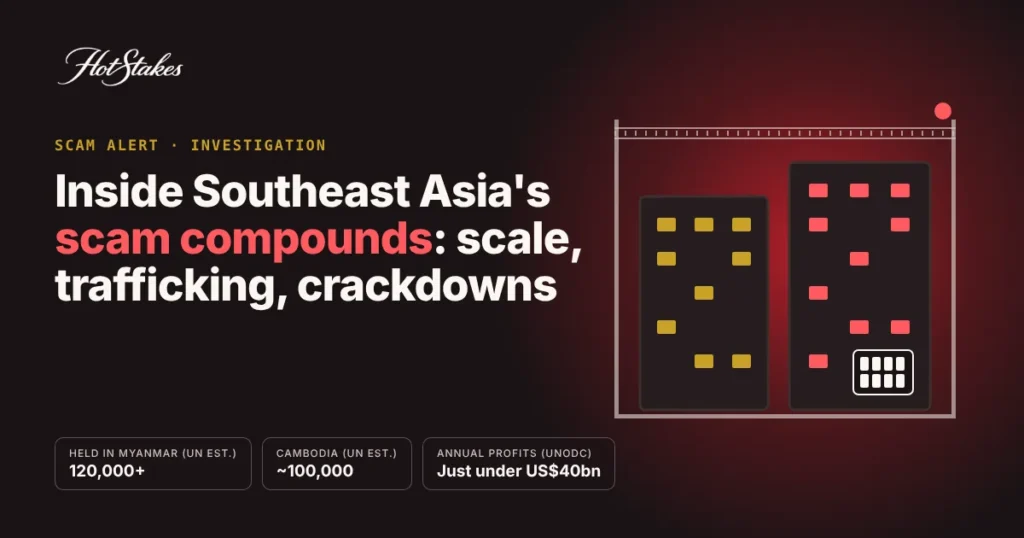
In February 2025, BI said syndicates were recruiting Filipinos for scam hubs abroad. It named Cambodia, Myanmar and Laos as places where POGO-like operations had been seen, and it warned that such job offers on social media were “too good to be true.” For more on those sites, see our guide to Southeast Asia’s scam compounds and what UN reports say about them.
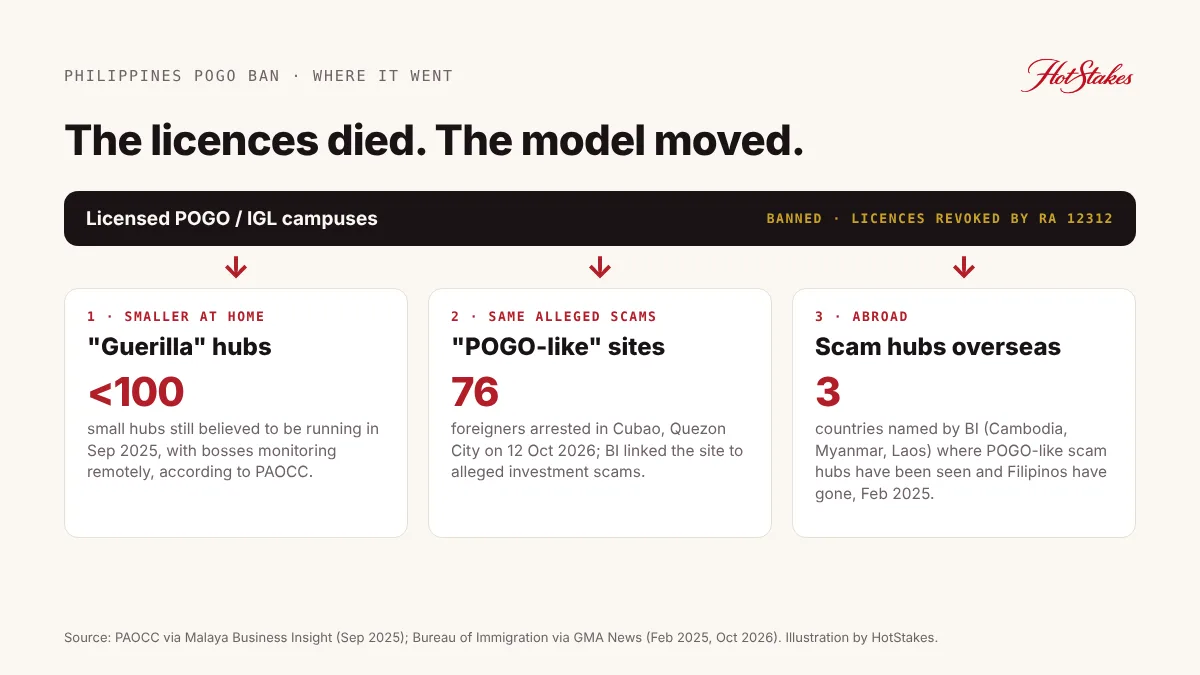
Takeaway: the licensed industry is gone. The scam operations that hid inside it got smaller, moved to new locations and in some cases left the country.
The Alice Guo verdict
The Bamban case reached a verdict on 20 November 2025. A Pasig court sentenced Guo and seven co-accused to life imprisonment for qualified trafficking, Al Jazeera reported. She had been arrested in Indonesia in September 2024 after fleeing the Philippines. In June 2025, a Manila court had already ruled that, as a Chinese citizen, she was never eligible to be mayor.
Takeaway: the case that started the crackdown ended with life sentences, and a court treated the compound as a trafficking case, not a licensing breach.
What it means for players in Southeast Asia
- A “Philippine licence” for offshore play no longer exists. If a site says it holds a PAGCOR offshore or POGO licence today, treat that as a red flag. Our guide to checking a casino licence shows how to verify one.
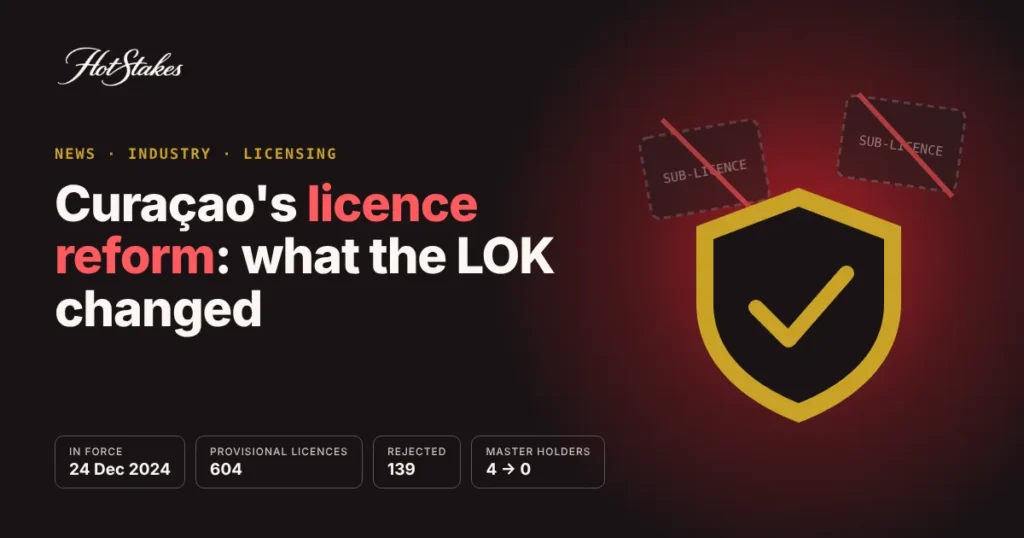
- Other licensing hubs are tightening too. Curaçao, a jurisdiction many offshore brands use, has rebuilt its own licensing system. Read our explainer on Curaçao’s LOK licensing reform.
- Scam-hub tactics are reaching players directly. The October 2026 Cubao raid was linked to alleged online investment scams, according to BI. Learn the patterns in our pieces on how pig-butchering scams work and fake gambling apps.
- Be wary of overseas job offers. BI’s warning about well-paid “POGO-style” jobs in Cambodia, Myanmar and Laos applies to job seekers anywhere in the region.
Takeaway: the ban changed where operators get licensed and where scammers operate, so players should check the licence and the regulator before they deposit.
FAQ
Is online gambling illegal for Filipinos now?
The Anti-POGO Act is aimed at offshore gaming, meaning operations that take bets from players outside the Philippines, and the POGO hubs that run them. Rules for gambling by people inside the Philippines are a separate subject that this article does not cover.
When did the POGO ban take effect?
It was announced on 22 July 2024 and formalised by Executive Order 74, signed on 5 November 2024. Operations had to stop by 31 December 2024, and Republic Act 12312 made the ban permanent law on 23 October 2025.
How many people worked in POGOs?
PAGCOR had 33,863 registered foreign POGO workers, according to BI. DOLE estimated about 40,000 Filipino workers would be displaced.
Are POGOs still operating?
Not legally. PAOCC estimated in September 2025 that fewer than 100 small illegal hubs were still running, and raids such as the October 2026 Cubao arrests show that enforcement is continuing.
Macau went through its own crackdown on cross-border gambling: read how the Macau junket collapse and the Suncity case unfolded.
HotStakes is an independent directory. Some links on this site are affiliate links; we may earn a commission at no cost to you, and it never changes our rankings. Gambling involves risk — only play with money you can afford to lose, and if it stops being fun, seek help.
Looking for operators checked by Cyndia’s team? Browse vetted operators by currency.
 Next story →How to Spot an Unlicensed Online Casino: Licence Check



Start the discussion