

Roulette House Edge Explained: Every Bet, Every Wheel
Roulette house edge for every bet: 2.70% single zero, 5.26% double zero, 7.89% top line, 1.35% French rules, plus our 100,000-session simulation.
In this article
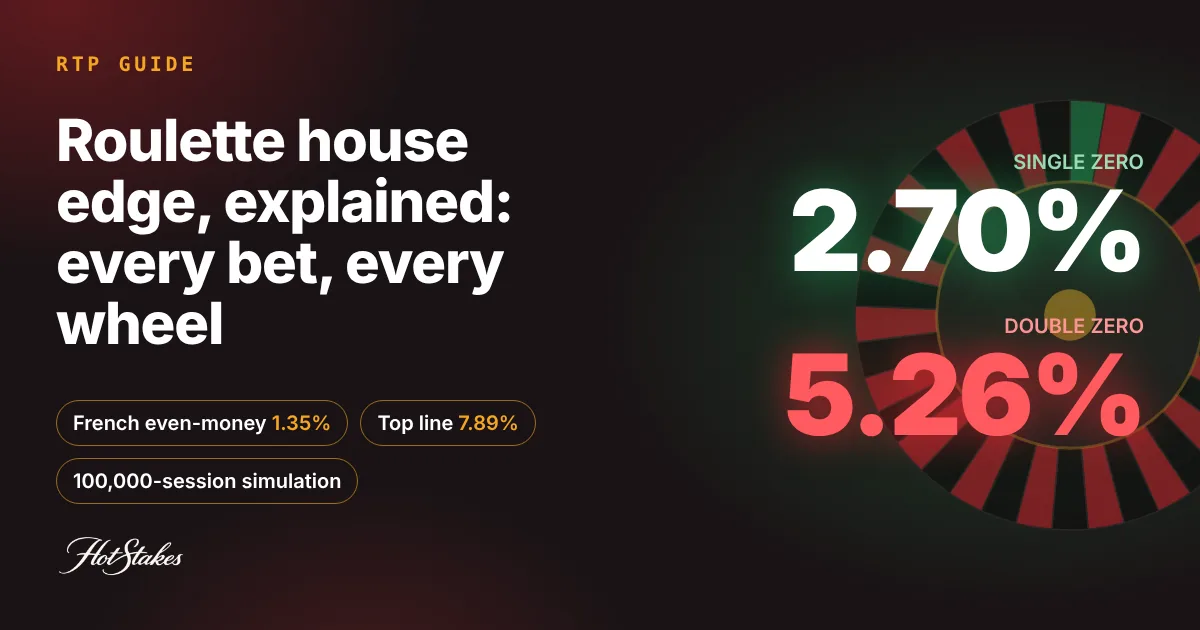
Roulette has one simple rule of money: the wheel sets the price, not the bet. The roulette house edge is 2.70% on every bet on a single-zero wheel and 5.26% on a double-zero wheel, except the five-number bet at 7.89%; French La Partage or En Prison rules cut even-money bets to 1.35%. Red, a dozen or a single number all cost the same on the same wheel. What changes the price is the wheel type, the table rules, and side features such as bonus multipliers.
Where the 2.70% comes from
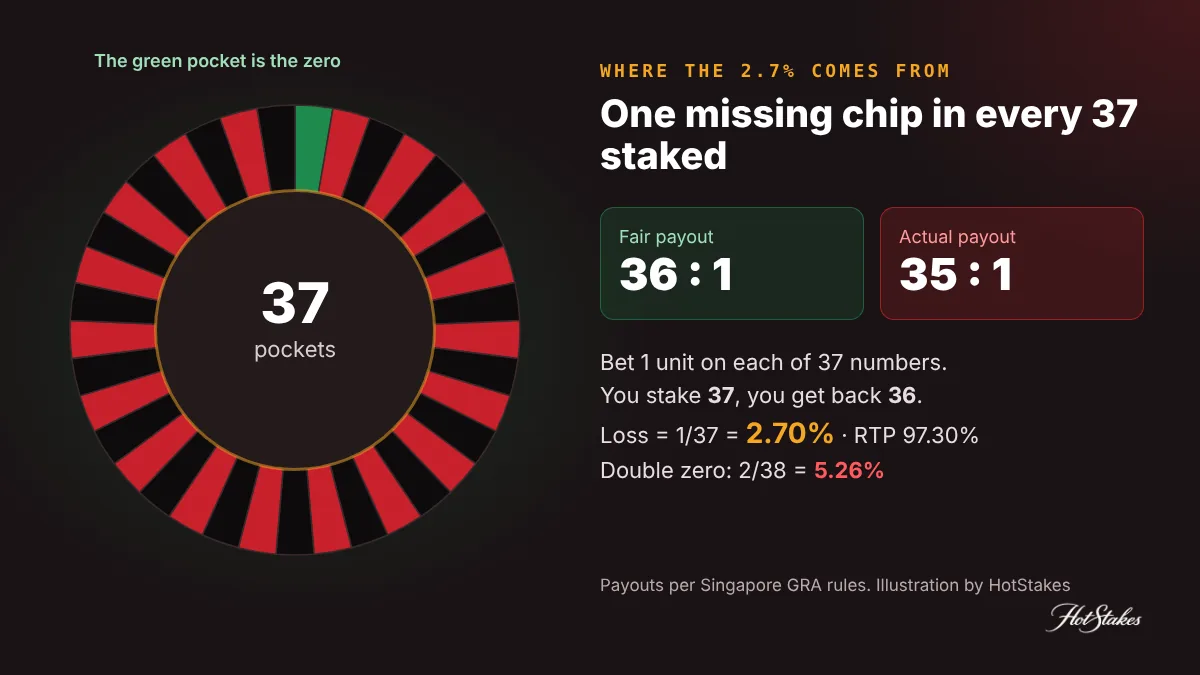
A European wheel has 37 pockets: 1 to 36 plus a single zero. A straight-up bet wins 1 time in 37 and pays 35 to 1.
A fair price would be 36 to 1. That one missing chip is the whole business model.
- Single zero: you get back 36 units for every 37 staked on average. Loss = 1/37 = 2.70%.
- Double zero: 38 pockets, same 35 to 1 payout. Loss = 2/38 = 5.26%.
- RTP view: RTP is simply 100% minus the edge, so 97.30% and 94.74%. Our guide to RTP vs volatility explains why that long-run number says nothing about tonight’s result.
The payouts themselves are not a casino secret. Singapore’s regulator publishes approved rules: the single-zero electronic roulette rules list straight up at 35 to 1, and when zero lands “all Bets shall lose” except bets covering zero. A university maths text works the double-zero case the same way: about minus 5.3 cents per dollar.
Takeaway: the edge is the zero. Add a second zero and you double the price. See our glossary entry on house edge for the general definition.
Every roulette bet, ranked by house edge
We recalculated every standard bet with exact fractions in Python on 24 Oct 2026. The payouts match the Wizard of Odds roulette basics table and the Singapore GRA rules for both wheels, including the approved double-zero roulette rules.
| Bet | Numbers | Pays | Single zero | Double zero | French rules |
|---|---|---|---|---|---|
| Straight up | 1 | 35:1 | 2.70% | 5.26% | 2.70% |
| Split | 2 | 17:1 | 2.70% | 5.26% | 2.70% |
| Street | 3 | 11:1 | 2.70% | 5.26% | 2.70% |
| Corner | 4 | 8:1 | 2.70% | 5.26% | 2.70% |
| Five-number (0-00-1-2-3) | 5 | 6:1 | n/a | 7.89% | n/a |
| Six line | 6 | 5:1 | 2.70% | 5.26% | 2.70% |
| Dozen / column | 12 | 2:1 | 2.70% | 5.26% | 2.70% |
| Red/black, odd/even, 1-18/19-36 | 18 | 1:1 | 2.70% | 5.26% | 1.35% |
The one bet that costs more: the five-number “top line”
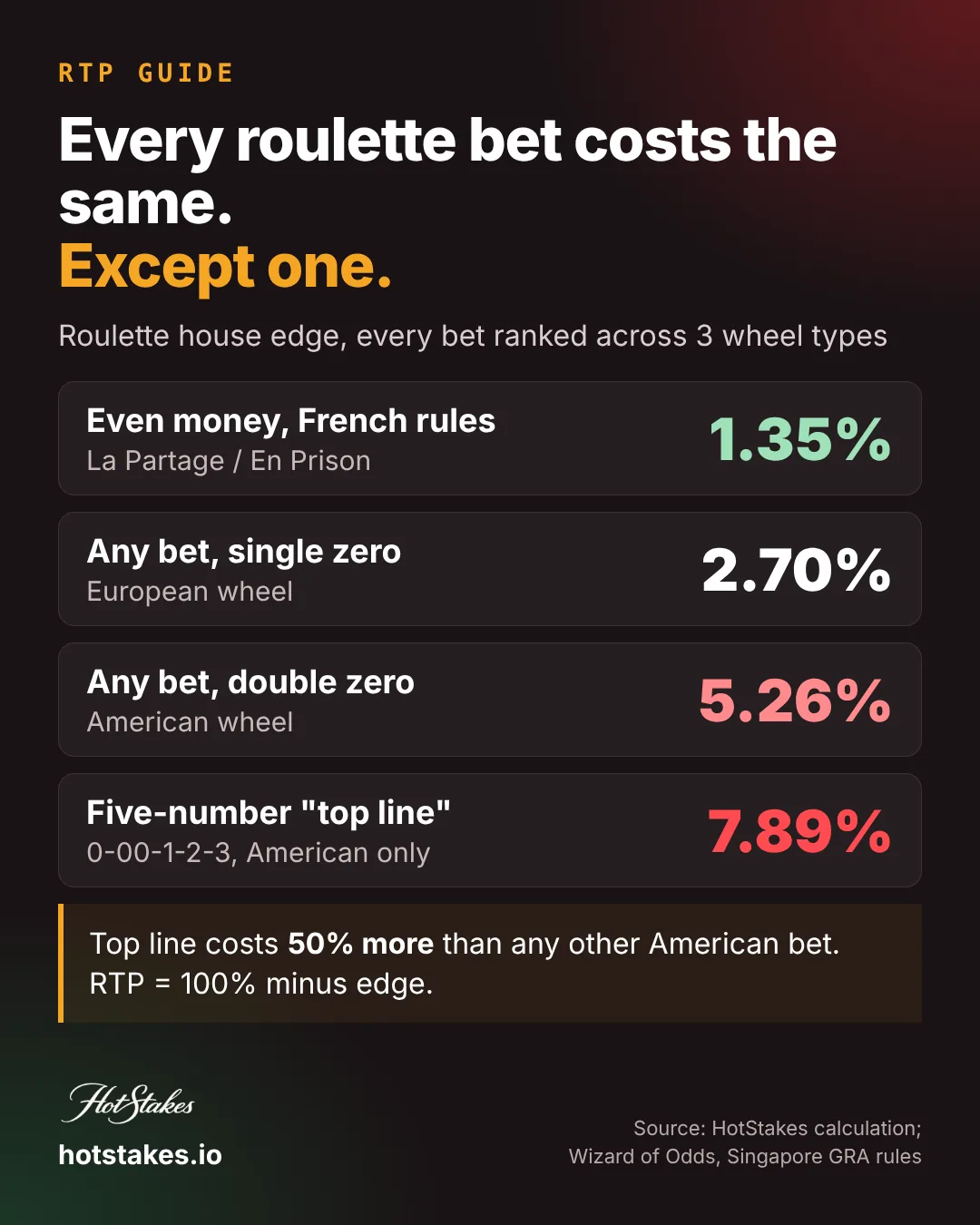
Only double-zero wheels offer it. It covers 5 numbers but pays 6 to 1, when it would need to pay 6.6 to 1 to match the rest of the table.
Wizard of Odds puts it plainly: the 0-00-1-2-3 combination “carries a house edge of 7.89%”. That is exactly 1.5 times the 5.26% on every other American bet.
Every roulette bet costs the same, except the one that costs 50% more.
French rules: La Partage and En Prison
Some single-zero tables soften the zero for even-money bets:
- La Partage: when zero lands, “the player gets half the bet back” (Wizard of Odds). Losing half instead of all on 1 spin in 37 halves the edge to 1.35%.
- En Prison: the bet is held for the next spin; if it wins, it is “released and the player gets it back, without winnings”. Wizard’s imprisonment table gives the same 1.35% under French rules.
A peer-reviewed paper, Downton’s “Rational Roulette” (1982), reaches the same 1.35% for even-money bets where half the stake is lost on zero. Neither Singapore rule set we opened includes a half-back rule, so do not assume it: check the table rules.
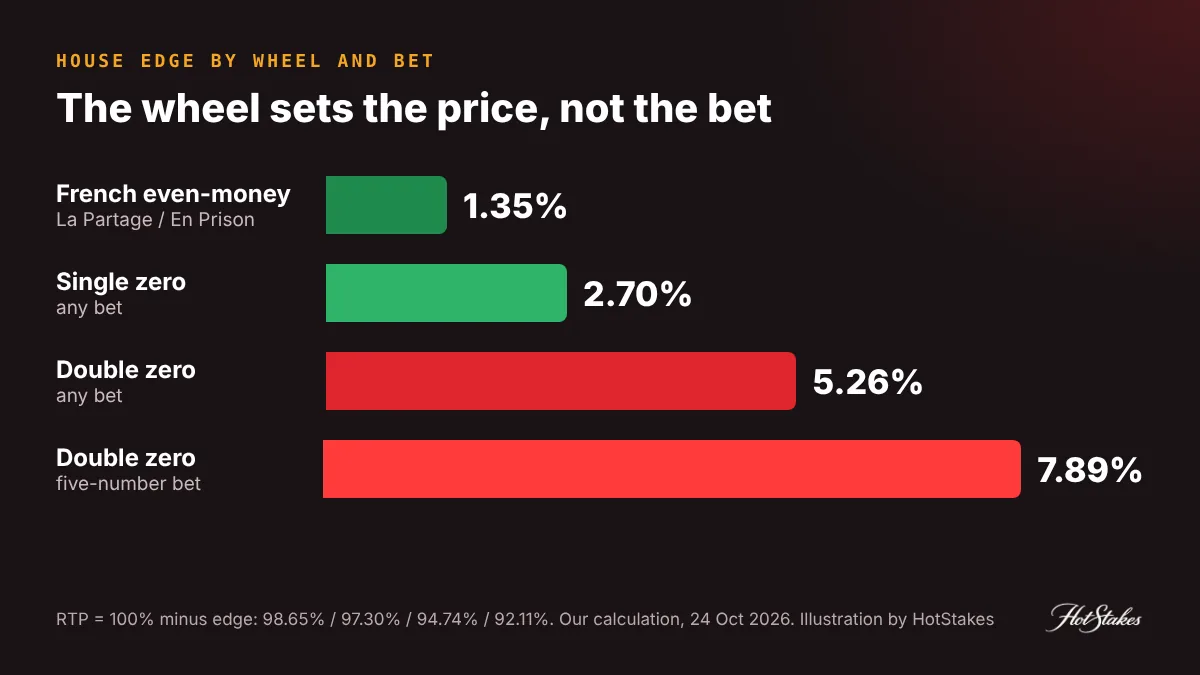
Takeaway: the best roulette bet is an even-money bet on a French-rules table. Next best is any bet on a single-zero wheel. Worst is the American top line.
What the house edge costs you per hour
Edge times money wagered gives expected loss. Our assumptions: RM10 per spin, 40 to 60 spins an hour (live tables run slower than auto-roulette), one bet per spin.
- French rules, even money (1.35%): RM5.41 to RM8.11 an hour.
- Single zero (2.70%): RM10.81 to RM16.22 an hour.
- Double zero (5.26%): RM21.05 to RM31.58 an hour.
- Five-number bet (7.89%): RM31.58 to RM47.37 an hour.
Plug in your own stake and pace with our RTP calculator.
Takeaway: the same RM10 habit costs roughly twice as much on a double-zero wheel.
Our simulation: 100,000 roulette sessions
Expected loss is an average. Real sessions swing. So we simulated it.
Model (Python/numpy, run 24 Oct 2026, seed 20261024): 100,000 sessions of 200 spins, RM10 on red every spin (RM2,000 wagered per session), on a European wheel, an American wheel, and a single-zero wheel with La Partage.
| Wheel | Sessions ahead | Median result | Average result | Expected (maths) |
|---|---|---|---|---|
| European (2.70%) | 32.8% | -RM60 | -RM53.57 | -RM54.05 |
| American (5.26%) | 20.8% | -RM100 | -RM105.15 | -RM105.26 |
| La Partage (1.35%) | 41.9% | -RM25 | -RM26.40 | -RM27.03 |
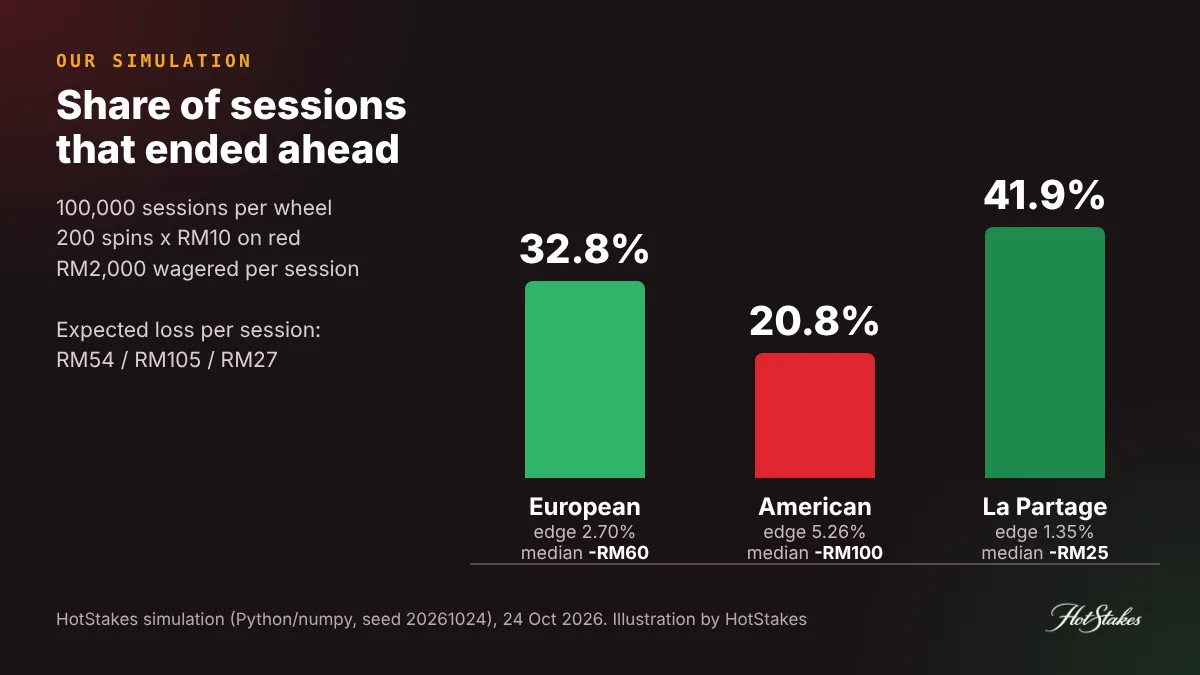
Two things stand out. First, plenty of people walk away ahead, even on the worst wheel. That is why roulette feels beatable.
Second, the averages land almost exactly on the maths. Downton notes systems can look successful over short periods because not losing in a short run is quite likely.
Takeaway: a third of European sessions win; the casino still collects about 2.7% of everything wagered.
What our StakeGO data shows: the 2.7 vs 2.9 tables
The HotStakes directory lists 16 StakeGO live and auto roulette tables (data synced 22 Oct 2026). Here is what their “house edge” field says:
- 6 tables list a single 2.7, including Galaxy Roulette EU01 and the auto-roulette ROU tables.
- 7 VR Series tables list “B.Off: 2.7/ B.On: 2.9”, for example Royal Roulette VR03.
- 2 tables list “S.U: 2.7/ O: 2.9”: Cosmic Roulette VR01 and Techno Roulette VR04.
- 1 table (Diamond Roulette WR01) lists no edge.
What the rules documents actually say
We opened the rules documents linked from five of these tables on 24 Oct 2026. The short version:
- “B.Off / B.On” means a Boost or Bonus mode. Sakura Roulette VR05’s rules say: “You can activate or deactivate Boost Mode at any time using the Boost On / Boost Off button.” With Boost off, straight up pays the classic 35:1. With it on, straight up pays “29-499:1 depending on the result”.
- Bonus rounds add multipliers. Royal Roulette VR03 describes 1 to 5 bonus numbers per round carrying 50x to 500x multipliers.
- “S.U / O” is not defined in the Cosmic VR01 or Techno VR04 documents, so we won’t guess what the letters stand for. Both describe the same multiplier-style straight-up payout.
- The rules documents don’t state the 2.9 figure itself. It comes from the table listing in our data. We have asked for the documents to be checked and will update this page.
Why multiplier versions cut the base payout
The rules confirm the mechanism. On a bonus round, a straight-up hit pays 29:1 unless your number carries a multiplier.
Our maths: on a 37-pocket wheel, 29:1 on its own returns only 81.08%, an 18.92% edge. The 50x to 500x multipliers have to add back about 16 percentage points just to reach 97.10%. You trade a steady 35:1 for a smaller base payout plus a lottery ticket.
Before you sit at a two-number table:
- Open the table’s rules and find the payout table for straight up.
- Check whether the bonus or Boost feature is on, and whether you can switch it off.
- Check the edge listed for the table and which mode it belongs to, for example “B.Off: 2.7 / B.On: 2.9”.
- If you mostly bet red/black or dozens, a plain single-zero table gives the same 2.70% with no multiplier noise.
Takeaway: the 0.2% you don’t see is the price of the multiplier feature, and the documents don’t yet explain it cleanly.
Does any roulette system beat the edge?
No. Martingale, Fibonacci, sector patterns: all just rearrange the same negative-value bets.
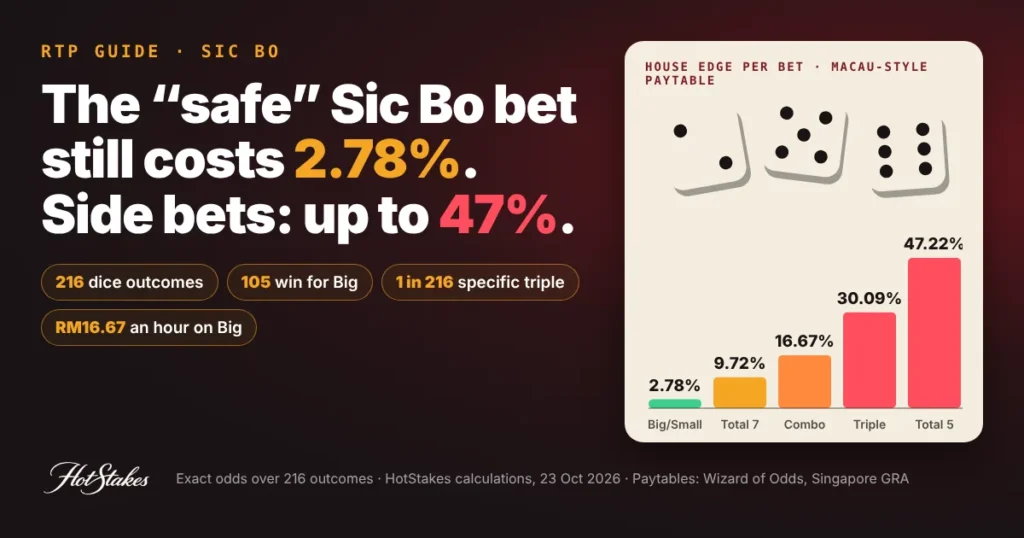
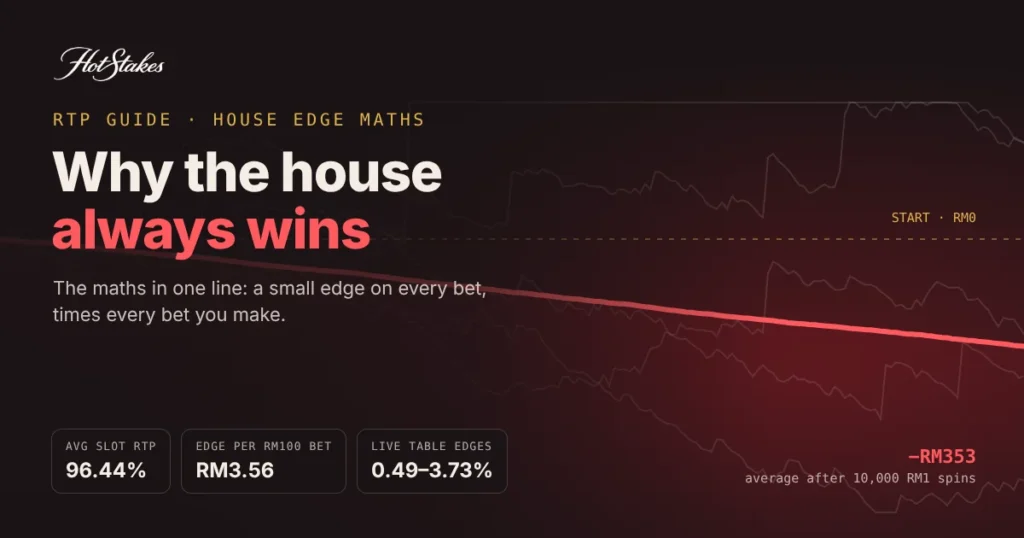
Wizard of Odds: “regardless of what system is used, in the long run it cannot overcome the house’s advantage”. Downton (1982) says the same holds on an unbiased wheel. Our explainer on why the house always wins covers the maths, and our sic bo house edge guide shows how roulette’s flat 2.70% compares with a game where edges vary wildly by bet.
Takeaway: pick the wheel, not a system. If you choose to play, set a budget you are happy to lose.
FAQ
What is the house edge in roulette?
It is 2.70% on a single-zero (European) wheel and 5.26% on a double-zero (American) wheel. The American five-number bet is 7.89%, and French La Partage or En Prison rules cut even-money bets to 1.35%.
What is the best roulette bet?
An even-money bet (red/black, odd/even, high/low) on a single-zero table with La Partage or En Prison, at 1.35%. Without those rules, every single-zero bet costs the same 2.70%.
European vs American roulette: how big is the difference?
The extra double zero almost doubles the edge, from 2.70% to 5.26%. At RM10 a spin and 50 spins an hour, that is about RM13.51 versus RM26.32 expected loss per hour.
Why do some roulette tables show 2.9% instead of 2.7%?
In our StakeGO data, 9 of 16 roulette tables list both 2.7 and 2.9. Their rules describe a bonus or Boost mode where straight up pays 29:1 plus random 50x to 500x multipliers. The documents do not explain the 2.9 figure itself.
Can a betting system beat the roulette house edge?
No. Every bet has negative expected value, so combining them in any order keeps the same edge. Systems can look successful over short runs, but the long-run loss rate does not change.
Comparing tables? Baccarat beats every roulette bet on price: see our baccarat house edge breakdown (Banker 1.06%, Player 1.24%).
HotStakes is an independent directory. Some links on this site are affiliate links; we may earn a commission at no cost to you, and it never changes our rankings. Gambling involves risk — only play with money you can afford to lose, and if it stops being fun, seek help. This article is general information, not legal advice. Read our full disclaimer.
 Next story →Digital Arrest Scam: Inside the Fake CBI Call Centre



Start the discussion