

Casino Loyalty Points: What They’re Really Worth
Casino loyalty points pay back 0.1–0.2% of what you bet. We ran the maths on three real programmes, tiers and expiry rules.
In this article
- How casino loyalty points work: you earn on turnover, not losses
- Three real programmes, side by side
- What RM100,000 of bets actually earns
- Points with wagering attached are worth less (sometimes nothing)
- The tier ladder: what “Gold” costs
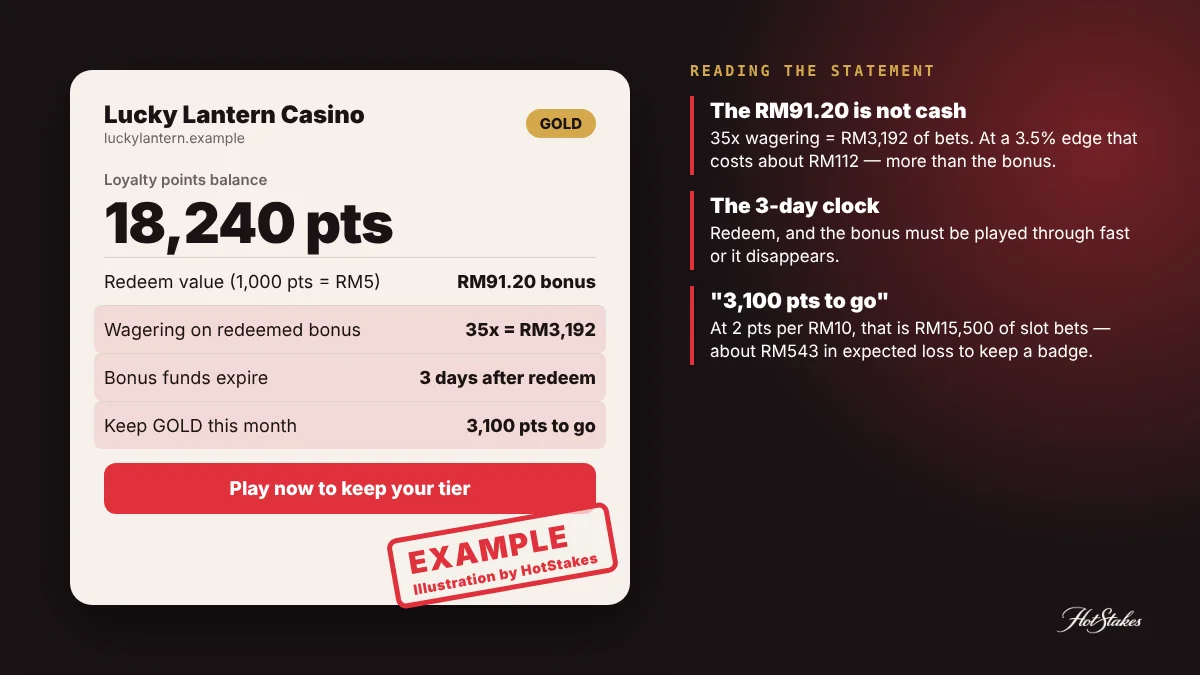
- Expiry and “maintain your tier”: the pressure built in
- Read any loyalty programme in 60 seconds
- FAQ
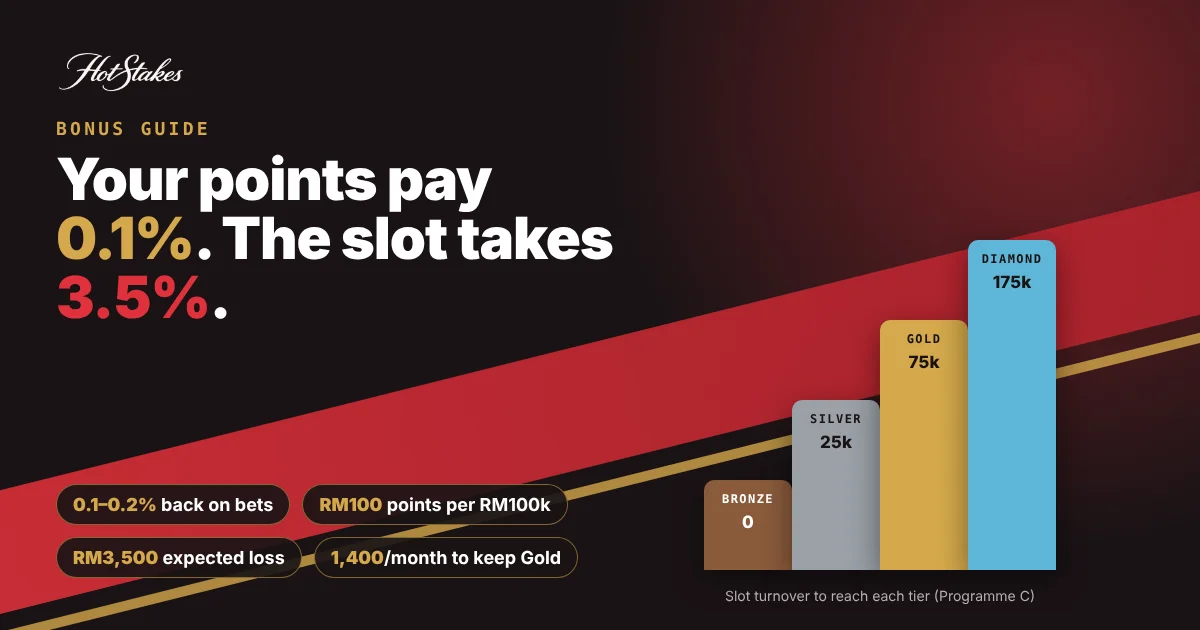
Casino loyalty points are a rebate on how much you bet, and it is a small one. In the three real programmes we checked on 28 Oct 2026, points paid back 0.1% to 0.2% of turnover. On RM100,000 of slot bets that is about RM100 to RM200 in points, against an expected loss of RM3,500. Below is the maths, what a “Gold” tier really costs, and a 60-second checklist for reading any programme.
How casino loyalty points work: you earn on turnover, not losses
Almost every programme pays points on turnover — the total of all your bets — not on what you lose. Win or lose a spin, the meter moves the same.
That matters because the house edge is also charged on turnover. So the fair comparison is simple:
- Points return = points per unit bet × cash value per point, written as a % of turnover.
- House edge = 100% − RTP, also a % of turnover. A 96.5% slot keeps 3.5% on average.
- Net cost of play = house edge − points return.
Most programmes run two meters at once:
- Redeemable points you swap for free play, bonus funds or comps.
- Tier credits that decide your status (Silver, Gold, Diamond) and usually reset every year or need “maintaining”.
If you want the background on why the edge always wins over volume, our explainer on why the house always wins covers the maths.
Three real programmes, side by side
We read the public loyalty terms of three licensed operators on 28 Oct 2026 and worked out the return on slots. We have anonymised them; the exact rules are in our source notes.
- Programme A — a large US land-casino group’s public rewards terms.
- Programme B — a Las Vegas resort casino’s public rewards page.
- Programme C — a UK- and MGA-licensed online casino group’s public loyalty terms (two of its brands, same rules).
| Programme | Earn on slots | Redeem | Paid as | Return % of turnover | Expiry rule |
|---|---|---|---|---|---|
| A | 1 point per 5 bet | 200 points = 1 | Free play | 0.10% | Tier credits reset to 0 on 1 January |
| A (online option) | 1 point per 5 bet | 100 points = 1 | Casino bonus cash | 0.20% | Same tier reset |
| B | 1 point per 5 bet | 500 points = 5 | Free slot credit | 0.20% | Points: 12 months |
| C | 2 points per 10 bet | 1,000 points = 5 | Bonus funds, 35x wagering | 0.10% face value | Bonus funds: 3 days |
Game choice changes the rate. Programme C pays 2 points per 10 on slots but only 0.5 on blackjack and 0.25 on roulette. That makes roulette worth 0.0125% of turnover — RM12.50 per RM100,000 bet.
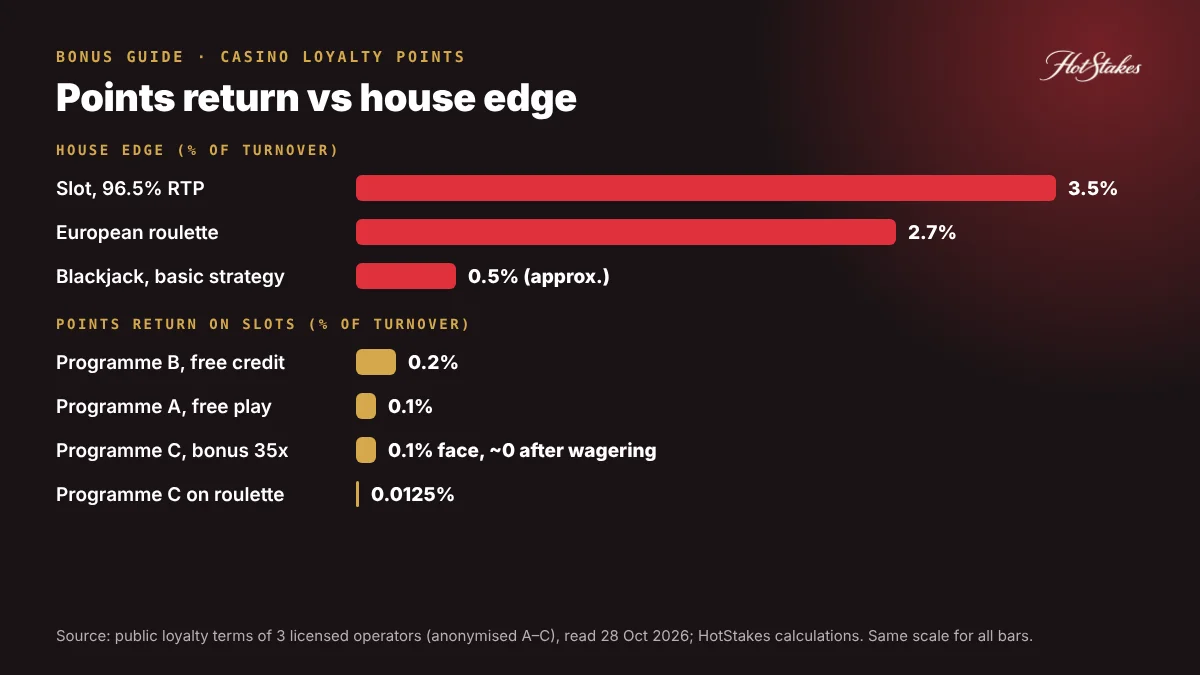
Takeaway: every programme we checked returned between 0.0125% and 0.2% of turnover. The slot edge in our example is 3.5%. No programme comes close.
What RM100,000 of bets actually earns
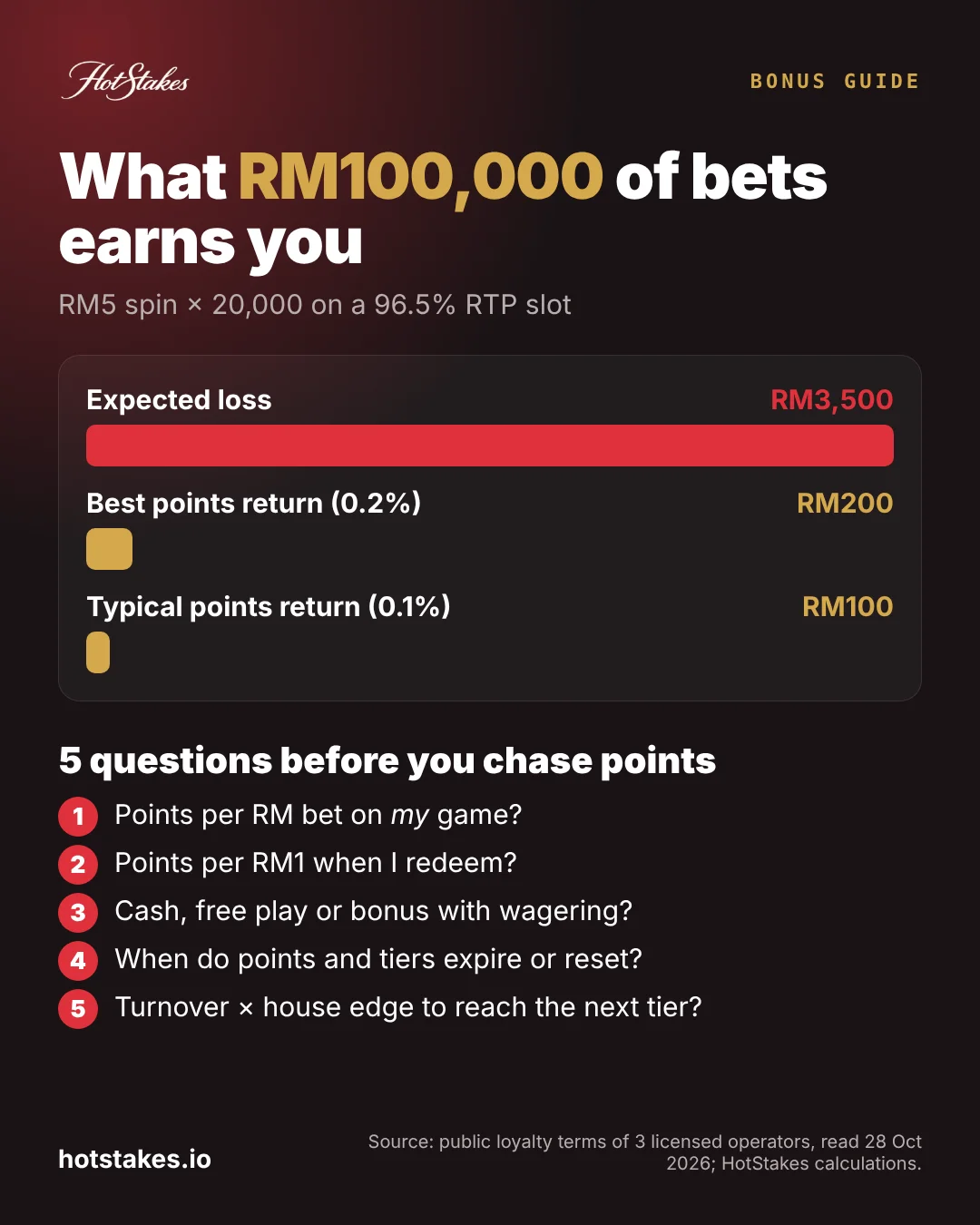
Here is a realistic heavy-play scenario: a RM5 spin, 20,000 times, on a 96.5% RTP slot. That is RM100,000 of turnover. At 500 spins an hour (our assumption), it is about 40 hours of play.
The expected loss is RM100,000 × 3.5% = RM3,500. We applied each programme’s return rate to that turnover (rates are percentages, so the currency does not change them).
| Programme | Points face value | Estimated cash value | Face value as % of expected loss |
|---|---|---|---|
| A — free play | RM100 | about RM96.50 | 2.9% |
| B — free slot credit | RM200 | about RM193 | 5.7% |
| C — bonus funds, 35x | RM100 | about RM0 | 2.9% |
Free play has to be bet once before you keep anything, so we valued it at face × 96.5%. Programme C is a different story, explained in the next section.
After points, the effective edge drops from 3.5% to 3.4% (A) or 3.3% (B). Programme A’s rate would need to be 35 times higher just to cancel the edge.
Takeaway: RM100,000 of bets buys you RM100 to RM200 of points while the maths expects you to lose RM3,500. Points are a small discount, not a reason to play.
Points with wagering attached are worth less (sometimes nothing)
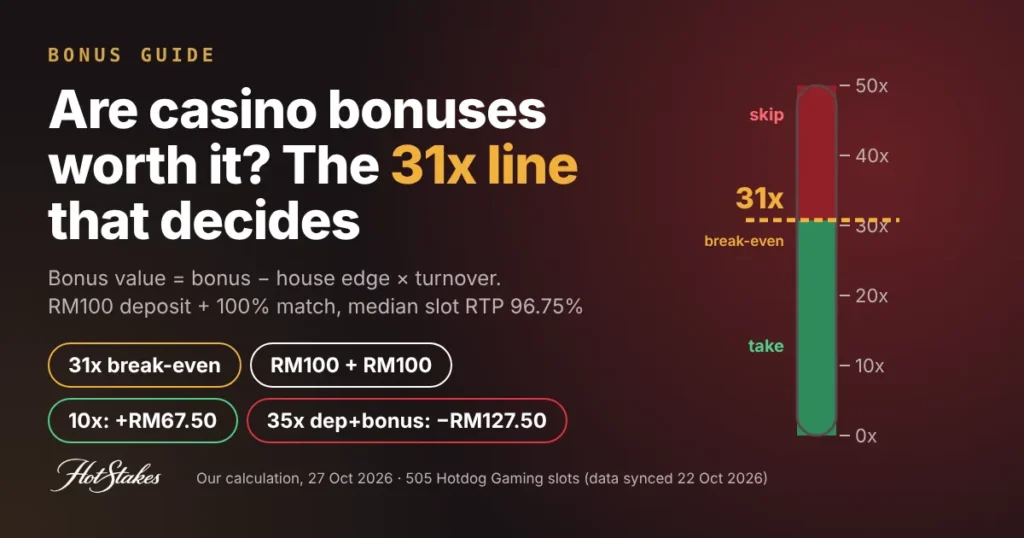
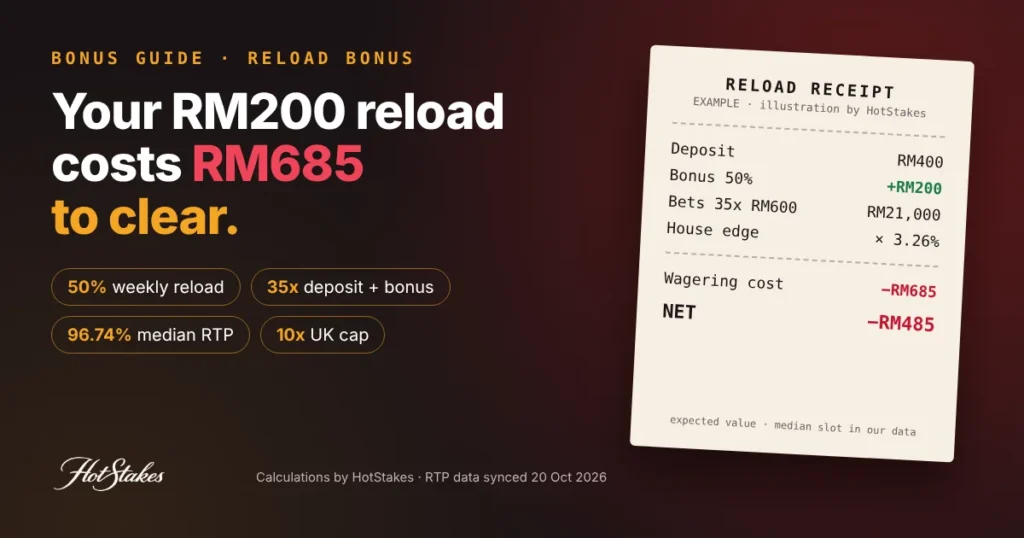
When points convert into “bonus money”, the bonus usually carries a wagering requirement. Our wagering requirements guide uses one rule: the expected cost of clearing a bonus ≈ required turnover × house edge.
So the value of the bonus ≈ bonus amount − (wagering × bonus × house edge). For Programme C’s RM100 of points:
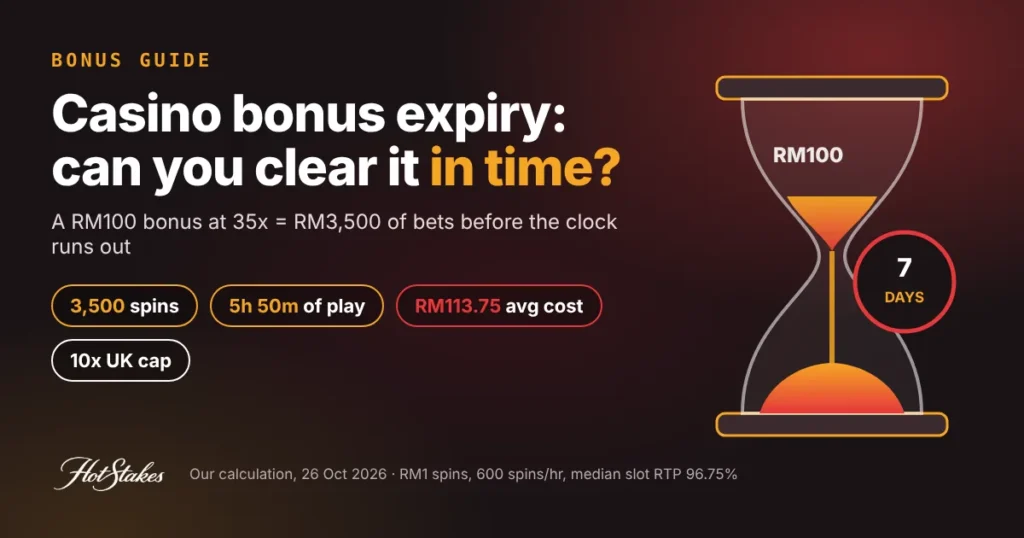
- Wagering: RM100 × 35 = RM3,500 of extra bets.
- Expected cost: RM3,500 × 3.5% = RM122.50.
- Value: RM100 − RM122.50 = −RM22.50. You cannot lose more than the bonus itself, so in practice it is worth roughly zero.
Programme C’s bonus funds also expire after 3 days, and redemption is capped at 10,000 points (50 in bonus) per day. Check the numbers on your own offer with our wagering calculator and the game’s edge with the RTP calculator.
Takeaway: cash or free play with no playthrough keeps most of its face value. Points paid as bonus funds with 35x wagering on a 3.5% slot are worth close to nothing. For the wider test, see whether casino bonuses are worth it.
The tier ladder: what “Gold” costs
Tiers are where the real spending happens. We converted each published threshold into turnover on slots and the expected loss at a 3.5% edge.
At Programme C, Gold needs 15,000 points. At 2 points per 10 bet, that is 75,000 of slot turnover and an expected loss of 2,625 (in the programme’s currency). The points earned on the way are worth 75 in bonus funds.
| Programme C tier | Points | Slot turnover | Expected loss (3.5%) | Monthly points to keep it | Expected loss per month to keep it |
|---|---|---|---|---|---|
| Silver | 5,000 | 25,000 | 875 | 2,500 | 438 |
| Gold | 15,000 | 75,000 | 2,625 | 8,000 | 1,400 |
| Diamond | 35,000 | 175,000 | 6,125 | 12,000 | 2,100 |
| Platinum | 50,000 | 250,000 | 8,750 | 15,000 | 2,625 |
Keeping Gold at Programme C means 40,000 of slot bets every month. That is an expected loss of 1,400 a month, or 16,800 a year, to hold a status.
Programme A works the same way on a calendar year. Platinum needs 5,000 tier credits, or 25,000 of slot coin-in (expected loss 875). Diamond needs 75,000 of coin-in (expected loss 2,625). Then the count resets to zero on 1 January.
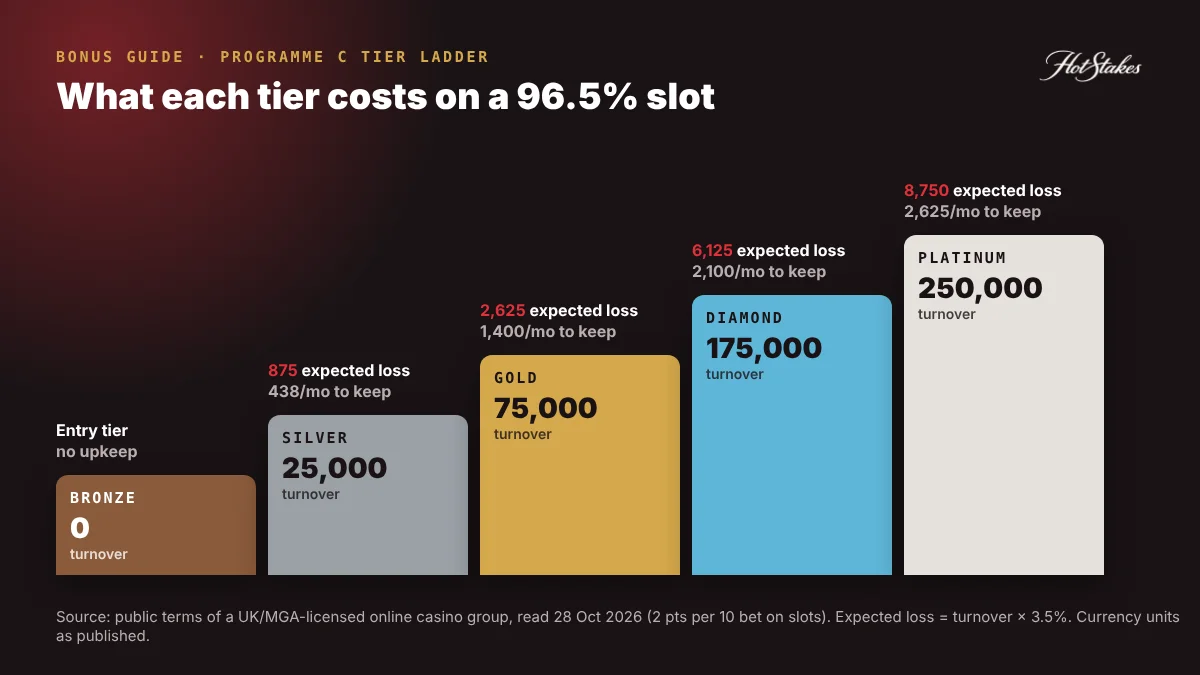
Takeaway: each step up the ladder costs thousands in expected loss and returns tens in points. Judge the perks against that cost, not against zero.
Expiry and “maintain your tier”: the pressure built in
Every programme we read has a clock on it:
- Programme B: slot points expire after 12 months; at a sister property, after six months, and free play must be used within 30 days.
- Programme A: tier credits reset to zero every 1 January.
- Programme C: monthly points to keep your tier, and converted bonus funds expire in 3 days.
Expiry and resets turn a rebate into a deadline. A player 500 points short of a tier in December has a reason to play more in December.
Regulators have noticed. The UK Gambling Commission’s 2020 rules followed what it called “repeated instances of failure to protect high value customers”. Since 31 Oct 2020, UK operators must check affordability, harm risk and source of funds before treating anyone as a VIP. A senior licensed manager must be accountable for each scheme.
The Commission’s 2025 monitoring report found cases where VIP schemes were a potential factor fell from 44 to 2 after the change. It also notes a small sample of 30 operator responses.
Research points the same way, with caveats. A 2020 study in the Journal of Behavioral Addictions found about 46.5% of problem gamblers in Australian surveys used loyalty cards, against about 10.5% of non-problem gamblers. The authors say causality is unclear. They also flag “the sunk-cost of ceasing to gamble” once you reach a higher tier.
Not everyone agrees on cause. A 2020 London South Bank University working paper (not peer-reviewed) argues “loyalty schemes do not segment the market in this way” — heavy players spread across brands either way.
The people side — hosts, personal offers, calls when you go quiet — is covered in our pieces on how casino VIP hosts work and win-back offers. If you are comparing points with a loss rebate, read casino cashback explained. And if points bonuses get voided, bonus abuse rules are usually why.
Takeaway: the expiry date and the tier reset are the parts of a loyalty programme that cost money. The points themselves barely register.
Read any loyalty programme in 60 seconds
- Find the earn rate for your game. Points per amount bet, by game. Slots usually earn most; table games least.
- Find the redeem rate. Points per 1 unit of cash, free play or bonus.
- Multiply them. Earn × value = return % of turnover. Compare it with the game’s house edge.
- Check the form. Cash or free play keeps most of its value. Bonus funds with wagering may be worth nothing.
- Check the clocks. Points expiry, bonus expiry, tier reset date and monthly maintenance.
- Price the next tier. Tier threshold → turnover → × house edge = what it is expected to cost you.
Comparing operators? Start from licensed sites in our operator directory and read the loyalty terms before you sign up.
FAQ
How much are casino loyalty points worth?
In the three real programmes we checked on 28 Oct 2026, points returned 0.1% to 0.2% of slot turnover, and as little as 0.0125% on roulette. That is about RM100 to RM200 per RM100,000 bet.
Is a casino VIP program worth it?
Only as a discount on play you would do anyway. At Programme C, reaching Gold means about 75,000 of slot bets and an expected loss of 2,625, for 75 in bonus points. Keeping it costs an expected 1,400 a month.
How do casino loyalty programs work?
You earn points on every bet, win or lose. Points convert into free play, bonus funds or comps. Separate tier credits set your status, which usually resets each year or needs monthly maintenance.
Are comp points paid as bonus money worth less?
Yes. A RM100 bonus with 35x wagering needs RM3,500 of bets. On a 96.5% slot that costs about RM122.50 on average, so the bonus is worth roughly nothing.
Can loyalty points make a casino game profitable?
No. A 0.1% to 0.2% return cannot offset a 3.5% slot edge. Programme A’s rate would need to be 35 times higher just to break even.
HotStakes is an independent directory. Some links on this site are affiliate links; we may earn a commission at no cost to you, and it never changes our rankings. Gambling involves risk — only play with money you can afford to lose, and if it stops being fun, seek help. This article is general information, not legal advice. Read our full disclaimer.
 Next story →Overseas Job Scam Script: 6 Messages Before the Trap
Start the discussion