

Slot Hit Frequency Explained: Why 1 in 4 Isn’t Winning
Slot hit frequency counts payouts, not profits. 12 real games list 9% to 40% at the same 96% RTP, and many hits pay less than your bet.
In this article
- What does slot hit frequency mean?
- A hit is not a win: losses disguised as wins
- Published hit frequencies: what 12 real games list
- The formula: average win per hit = RTP ÷ hit frequency
- Same 96% RTP, 45% vs 15% hit rate: our simulation
- What our 548-game data shows (and doesn’t)
- How to read hit frequency in 5 steps
- FAQ
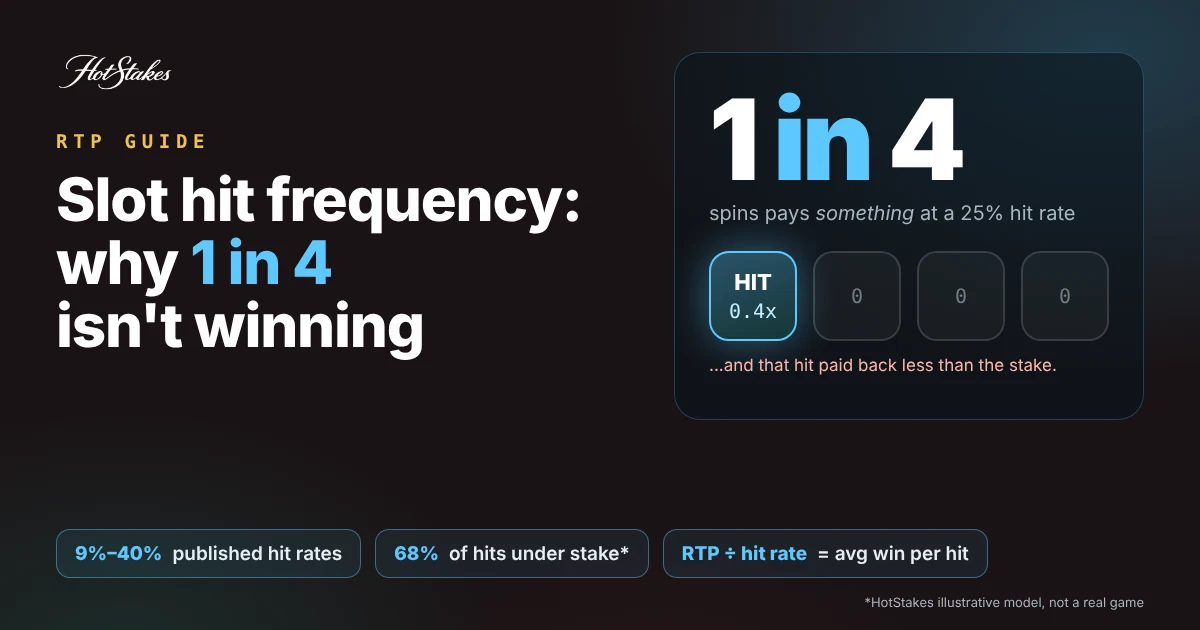
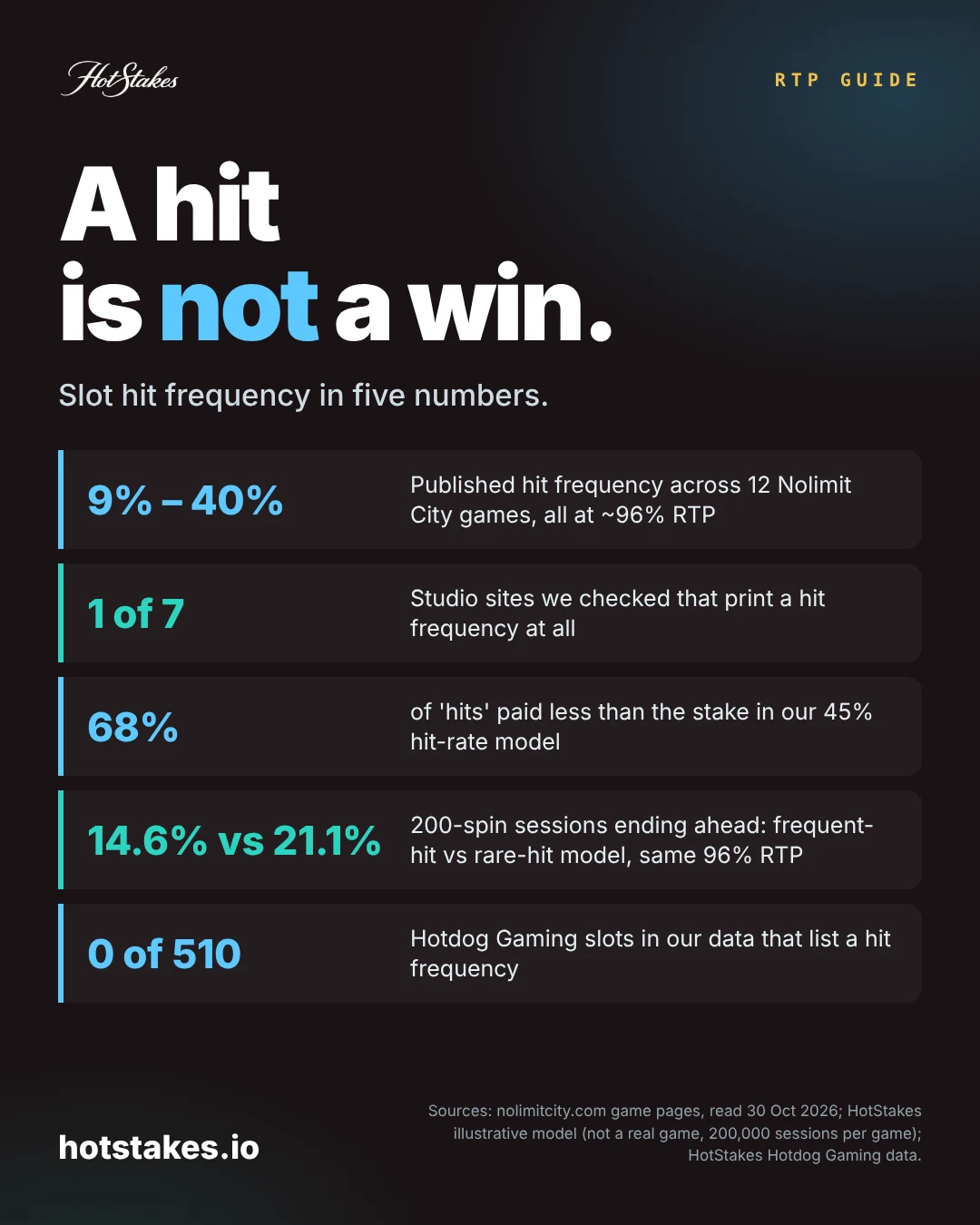
Slot hit frequency is the share of spins that pay anything at all. A 25% hit frequency means 1 spin in 4 returns some money on average, so about 75 spins in 100 pay nothing. A “hit” is not a win: many hits pay back less than you staked, and hit frequency tells you nothing about how much you lose over time. That job belongs to RTP. On the 12 official game pages we read on 30 Oct 2026, published hit rates ran from 9.08% to 40.17%, all on games with roughly the same 96% RTP.
What does slot hit frequency mean?
Hit frequency, or hit rate, is a long-run average. The studio’s maths model counts every spin outcome that returns more than zero, then divides by all outcomes.
It is written as a percentage or as “1 in X spins”. The two are the same number turned around:
| Hit frequency | Same as | Spins in 100 that pay nothing |
|---|---|---|
| 10% | 1 in 10 spins | 90 |
| 15% | 1 in 6.7 spins | 85 |
| 25% | 1 in 4 spins | 75 |
| 40% | 1 in 2.5 spins | 60 |
“1 in 4” is not a schedule. You will not get a hit every fourth spin, and a run of 20 blanks does not make the next spin more likely to pay. Each spin is independent, as we show in our test of the “slot is due” myth.
Takeaway: hit frequency answers “how often does something pay?”, averaged over millions of spins. It does not answer “how much?”
A hit is not a win: losses disguised as wins
Here is the catch most explainers skip. If you bet RM1 and the reels pay RM0.40, that counts as a hit. The screen may even say WIN. You are still RM0.60 down.
Researchers call these “losses disguised as wins”. A University of Waterloo team led by Mike Dixon published the key study in Addiction in 2010. They analysed all 259,440,000 possible outcomes of a multi-line slot:
- Played on 1 line, it produced 0% losses disguised as wins.
- Played on 15 lines, 14.2% of spins were real wins and 18.4% were losses disguised as wins.
- So about a third of spins “paid”, but more than half of those paid less than the bet. In the authors’ words, “the LDWs actually outnumber the wins.”
It also mattered how players felt. Skin conductance, a measure of arousal, rose about as much for these disguised losses as for real wins.
Regulators have noticed. The UK Gambling Commission’s RTS 14F says a game “must not celebrate a return which is less than or equal to the total stake”. The UK’s game-information rules, RTS 3, require RTP or the “probability (likelihood) of winning events” to be available, but they never use the phrase “hit frequency”. Many markets in Asia have no such rule at all. Our full guide to losses disguised as wins covers the design tricks in detail.
Takeaway: a published hit frequency counts sub-stake payouts as hits. The share of spins that actually grow your balance is lower.
Published hit frequencies: what 12 real games list
Few studios publish this number. On 30 Oct 2026 we opened official game pages from seven studios that loaded. Hacksaw Gaming (Wanted Dead or a Wild), Pragmatic Play (Gates of Olympus), Play’n GO, ELK Studios, Big Time Gaming and Thunderkick: some of these pages showed RTP, a volatility label or a max win, but none showed a hit frequency. Push Gaming, Relax Gaming and Quickspin pages would not load for us.
Nolimit City was the exception. It prints a hit frequency on each game page. Here are the 12 we read:
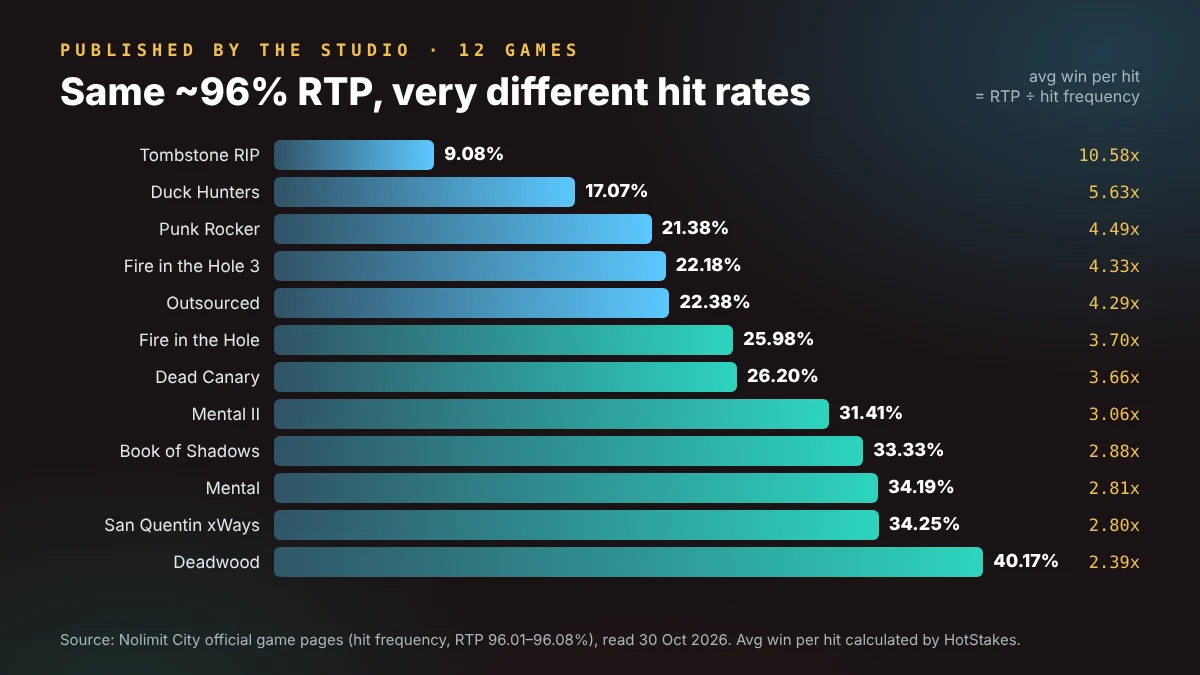
| Game (Nolimit City) | Hit frequency | 1 in | Avg win per hit | Max win | RTP |
|---|---|---|---|---|---|
| Tombstone RIP | 9.08% | 11.0 | 10.58x | 300,000x | 96.08% |
| Duck Hunters | 17.07% | 5.9 | 5.63x | 30,000x | 96.05% |
| Punk Rocker | 21.38% | 4.7 | 4.49x | 15,072x | 96.01% |
| Fire in the Hole 3 | 22.18% | 4.5 | 4.33x | 70,000x | 96.05% |
| Outsourced | 22.38% | 4.5 | 4.29x | 5,000x | 96.08% |
| Fire in the Hole | 25.98% | 3.8 | 3.70x | 60,000x | 96.06% |
| Dead Canary | 26.20% | 3.8 | 3.66x | 65,000x | 96.02% |
| Mental II | 31.41% | 3.2 | 3.06x | 99,999x | 96.06% |
| Book of Shadows | 33.33% | 3.0 | 2.88x | 30,338x | 96.01% |
| Mental | 34.19% | 2.9 | 2.81x | 66,666x | 96.08% |
| San Quentin xWays | 34.25% | 2.9 | 2.80x | 150,000x | 96.03% |
| Deadwood | 40.17% | 2.5 | 2.39x | 13,950x | 96.03% |
“Avg win per hit” is our calculation from the published RTP and hit frequency (see the formula below). Three things stand out:
- A 4.4-fold spread at the same price. RTP only moves from 96.01% to 96.08%, yet the hit rate runs from 9.08% to 40.17%. The median is 26.09%, close to “1 in 4”.
- Volatility labels don’t predict hit rate. Deadwood is described as extreme volatility and still hits 40% of the time. Punk Rocker, labelled high (a step below), hits 21%.
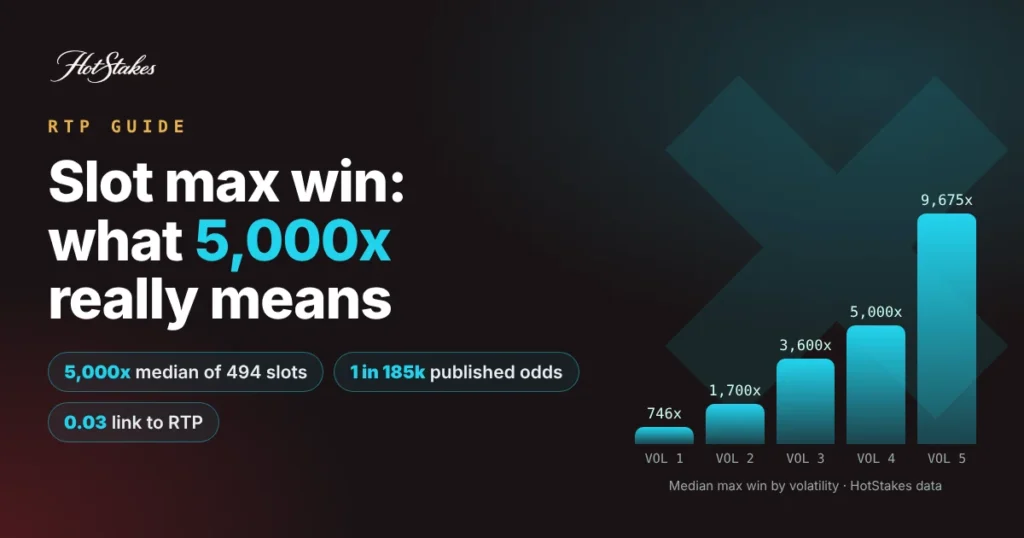
- Hit rate doesn’t track the cap either. The rank correlation between hit frequency and max win across these 12 is -0.01, effectively none. Our slot max win guide explains what those caps really mean.
These are one studio’s games, chosen because their numbers are public. Don’t assume other games behave the same.
Takeaway: two games at the same 96% RTP can hit 1 spin in 2.5 or 1 spin in 11. Without the published figure, you can’t tell which you’re playing.
The formula: average win per hit = RTP ÷ hit frequency
This is the simplest way to connect the numbers on an info screen.
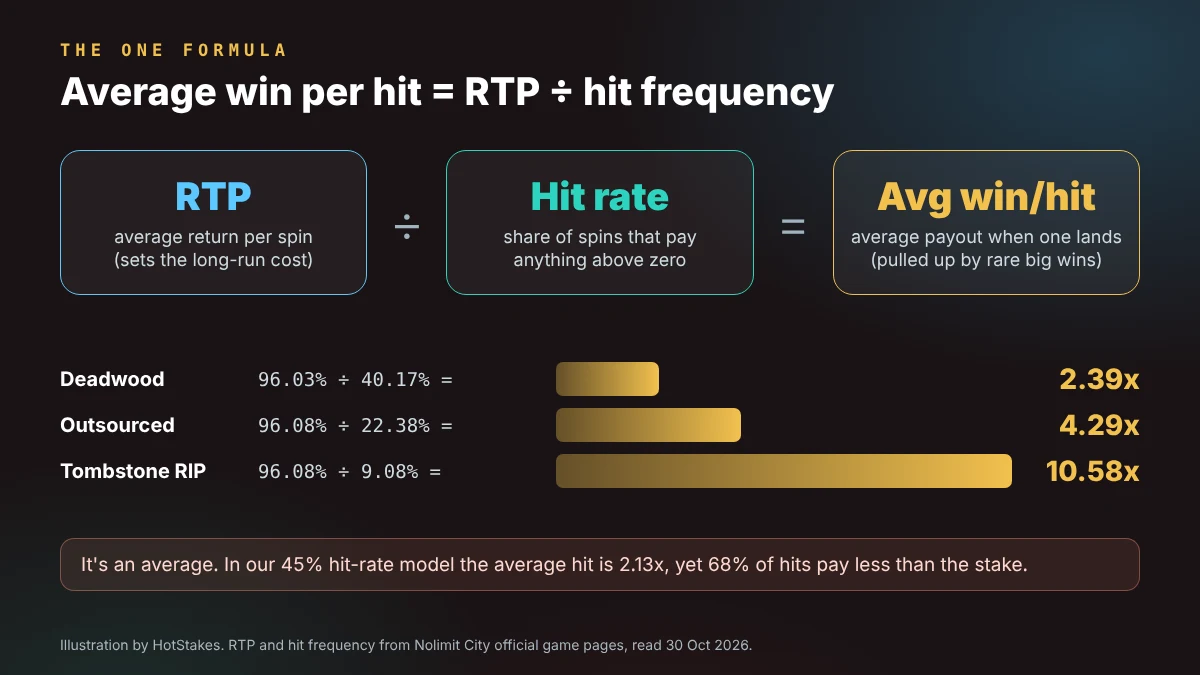
RTP is the average return per spin. Hit frequency is the share of spins that return anything. Divide one by the other and you get the average size of a payout when one lands:
- Deadwood: 96.03% ÷ 40.17% = 2.39x your stake per hit, on average.
- Outsourced: 96.08% ÷ 22.38% = 4.29x.
- Tombstone RIP: 96.08% ÷ 9.08% = 10.58x.
One warning. This is an average, and slot averages are dragged up by rare huge wins. The typical hit is far smaller. In our 45% hit-rate model below, the average hit is 2.13x, yet two thirds of hits pay less than 1x.
Takeaway: same RTP plus lower hit frequency means bigger but rarer payouts. The long-run cost does not change.
Same 96% RTP, 45% vs 15% hit rate: our simulation
To see what hit frequency does to a real session, we built two invented slots in Python and played them 200,000 times each. This is an illustrative model, not a real game. Both return exactly 96%. Each session is 200 spins at RM1, so RM200 staked and an expected loss of RM8.
| Illustrative model | Game A: frequent hits | Game B: rare hits |
|---|---|---|
| RTP | 96.00% | 96.00% |
| Hit frequency | 45% (1 in 2.2) | 15% (1 in 6.7) |
| Hits per 200 spins (avg) | 90 | 30 |
| Of those, paying more than the stake | 21 | 18 |
| Hits paying less than the stake | 67.8% | 26.7% |
| Average win per hit | 2.13x | 6.40x |
| Top prize | 656x | 1,295x |
| Sessions ending ahead | 14.6% | 21.1% |
| Sessions losing RM100 or more | 27.0% | 40.1% |
| Median result | -RM75 | -RM85 |
| Average result (simulated) | -RM7.90 | -RM7.70 |
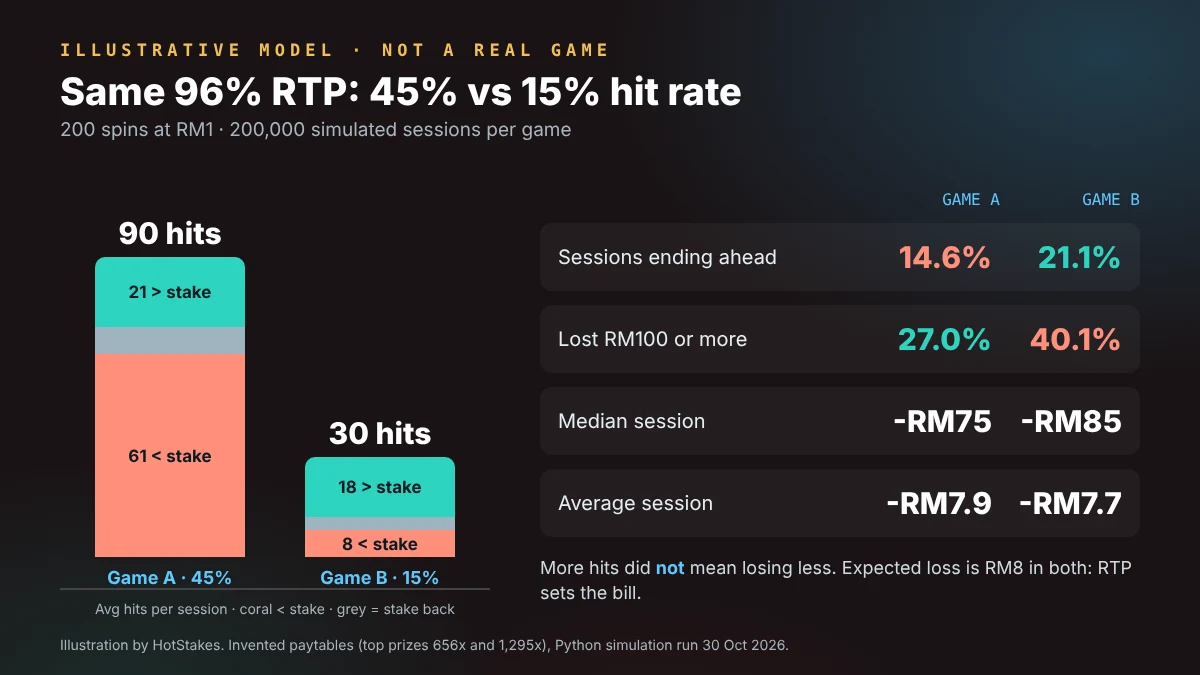
What the runs show:
- Game A felt busier, not kinder. It paid 90 times per session, but only 21 of those beat the stake. The other 69 were blanks in disguise or a straight refund.
- Game A finished ahead less often. 14.6% of sessions versus 21.1%. Most of A’s winning sessions (9.5 points of the 14.6%) came from landing its 656x top prize. Without it, only 5.1% of sessions ended up.
- Game B swung harder. 40.1% of its sessions lost half the stake or more, against 27.0% for Game A.
- The average loss was the same. About RM8 per RM200, as a 96% RTP predicts. The typical session lost far more than that, because a few big winners pull the average up.
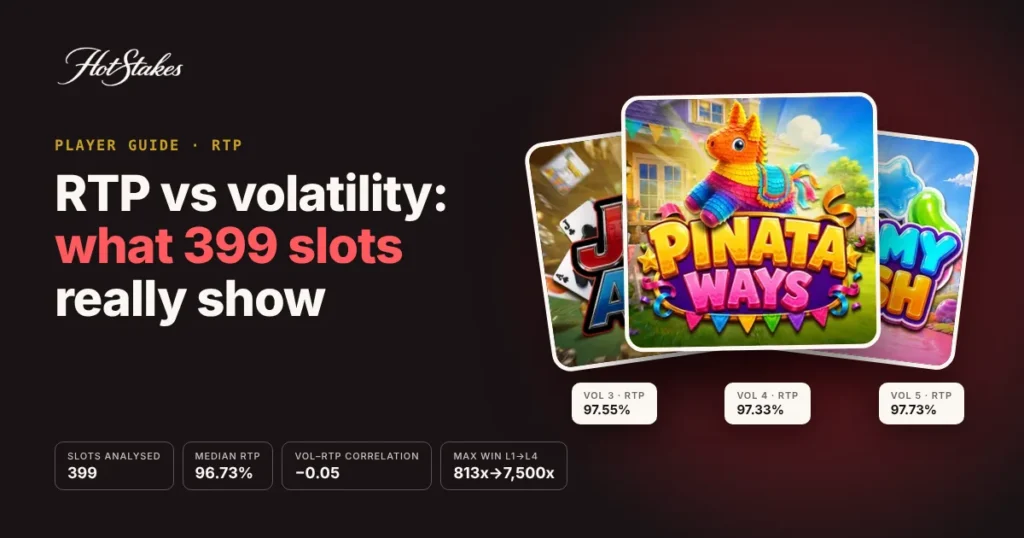
Change the paytables and these exact numbers change. The point holds: hit frequency reshapes the ride, while RTP sets the bill. Our RTP vs volatility guide goes deeper on that split, and why the house always wins shows why no setting flips the maths.
Takeaway: a high hit rate means more small payouts, not smaller losses. In our model it actually ended ahead less often.
What our 548-game data shows (and doesn’t)
Our Hotdog Gaming catalogue holds 548 games, 510 of them slots. On 30 Oct 2026 we checked every field. Each slot lists an RTP and a volatility rating from 1 to 5; 487 list a numeric max win. None lists a hit frequency.
That gap matters. Take two slots with almost identical RTP in our data:
- Vault Blast: 97.74% RTP, volatility 1, max win 327x.
- Gummy Rush: 97.73% RTP, volatility 5, max win 5,000x.
Their long-run cost is the same. Their hit rates are likely to be very different, but we can’t tell you by how much, because the figure isn’t published in our data.
One game’s description, African Buffalo 2, promises “high hit frequency”. It is rated volatility 5, the highest level, and gives no number. A claim without a figure can’t be checked.
Takeaway: volatility and max win hint at the ride. Only a published hit frequency, ideally with RTP, tells you how often a game pays.
How to read hit frequency in 5 steps
- Find it in the game info or rules. Look for “hit frequency”, “hit rate” or “win frequency”. If it isn’t there, treat any “pays often” claim as marketing.
- Turn it into blank spins. 25% means about 75 of every 100 spins pay nothing.
- Remember hits include sub-stake payouts. The share of spins that actually grow your balance is lower than the headline rate.
- Divide RTP by hit frequency. That’s the average payout per hit. Bigger numbers mean rarer, lumpier payouts.
- Judge cost by RTP alone. Plug your stake and spins into our RTP calculator to see the expected loss before you play.
Takeaway: use hit frequency to set expectations about dry spells, never to pick a “cheaper” game.
FAQ
What does hit frequency mean on a slot?
It is the share of spins that return any payout, averaged over the long run. A 25% hit frequency means roughly 1 spin in 4 pays something; the rest pay nothing.
Is a higher hit frequency better?
Not for your balance. RTP sets the long-run cost. In our illustrative model, a 45% hit-rate game with 96% RTP finished 200-spin sessions ahead less often (14.6%) than a 15% hit-rate game with the same RTP (21.1%).
Does a hit mean I won money?
No. A hit is any payout above zero, including ones smaller than your bet. Researchers call these losses disguised as wins; in our 45% hit-rate model, 68% of hits paid less than the stake.
How often do slots pay out?
It varies by game. The 12 Nolimit City games we checked publish hit frequencies from 9.08% (about 1 in 11 spins) to 40.17% (about 1 in 2.5), all at roughly 96% RTP.
How do I work out the average win per hit?
Divide RTP by hit frequency. A 96% RTP game with a 24% hit frequency averages 4x the stake per hit, though most individual hits are smaller than that.
HotStakes is an independent directory. Some links on this site are affiliate links; we may earn a commission at no cost to you, and it never changes our rankings. Gambling involves risk — only play with money you can afford to lose, and if it stops being fun, seek help. This article is general information, not legal advice. Browse vetted operators by currency. Read our full disclaimer.
 Next story →WhatsApp Hijack Scam: The Script and the Call That Stops It
Start the discussion