

Low Volatility Slots: Does Your Money Really Last Longer?
We simulated 1M sessions: low volatility slots last about 3x longer on RM100, but cost the same RM21 an hour. Plus data from 513 slots.
In this article
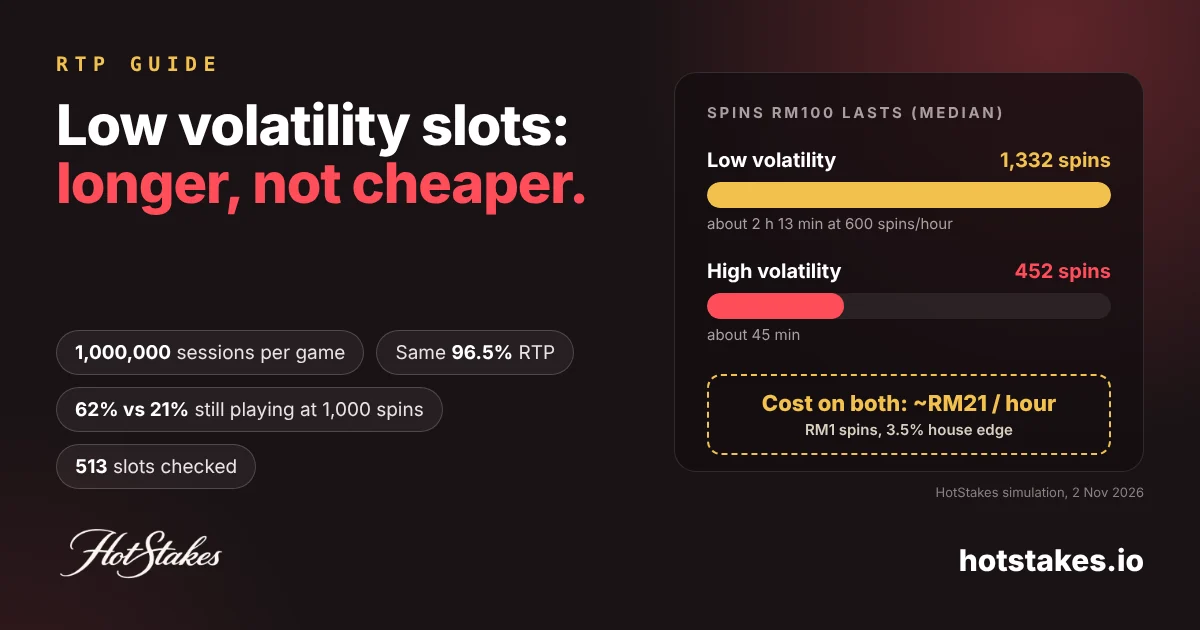
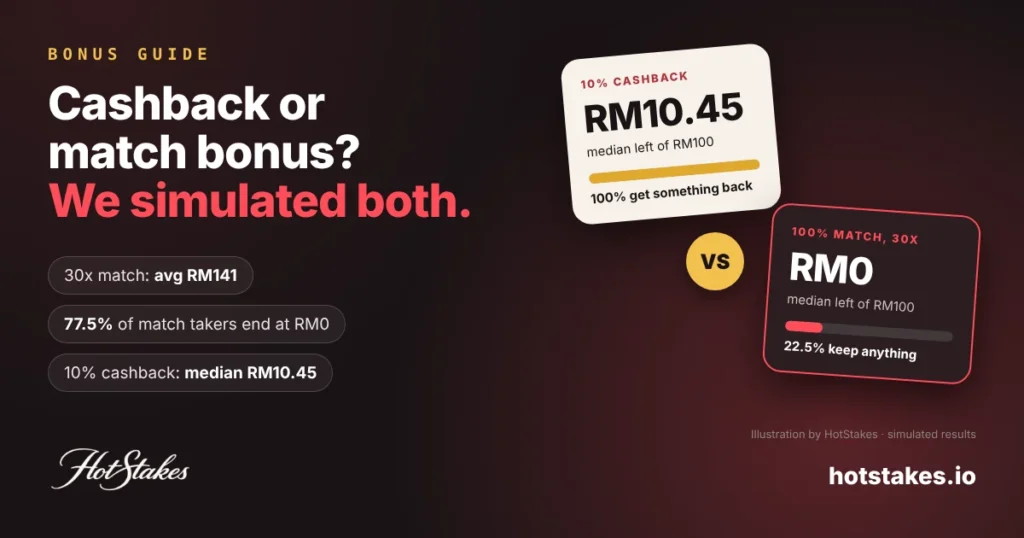
Yes, low volatility slots usually make your money last longer. In our simulation of 1,000,000 sessions per game, a typical RM100 bankroll lasted 1,332 spins on a low volatility slot and 452 spins on a high volatility one with the same 96.5% RTP. But low volatility doesn’t make slots cheaper: both games cost about RM21 an hour at RM1 a spin, so playing longer just means you bet more in total.
Our RTP vs volatility pillar guide explains what the two terms mean and shows that RTP barely changes with volatility. This piece answers the next question: what does low volatility actually do to your time and your money? We ran our own simulation and checked our 513-slot Hotdog Gaming file on 2 Nov 2026.
How long does RM100 last on low vs high volatility slots?
We built two made-up slots. Both return exactly 96.5% of every ringgit staked. The only difference is how bumpy the ride is.
- Low volatility game: standard deviation of 3.2 per RM1 spin, top prize 500x, something comes back on 45.6% of spins.
- High volatility game: standard deviation of 15.1 per RM1 spin, top prize 5,000x, something comes back on 30.7% of spins.
Each simulated player starts with RM100, bets RM1 a spin, and stops when broke or after 1,000 spins. Here’s what 1,000,000 players per game experienced.
| RM100 bankroll, RM1 spins | Low volatility | High volatility |
|---|---|---|
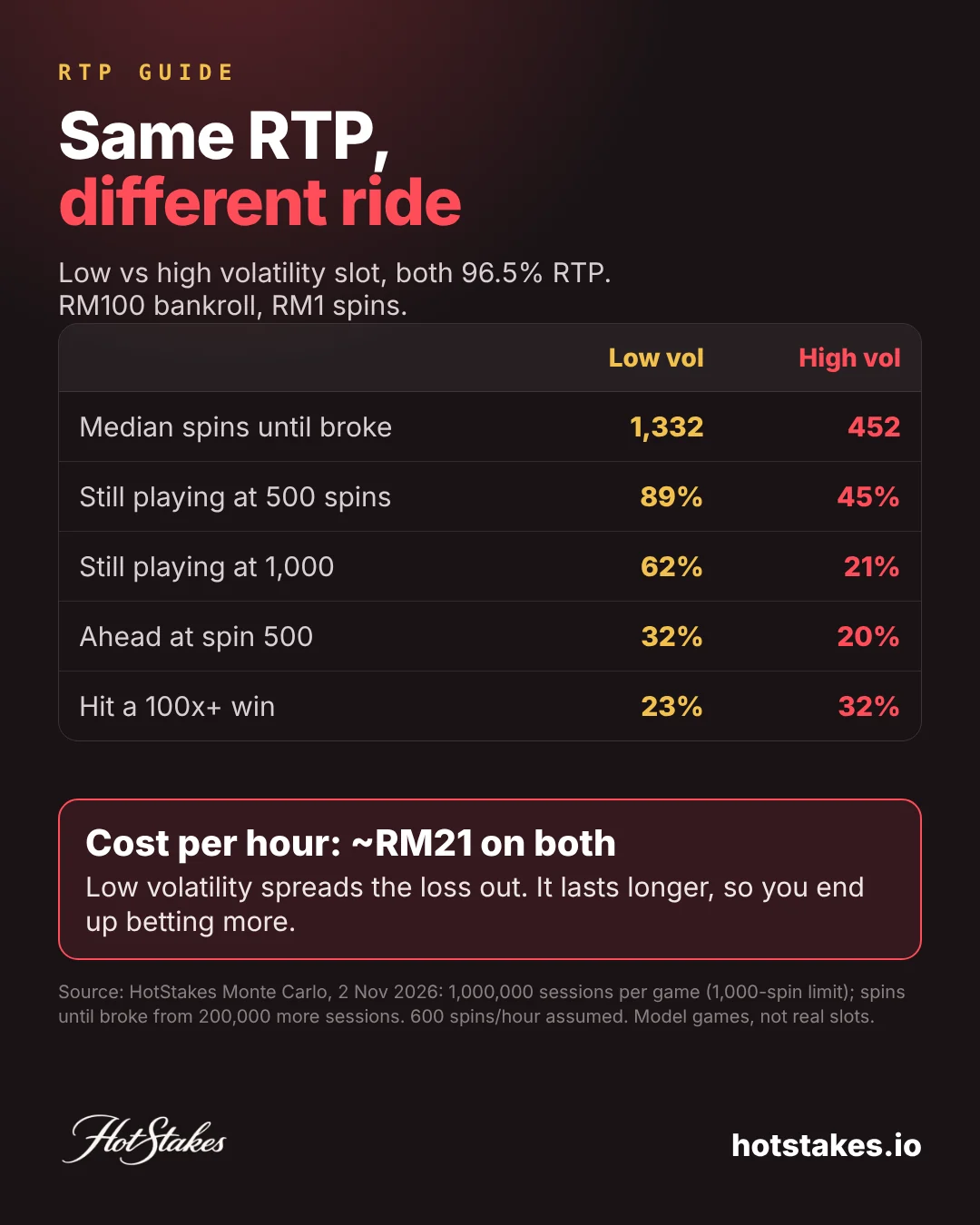
| Still playing after 200 spins | 99.98% | 94.2% |
| Still playing after 500 spins | 89.3% | 44.9% |
| Still playing after 1,000 spins | 61.7% | 21.2% |
| Ahead (above RM100) at spin 500 | 32.4% | 20.3% |
| Hit at least one 100x+ win in the session | 22.6% | 31.7% |
| Median balance at the end | RM43.50 | RM0.50 |
| Median spins until broke (no 1,000-spin limit) | 1,332 (about 2 h 13 min) | 452 (about 45 min) |
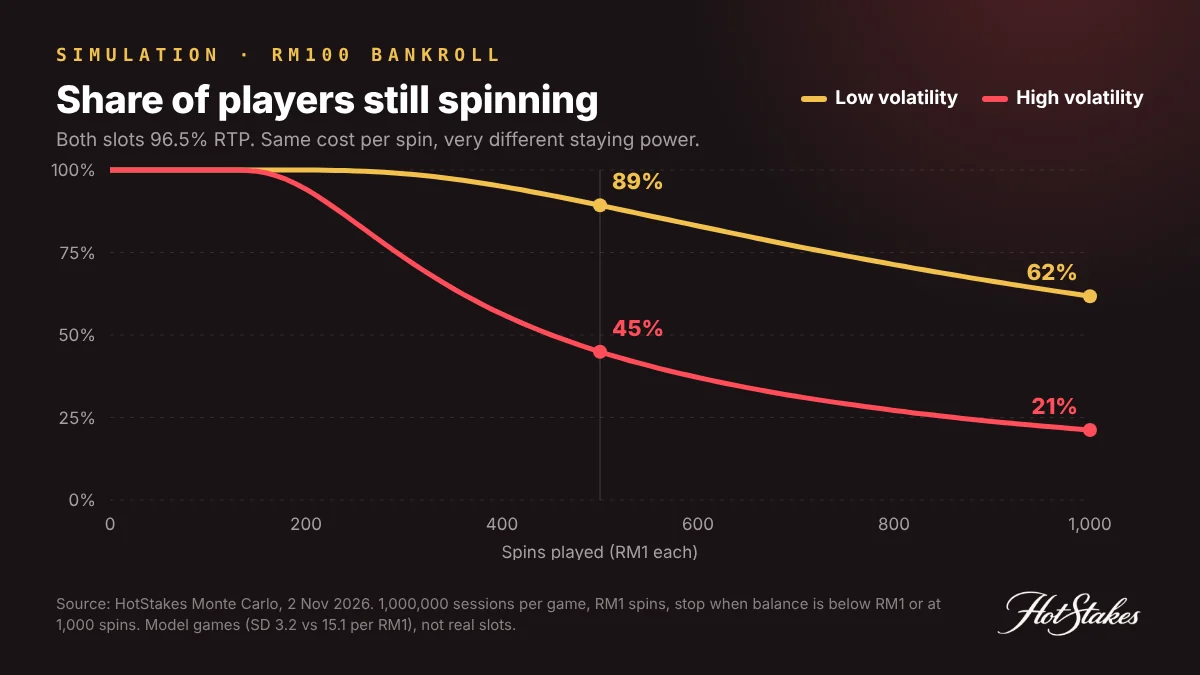
So the popular advice holds up. The typical low volatility player plays roughly three times as long before the RM100 is gone. More players are also ahead at the halfway mark.
The trade-off is the big hit. The high volatility player was more likely to land a 100x+ win (31.7% vs 22.6%), and only that game can pay 5,000x at all.
Takeaway: Low volatility buys you time and a smoother balance, not better odds. Most high volatility sessions with RM100 at RM1 a spin are over in well under an hour.
The catch: low volatility isn’t cheaper
This is the part most “low vs high volatility slots” guides skip. The house edge is charged on every spin, whatever the volatility.
At 96.5% RTP the edge is 3.5%. That’s 3.5 sen lost on average per RM1 spin, on both games. Our simulated players lost 3.51 sen (low) and 3.46 sen (high) per ringgit bet, which matches the maths.
Now add time. We assume 600 spins an hour (one spin every 6 seconds, including pauses). For comparison, the UK Gambling Commission’s technical standards set a minimum of 2.5 seconds per slot game cycle and ban turbo spin for UK-licensed games, so 1,440 spins an hour is the ceiling there.
- Cost per hour is identical: 600 spins × RM1 × 3.5% = about RM21 an hour on either game.
- Longer sessions mean more total betting: in our 1,000-spin sessions, the average low volatility player bet RM862 and lost RM30.28. The average high volatility player bet RM549 and lost RM19.00, because so many went broke early.
- If you play until broke, the total is the same: both games eventually take all RM100. On average that takes about 2,850 spins (RM100 ÷ 3.5%), or roughly 4 hours 45 minutes at our pace. Our sim gave 2,850 spins (low) and 2,933 (high, after adjusting for the 0.97% of players still going at the 50,000-spin cap).
Why is the high volatility average as long as the low one when its median is three times shorter? A small group hits a big win and then plays for hours. Most players bust fast, and a few play much longer.
Research backs the idea that variance shapes session length. A 2026 study by Lucas and Singh in UNLV’s Gaming Research & Review Journal found that how a pay table’s variance is allocated significantly affected spins per losing player, even with identical house edge and total variance. The authors note operators value “time on device”. Real-world behaviour is messier, though. In data from 4,281 regular UK online slot players, Percy and colleagues (2021) found that playing lower-volatility games than usual was linked to lower losses and shorter sessions at a casino operator, but found no significant link at a bingo operator. People don’t play to a fixed rule like our simulated players.
Takeaway: Low volatility is a slower spend, not a smaller one. Set your budget in ringgit and in minutes, because a game that lasts longer will happily take more bets. Our guide to why the house always wins shows the same edge at work across games.
What our 513 Hotdog Gaming slots show
Our snapshot (updated 30 Oct 2026) holds 513 Hotdog Gaming slots, each rated by the provider from 1 (lowest) to 5 (highest volatility). The file has grown since the 399 slots in our pillar guide, so the figures differ slightly.
| Volatility | Slots | Median RTP | Median max win | 90th-percentile max win | Max win 1,000x or less |
|---|---|---|---|---|---|
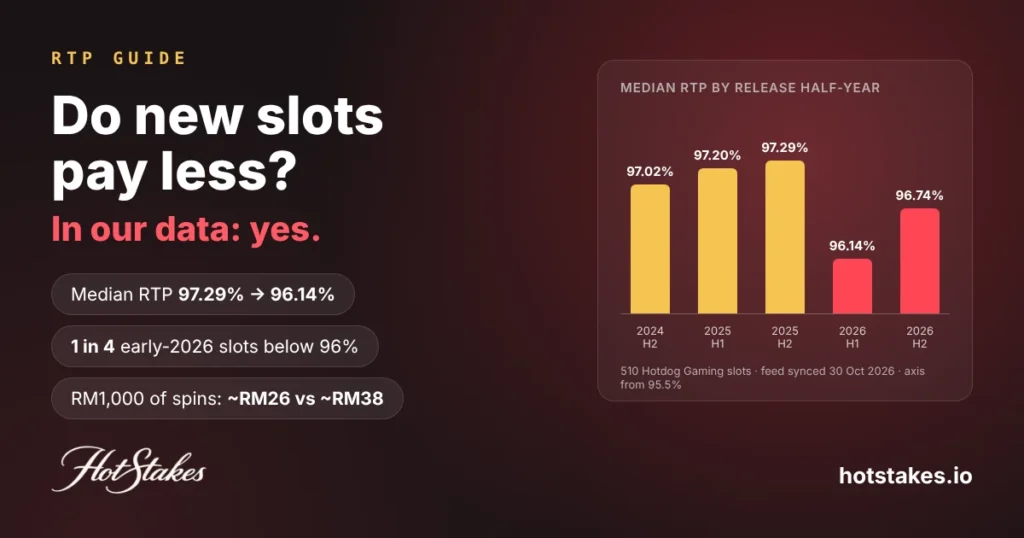
| 1 | 30 | 97.03% | 747x | 4,621x | 60% |
| 2 | 39 | 96.87% | 1,500x | 6,160x | 44% |
| 3 | 256 | 96.75% | 3,500x | 10,000x | 13% |
| 4 | 136 | 96.73% | 5,000x | 15,000x | 5% |
| 5 | 52 | 96.35% | 6,077x | 20,378x | 6% |
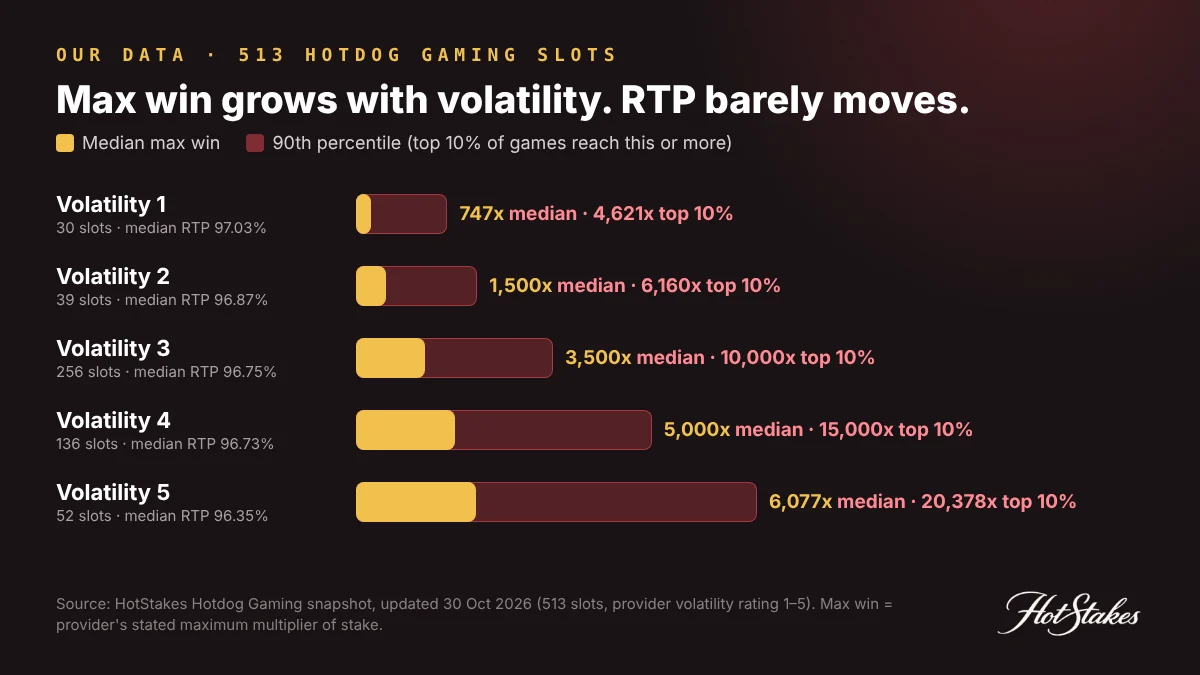
Three things stand out:
- Low volatility is rare. Only 69 of 513 slots (13%) are rated 1 or 2. Half the catalogue sits at level 3.
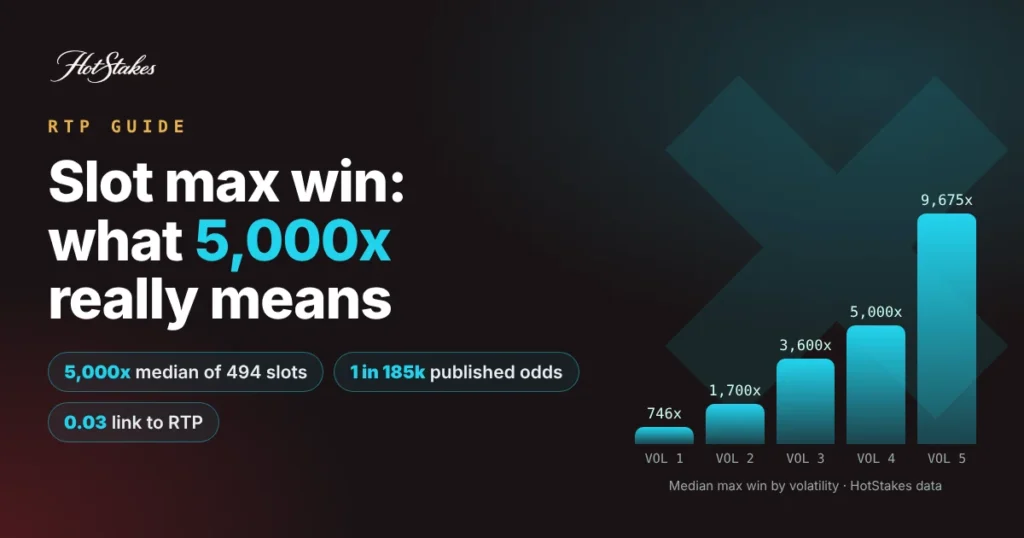
- Max win climbs with volatility. The median top prize goes from 747x at level 1 to 6,077x at level 5.
- RTP doesn’t fall with low volatility here. Level 1 has the highest median RTP (97.03%) in this snapshot, but the gap is small and RTP varies a lot within each level.
Some real low volatility slots with the highest RTPs in our file:
- Vault Blast: volatility 1, RTP 97.74%, max win 327x
- Civilization of Bull Bull – x88: volatility 1, RTP 97.56%, max win 1,188x
- Fortune Lions: volatility 1, RTP 97.53%, max win 1,510x
- Giant Fruits: volatility 1, RTP 97.53%, max win 1,500x
- Sushi Saga: volatility 1, RTP 97.51%, max win 5,000x
- Book of Antique: volatility 2, RTP 97.49%, max win 1,801x
Even at 97.7% RTP, the edge is still 2.3 sen per RM1 spin, or about RM14 an hour at 600 spins. You can browse the rest in our slot directory.
Takeaway: If you want long, steady sessions, look for level 1-2 games with a high RTP. Just remember the whole group is a small corner of the catalogue.
How to find a slot’s volatility
Not every game shows a volatility rating, and providers use different scales. Use these clues, roughly in order of reliability.
- Provider rating. Check the info or help screen and the provider’s game sheet. A 1-5 scale or “low/medium/high” label is the clearest signal. Our slot pages show Hotdog Gaming’s rating.
- Game rules and pay table. Licensed games must show how winners are decided, RTP or odds, and the prizes. The UK Gambling Commission’s RTS 3 standard requires this information before you bet. If a site hides it, that’s a red flag.
- Max win as a clue. In our data, 60% of level 1 slots cap at 1,000x or less, against 5% of level 4 games. A top prize of 5,000x or more points to higher volatility, but not always: Sushi Saga is rated 1 with a 5,000x cap. More in our slot max win guide.
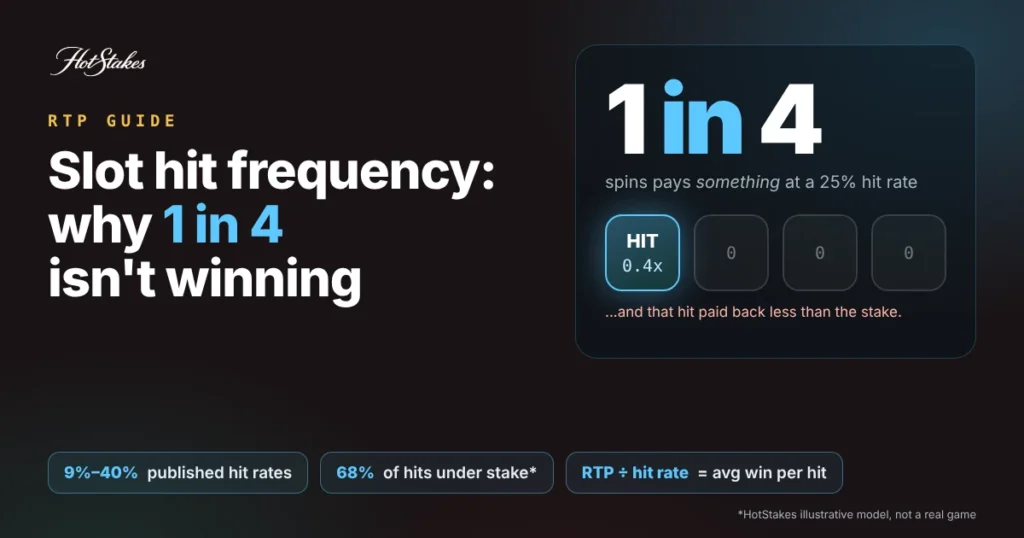
- Hit frequency. Lots of small returns suggest low volatility. Many of those “wins” pay back less than your stake, though: in our low volatility model, 45.6% of spins returned something but only 19.6% paid more than the bet. See slot hit frequency explained.
- Demo play. A few hundred free spins give you a feel for the rhythm, but they are far too few to measure volatility or RTP.
Don’t read anything into a cold or hot streak. The UK Gambling Commission’s player guide says that on random games the odds “remain constant and are not affected by wins or losses in previous games”, and that RTP is an average over a large number of plays, not each session. Our article on whether a slot is “due” to hit goes deeper.
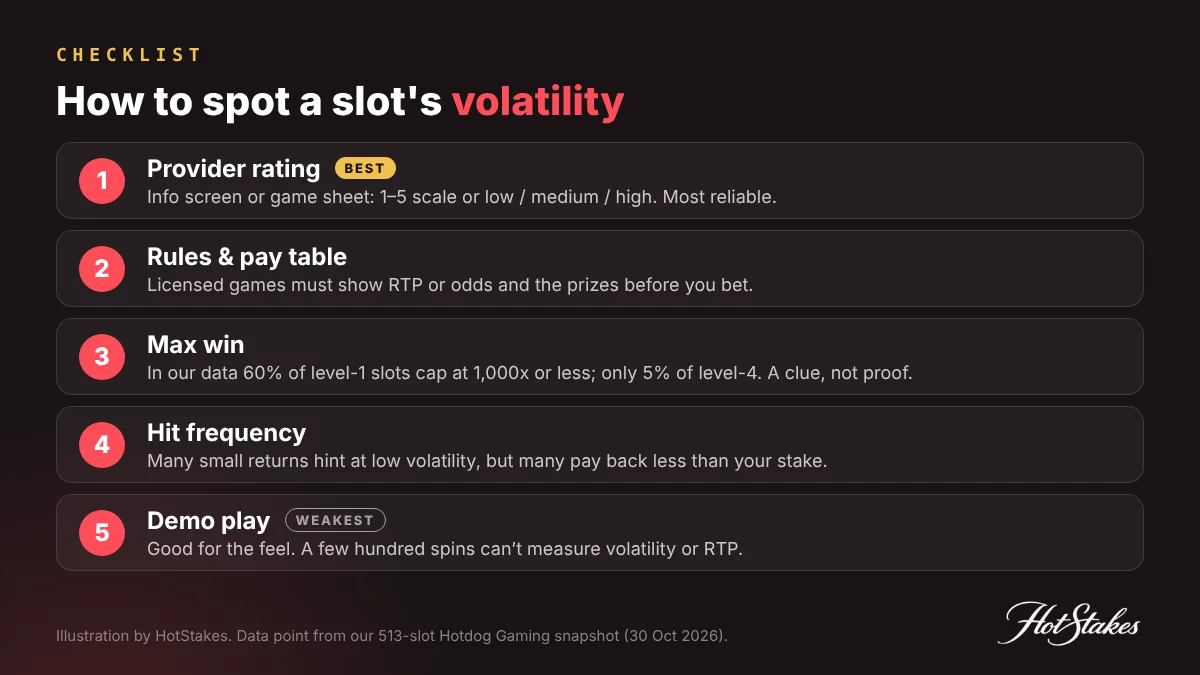
Takeaway: Trust the provider rating first, use max win and pay table as backup clues, and never judge volatility from a short streak.
How to use this before you spin
- Set a time budget as well as a money budget. At RM1 spins and 96.5% RTP, plan on losing about RM21 for each hour, whatever the volatility.
- Pick volatility for the experience you want. Low for long, calm sessions; high only if you accept that most sessions end early.
- Check the exact RTP. Our RTP calculator turns any RTP, stake and spin count into an expected cost.
- Stop when the timer or budget says so, even if you’re ahead.
If a session stops being fun, or you keep playing longer than planned, take our 2-minute gambling self-check.
FAQ
Do low volatility slots make your money last longer?
Usually, yes. In our simulation, the median RM100 bankroll at RM1 spins lasted 1,332 spins on a low volatility slot and 452 on a high volatility slot with the same 96.5% RTP. Individual sessions vary a lot.
Do you lose less on low volatility slots?
Not per spin or per hour. The house edge is the same, so the average loss is about 3.5 sen per RM1 at 96.5% RTP either way. Because you play longer, you may actually bet and lose more in one sitting.
How long will my money last on slots?
Divide your bankroll by the house edge to get the average total you’ll bet before it’s gone: RM100 ÷ 3.5% ≈ RM2,850 of bets. At RM1 spins and 600 spins an hour, that’s under 5 hours on average, but the typical session is far shorter, especially on high volatility games.
Are low volatility slots better for beginners?
They’re gentler, not better value. The balance moves more slowly, which makes a budget easier to stick to. The cost per hour doesn’t change.
Is a low volatility slot easier to win on?
You’re more likely to be slightly ahead after a few hundred spins (32% vs 20% at spin 500 in our sim), but less likely to land a big win. Over the long run both games return the same RTP.
Where can I see a slot’s volatility?
In the game’s info screen or the provider’s game sheet. Our individual slot pages list RTP, volatility and max win for each Hotdog Gaming title.
HotStakes is an independent directory. Some links on this site are affiliate links; we may earn a commission at no cost to you, and it never changes our rankings. Gambling involves risk — only play with money you can afford to lose, and if it stops being fun, seek help. This article is general information, not legal advice. Read our full disclaimer.
 Next story →Malaysia Airlines Data Breach: 5 Scam Scripts to Expect
Start the discussion